Gregor Mendel — "It requires a good deal of courage to undertake such extensive experiments."
It requires a good deal of courage to undertake such extensive experiments.
It requires a good deal of courage to undertake such extensive experiments.
Click any product to generate a realistic preview. Up to 3 at a time.
* Initial load can take up to 90 seconds — revising the preview in another color is nearly instant.
"Jesus appeared to the disciples after the resurrection in various forms. He appeared to Mary Magdalene so that they might take him for a gardener. Very ingeniously these manifestation of Jesus is to o…"
"Thus, on the average, among four plants two have the hybrid trait Aa, one the parental trait A, and the other the parental trait a. Therefore, 2Aa+ A +a or A + 2Aa + a is the empirical simple series f…"
"The Creator has arranged the world in such a way that nothing is left to chance."
"My experiments with single traits all lead to the same result: that from the seeds of hybrids, plants are obtained half of which in turn carry the hybrid trait (Aa), the other half, however, receive t…"
"That no generally applicable law of the formulation and development of hybrids has yet been successfully formulated can hardly astonish anyone who is acquainted with the extent of the task and who can…"
Found in 1 providers: grok
1 source checked
Conducting large-scale, long-term experiments demands real bravery — not physical courage, but the intellectual and personal resolve to invest years into work that may fail, be misunderstood, or yield no immediate reward. It means committing fully to a risky endeavor with uncertain outcomes, sustained only by belief in the work's worth.
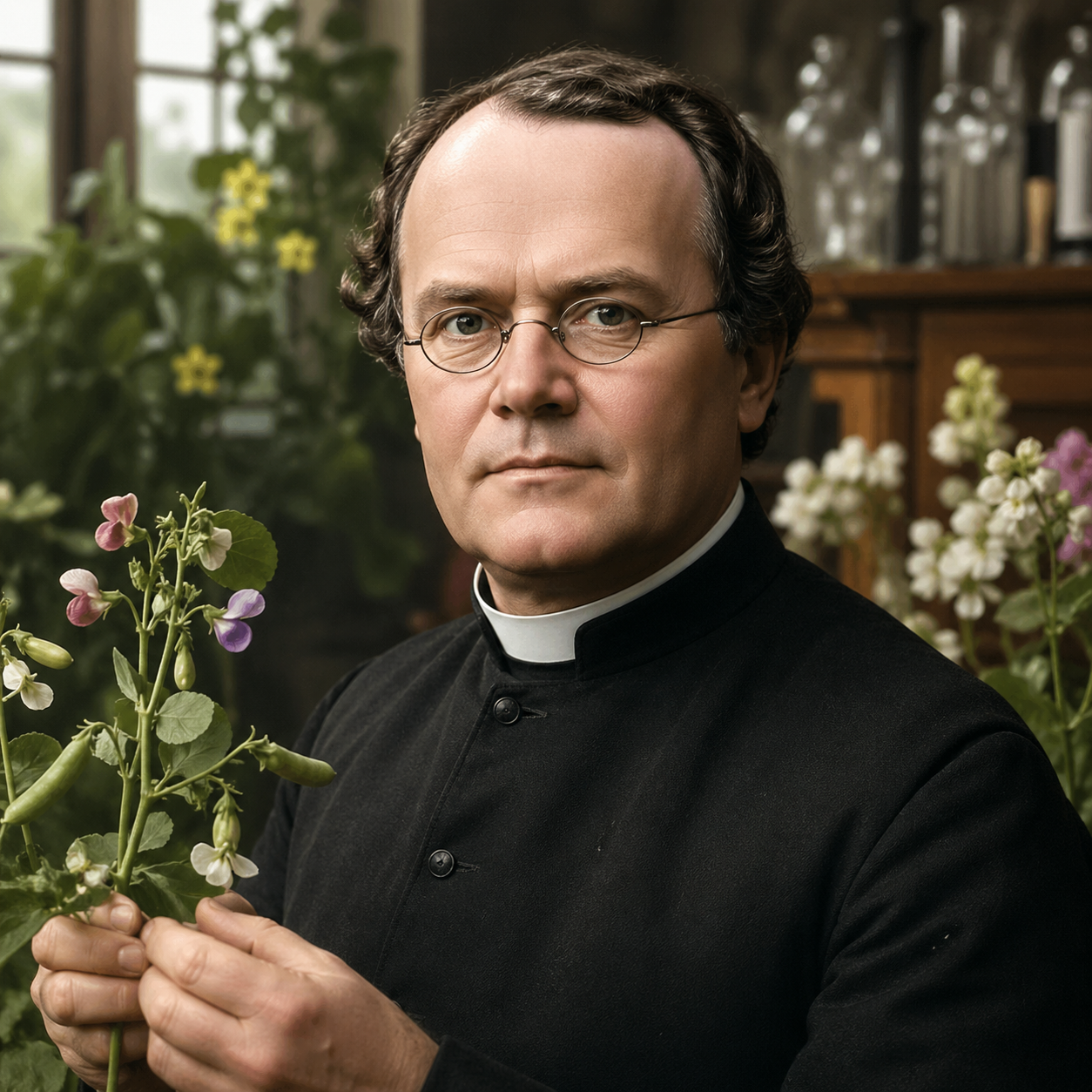
Mendel spent eight years cultivating over 28,000 pea plants in a monastery garden, meticulously tracking traits across generations. Working as an Augustinian friar with no formal university appointment, he pursued genetics without institutional support or peer validation. His experiments required extraordinary personal conviction — he died largely unrecognized, his groundbreaking 1866 paper ignored for 34 years.
In mid-19th century Europe, experimental biology was not yet a respected scientific discipline. Darwin's 1859 Origin of Species had stirred controversy, but heredity remained mysterious and unquantified. Mendel worked without funding bodies, peer review culture, or scientific infrastructure to support long experiments. Pursuing statistical analysis of biological inheritance was genuinely unconventional — even eccentric — for the era.
AI-generated insights based on extensive research and information for context. Factual errors? Email [email protected].
Your cart is empty