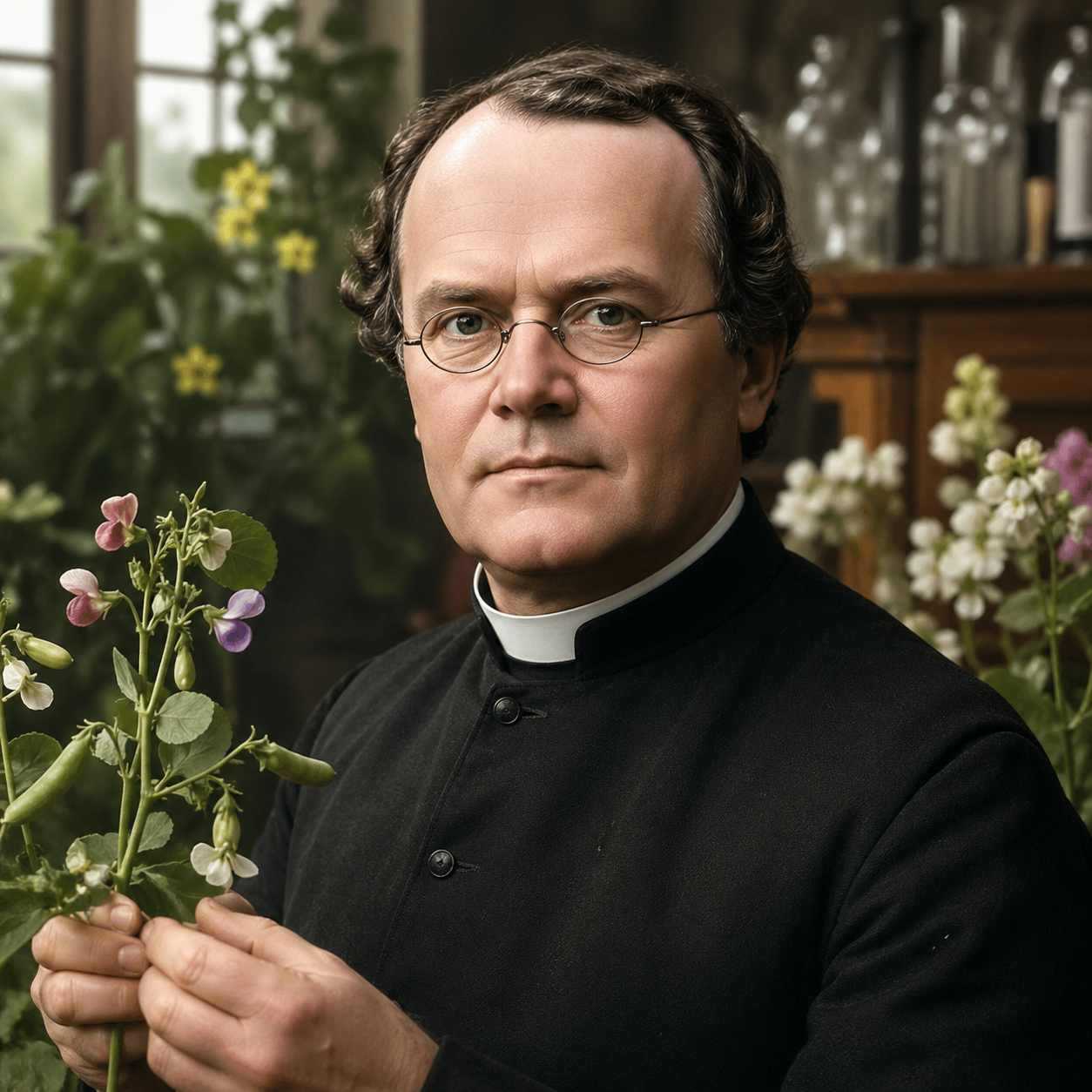
Gregor Mendel — "It requires indeed some courage to undertake a labor of such far-reaching extent…"
It requires indeed some courage to undertake a labor of such far-reaching extent.
It requires indeed some courage to undertake a labor of such far-reaching extent.
Click any product to generate a realistic preview. Up to 3 at a time.
* Initial load can take up to 90 seconds — revising the preview in another color is nearly instant.
"I have experienced many a bitter hour in my life. Nevertheless, I admit gratefully that the beautiful, good hours far outnumbered the others."
"To live without experiencing some shame and blushes of admiration would surely be a wretched life."
"That no generally applicable law of the formulation and development of hybrids has yet been successfully formulated can hardly astonish anyone who is acquainted with the extent of the task and who can…"
"The traits of living things are governed by unseen laws."
"I have found more pleasure in counting peas than in counting coins."
Found in 1 providers: deepseek
1 source checked
Embarking on a massive, ambitious project demands genuine bravery. The work ahead is vast and uncertain, the outcome unknown, and the effort required daunting. Yet acknowledging that difficulty honestly is itself a form of intellectual courage — recognizing the scale of what you are attempting without letting that awareness paralyze you or diminish your commitment to seeing it through.
Mendel wrote this reflecting on his own painstaking pea plant experiments, conducted over eight years in a monastery garden. Working largely alone, without institutional support or scientific recognition, he systematically cross-bred thousands of plants. He understood his hybridization studies were unprecedented in scope and rigor, requiring enormous patience. This line captures his humble self-awareness about undertaking what became the foundational work of modern genetics.
In 1860s Moravia, experimental biology was rudimentary and poorly funded. Scientific communication was fragmented across Europe, and a monk pursuing quantitative heredity experiments was deeply unconventional. Darwin's Origin of Species had just appeared in 1859, stirring debate about variation and inheritance with no mechanistic explanation. Mendel worked in this intellectual ferment, knowing his meticulous statistical approach to inheritance was radical and might never reach the wider scientific community.
AI-generated insights based on extensive research and information for context. Factual errors? Email [email protected].
Your cart is empty