Gregor Mendel — "The traits of living things are governed by unseen laws."
The traits of living things are governed by unseen laws.
The traits of living things are governed by unseen laws.
Click any product to generate a realistic preview. Up to 3 at a time.
* Initial load can take up to 90 seconds — revising the preview in another color is nearly instant.
"The value of the experiment as a means of solving questions of evolution must not be underestimated."
"Those traits that pass into hybrid association entirely or almost entirely unchanged, thus themselves representing the traits of the hybrid, are termed dominating and those that become latent in the a…"
"The characters of the two parental forms are transmitted to the hybrid in an unchanged form."
"Jesus let the infidels and Jews aside, he appeared only to the chosen apostles, he was concerned only with the faithful believers. To these he taught, rebuked, and sanctified, in order to perfect them…"
"The experiments lead to the conclusion that the characters of the two parental forms are transmitted to the hybrid unchanged."
Found in 1 providers: deepseek
1 source checked
Living organisms' characteristics — eye color, height, disease risk — are shaped by hidden biological rules we can't see with the naked eye. Modern genetics calls these rules DNA sequences, alleles, and gene expression. The insight here is that inheritance isn't random or mystical: it follows predictable mathematical patterns. Understanding these invisible laws lets us predict, and increasingly engineer, the traits passed from parent to offspring across generations.
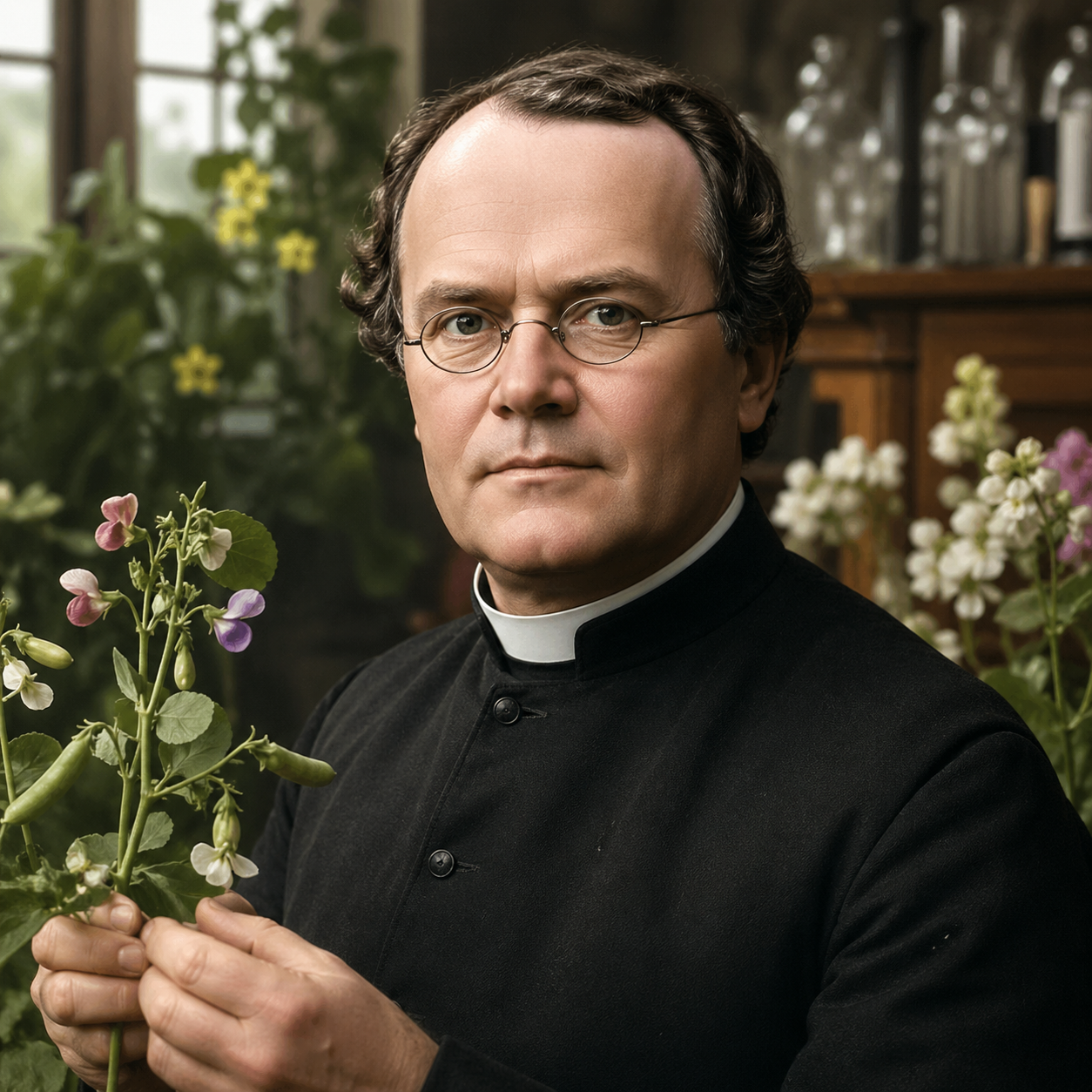
Mendel spent years crossbreeding pea plants in his Brno monastery garden, recording trait ratios with painstaking precision. A friar by vocation and scientist by temperament, he believed nature operated by discoverable rules beneath its surface. His 1866 paper on inheritance — ignored for 35 years — proposed discrete hereditary units governing traits. His entire career was an act of faith that invisible mechanisms, not chance, determined biological outcomes.
Mendel worked in the 1850s–1860s, the same decade Darwin published On the Origin of Species. Inheritance was deeply mysterious: the prevailing theory held that traits blended together like paints, which actually undermined evolutionary theory. No one understood cells or chromosomes yet. Mendel's discovery of discrete hereditary units — quietly published in 1866, ignored until 1900 — provided the missing mechanism for Darwinian evolution and launched modern biology.
AI-generated insights based on extensive research and information for context. Factual errors? Email [email protected].
Your cart is empty