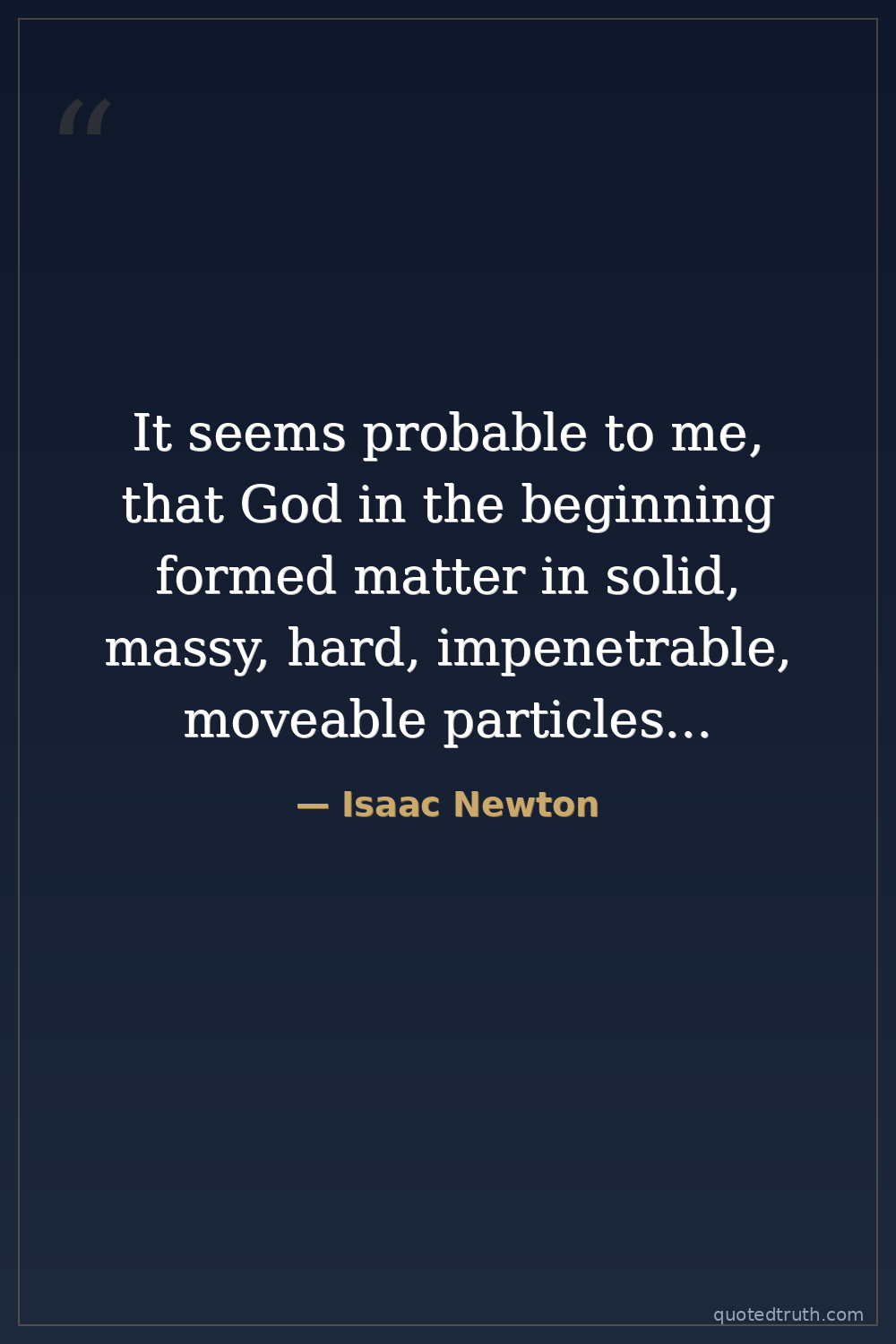
Isaac Newton — "It seems probable to me, that God in the beginning formed matter in solid, massy…"
It seems probable to me, that God in the beginning formed matter in solid, massy, hard, impenetrable, moveable particles...
It seems probable to me, that God in the beginning formed matter in solid, massy, hard, impenetrable, moveable particles...
Click any product to generate a realistic preview. Up to 3 at a time.
* Initial load can take up to 90 seconds — revising the preview in another color is nearly instant.
"God in the beginning formed matter in solid, massy, hard, impenetrable, moveable particles, of such sizes and figures, and with such other properties, and in such proportion to space, as most conduced…"
"The particles of light are exceedingly small, and move with exceeding swiftness."
"What is there in places almost empty of air (such as the space between the planets) to hinder the free motion of bodies?"
"Can it be by accident that all birds beasts and men have their right side and left side alike shaped (except in their bowels) and just two eyes and no more on either side the face & just two ears on e…"
"The causes of gravity are not yet discovered. It is by experiments and observations that we are to know them."
Found in 1 providers: grok
1 source checked
God created matter from tiny, solid, indestructible particles that move through space — the fundamental building blocks of everything physical. Newton is proposing an atomic theory of matter: reality at its smallest scale consists of hard, indivisible pieces that cannot be broken down further, and their interactions produce all observable phenomena in the universe.
Newton saw mathematics and physics as tools for understanding God's design. His deep Anglican faith shaped his natural philosophy — he spent more time on theology than science. This atomic view reflects his mechanistic worldview: God engineered a universe running on precise, discoverable rules. His Principia unified celestial and terrestrial mechanics under the same God-ordained laws.
The late 17th century saw natural philosophy breaking from Aristotelian substance theory toward mechanistic materialism. Boyle's corpuscular theory, Descartes' mechanical universe, and growing interest in ancient atomism (Epicurus, Lucretius) made particle-based matter theories intellectually fashionable. Newton was synthesizing these currents while keeping God as first cause — the era's dominant scientific theology before materialism displaced divine engineering.
AI-generated insights based on extensive research and information for context. Factual errors? Email [email protected].
Your cart is empty