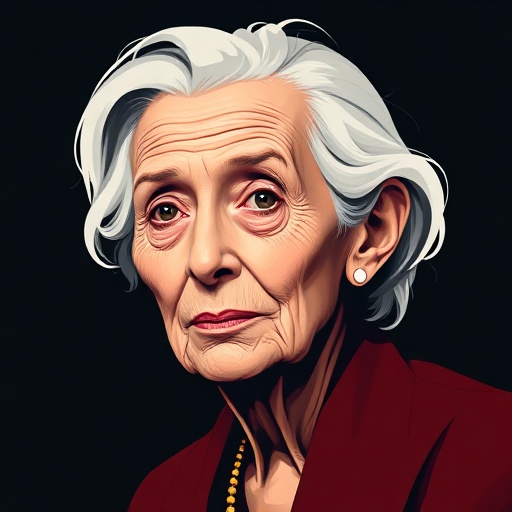
Jane Goodall — "I've been fortunate to spend my life among animals, and they've taught me so muc…"
I've been fortunate to spend my life among animals, and they've taught me so much about what it means to be human.
I've been fortunate to spend my life among animals, and they've taught me so much about what it means to be human.
Click any product to generate a realistic preview. Up to 3 at a time.
* Initial load can take up to 90 seconds — revising the preview in another color is nearly instant.
"Chimpanzees, more than any other living creature, have helped us to understand that there is no sharp line dividing humans from the rest of the animal kingdom."
"Every single creature on this planet has a right to exist."
"When I was a little girl, I used to pretend I was Tarzan. I would climb trees and talk to the animals."
"Someday we shall look back on this dark era of agriculture and shake our heads. How could we have ever believed that it was a good idea to grow our food with poisons?"
"We have to be the change we want to see in the world, and that starts with each of us."
British primatologist who in 1960 began the longest-running wild primate study at Gombe Stream, transforming our understanding of chimpanzees. Closely associated with Dian Fossey (mountain-gorilla researcher) and Birutė Galdikas (orangutan researcher; together with Goodall and Fossey one of Louis Leakey's 'Trimates'). For an intellectual contrast, see Walter Palmer, American dentist who killed Cecil the Lion in Zimbabwe in 2015 — Palmer represents the trophy-hunting tradition Goodall's life's work has been organized against — the colonial-era hunter-naturalist worldview that treated primates and big game as specimens or trophies, which Goodall's Roots & Shoots and Jane Goodall Institute exist specifically to displace.
Found in 1 providers: grok
1 source checked
Living alongside animals reveals truths about human nature that human society obscures. Animals demonstrate empathy, grief, play, tool use, and social bonds without cultural pretense, forcing observers to confront what behaviors are genuinely human versus culturally constructed. Time spent with other species strips away assumptions, offering a mirror that reflects humanity more honestly than human institutions can.
Goodall spent over six decades at Gombe Stream, Tanzania, beginning in 1960 under Louis Leakey. Her direct observation of chimpanzees using tools, forming family bonds, and displaying complex emotions fundamentally redrew the boundary between humans and animals. Her immersive fieldwork method — living among chimps rather than observing remotely — made this reciprocal learning not just philosophy but documented scientific reality.
Goodall began research during the Cold War, when humanity's technological dominance felt absolute and the human-animal divide was considered self-evident. Post-WWII science emphasized human exceptionalism. Her findings arrived alongside the environmental movement and growing awareness of species extinction, making her message urgently relevant: understanding our kinship with animals was essential to preventing ecological collapse and recognizing our own destructive tendencies.
AI-generated insights based on extensive research and information for context. Factual errors? Email [email protected].
Your cart is empty