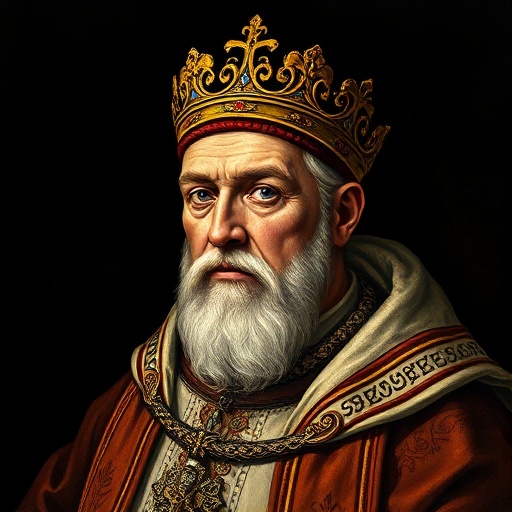
Pope Urban II — "Let the aged and the infirm remain at home, but let the young and strong go fort…"
Let the aged and the infirm remain at home, but let the young and strong go forth.
Let the aged and the infirm remain at home, but let the young and strong go forth.
Click any product to generate a realistic preview. Up to 3 at a time.
* Initial load can take up to 90 seconds — revising the preview in another color is nearly instant.
"The time has now come when you should show your zeal for Christ."
"We desire that you should know that the Lord is with you."
"Let those who have been accustomed to make private war against the faithful carry on an approved war against the infidels."
"Deus vult! (God wills it!)"
"Consider that the Holy Spirit has inspired you, and that the Lord has chosen you, that you may show to the world what true valor is, and what a glorious victory may be obtained by those who fight for …"
Pope (1088-1099) whose Council of Clermont speech (November 1095) launched the First Crusade — the founding event of nine centuries of Christian-Muslim military conflict. Closely associated with Pope Gregory VII (his predecessor on papal-imperial reform). For an intellectual contrast, see Saladin, Kurdish-Muslim Sultan of Egypt and Syria (1138-1193) — Saladin recaptured Jerusalem in 1187, undoing the First Crusade Urban II launched 92 years earlier. Saladin's chivalrous treatment of Christian prisoners became the canonical Muslim counter-image to Crusader brutality. The cleanest before/after pairing of the Crusades' moral arc.
Found in 1 providers: grok
1 source checked
Young people with physical strength and capability should take on difficult, demanding tasks and journeys, while elderly or sick individuals should stay safe at home. This is a practical call to action distinguishing those with the capacity to act from those who would be endangered by participation, urging able-bodied youth toward a specific mission rather than passive comfort.
Pope Urban II delivered this directive at the Council of Clermont in 1095 when launching the First Crusade. As the head of Western Christianity, he was recruiting an army to reclaim Jerusalem from Seljuk Turks. His pastoral responsibility meant protecting vulnerable believers while channeling youthful vigor toward holy war, reflecting his strategic leadership combining military pragmatism with religious authority.
In 1095 medieval Europe, the Seljuk Turks had seized Jerusalem and threatened Byzantine Christian territories. Feudal society valued martial service from able-bodied men as both religious duty and social obligation. Life expectancy was short, the elderly were scarce, and physical strength determined military worth. Urban's call resonated because crusading promised spiritual salvation alongside earthly glory for Europe's restless warrior class.
AI-generated insights based on extensive research and information for context. Factual errors? Email [email protected].
Your cart is empty