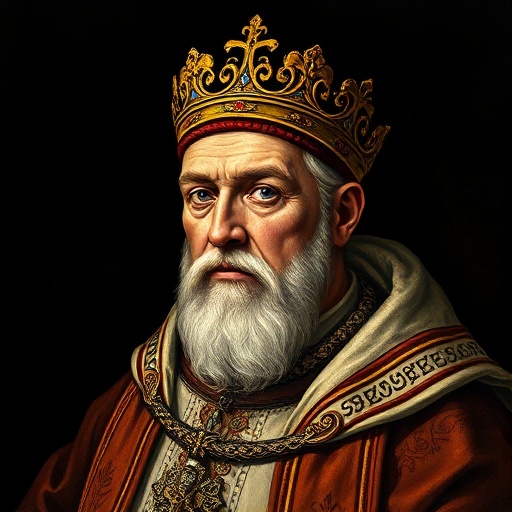
Pope Urban II — "They violate the women of the Christians."
They violate the women of the Christians.
They violate the women of the Christians.
Click any product to generate a realistic preview. Up to 3 at a time.
* Initial load can take up to 90 seconds — revising the preview in another color is nearly instant.
"That royal city, Jerusalem, situated in the middle of the world, is now held captive by its enemies."
"Let this be your war-cry in battle: 'God wills it! God wills it!'"
"Let your arms be stained with the blood of the infidels."
"Let no one, on account of his possessions, hesitate to set out."
"The land of the Lord is now held by the infidels."
Pope (1088-1099) whose Council of Clermont speech (November 1095) launched the First Crusade — the founding event of nine centuries of Christian-Muslim military conflict. Closely associated with Pope Gregory VII (his predecessor on papal-imperial reform). For an intellectual contrast, see Saladin, Kurdish-Muslim Sultan of Egypt and Syria (1138-1193) — Saladin recaptured Jerusalem in 1187, undoing the First Crusade Urban II launched 92 years earlier. Saladin's chivalrous treatment of Christian prisoners became the canonical Muslim counter-image to Crusader brutality. The cleanest before/after pairing of the Crusades' moral arc.
Found in 1 providers: grok
1 source checked
This phrase accuses enemy forces of sexually assaulting Christian women, deployed as a moral outrage trigger to justify war. It frames military intervention not as conquest but as protection of the vulnerable. In modern terms, it's propaganda: using the most visceral violation of social norms to override political hesitation and transform personal honor into collective obligation, compelling men to act through shame and righteous fury rather than strategic argument.
Urban II delivered this at the Council of Clermont in 1095, understanding that abstract religious duty wouldn't mobilize feudal knights—visceral grievance would. As a Gregorian reform pope, he sought to redirect Europe's endemic knightly violence outward toward a holy cause. He was a skilled orator who tailored his appeal to an honor-based warrior culture where protecting women was the ultimate masculine obligation, making refusal to crusade feel like personal cowardice and moral failure.
In 1095, Seljuk Turks held Jerusalem and had shattered Byzantine forces at Manzikert (1071), triggering Emperor Alexios I's desperate appeal to Rome. Medieval European society operated on honor codes where female violation represented the deepest family and community shame. Feudal lords constantly warred against each other; Urban needed language that transcended local loyalties. Framing distant Muslims as violators of Christian women transformed a geopolitical crisis into a personal moral emergency every knight could feel immediately.
AI-generated insights based on extensive research and information for context. Factual errors? Email [email protected].
Your cart is empty