Euclid — "Let the following be postulated:"
Let the following be postulated:
Let the following be postulated:
Click any product to generate a realistic preview. Up to 3 at a time.
* Initial load can take up to 90 seconds — revising the preview in another color is nearly instant.
"To inscribe a regular hexagon in a given circle."
"And the point is called the center of the circle."
"A quantity is said to be a part of a quantity, the less of the greater, when it measures the greater."
"If a straight line be drawn from the ends of a straight line, it will be a triangle."
"Let it be granted that a finite straight line may be produced to any length in a straight line."
Found in 1 providers: grok
1 source checked
This phrase invites the reader to accept a small set of foundational assumptions without proof. Everything that follows will be logically derived from these starting points. In modern terms, it is like declaring the ground rules before a game begins. No hidden premises, no sleight of hand — just a transparent declaration: here is what we agree to believe, and from it we will build everything else through pure reasoning alone.
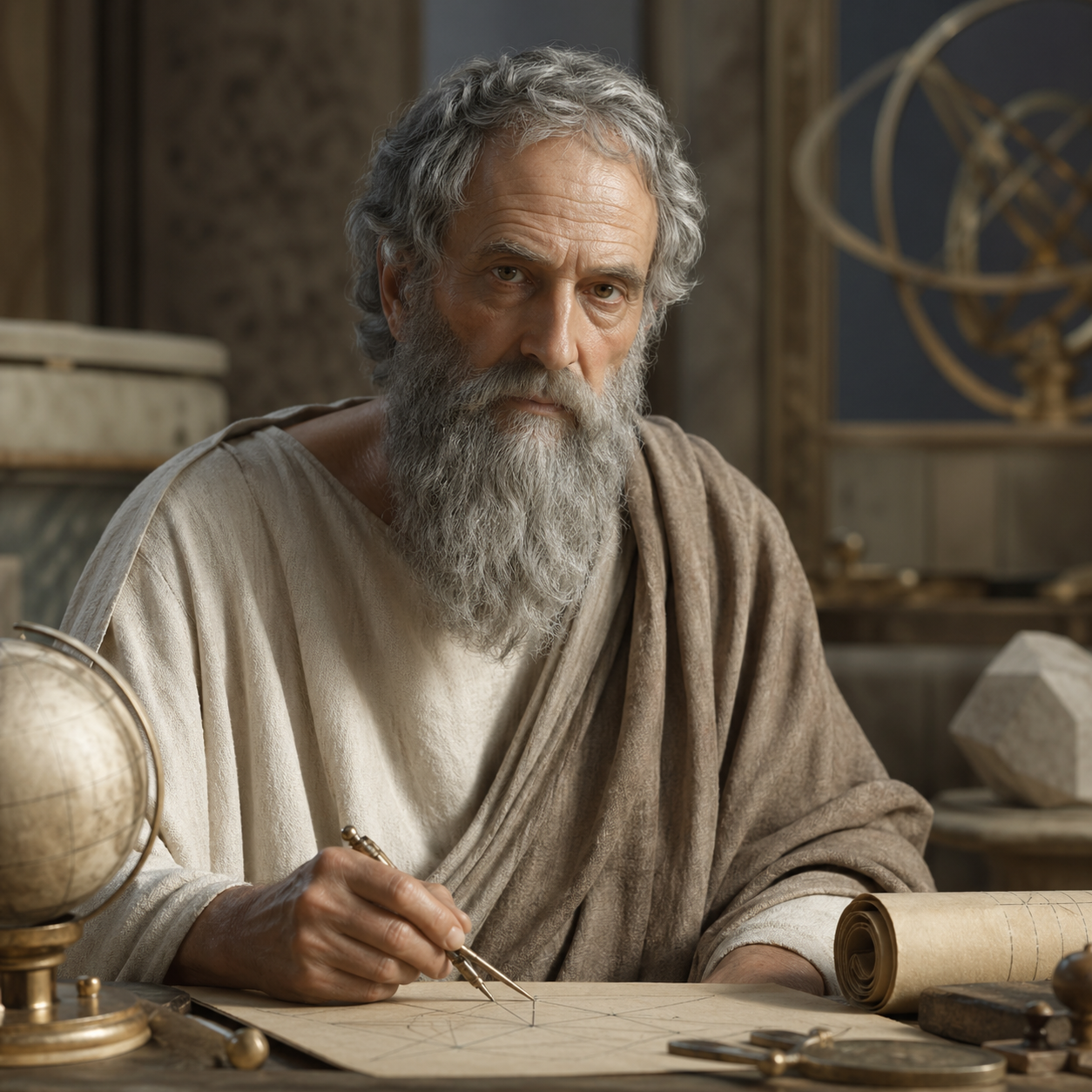
Euclid worked at Alexandria's Library around 300 BCE, synthesizing centuries of scattered Greek geometry into one coherent system. His defining intellectual trait was methodological discipline: he chose only five postulates, the minimum needed, then derived all of plane geometry by logic alone. This phrase reflects his character precisely: honest about assumptions, relentless in deduction. His Elements remained the primary geometry textbook for over two thousand years because of this transparent rigor.
In 300 BCE Alexandria, the intellectual heirs of Plato and Aristotle demanded that knowledge rest on demonstrable logic rather than tradition or divine authority. Hellenistic culture had unified the Mediterranean world, enabling unprecedented exchange of ideas. Yet much knowledge remained tangled with mythology and rhetoric. Euclid's radical move was transparency: declare every assumption openly before deducing consequences. This separated proven truth from assumed truth at a moment when that distinction was philosophically urgent.
AI-generated insights based on extensive research and information for context. Factual errors? Email [email protected].
Your cart is empty