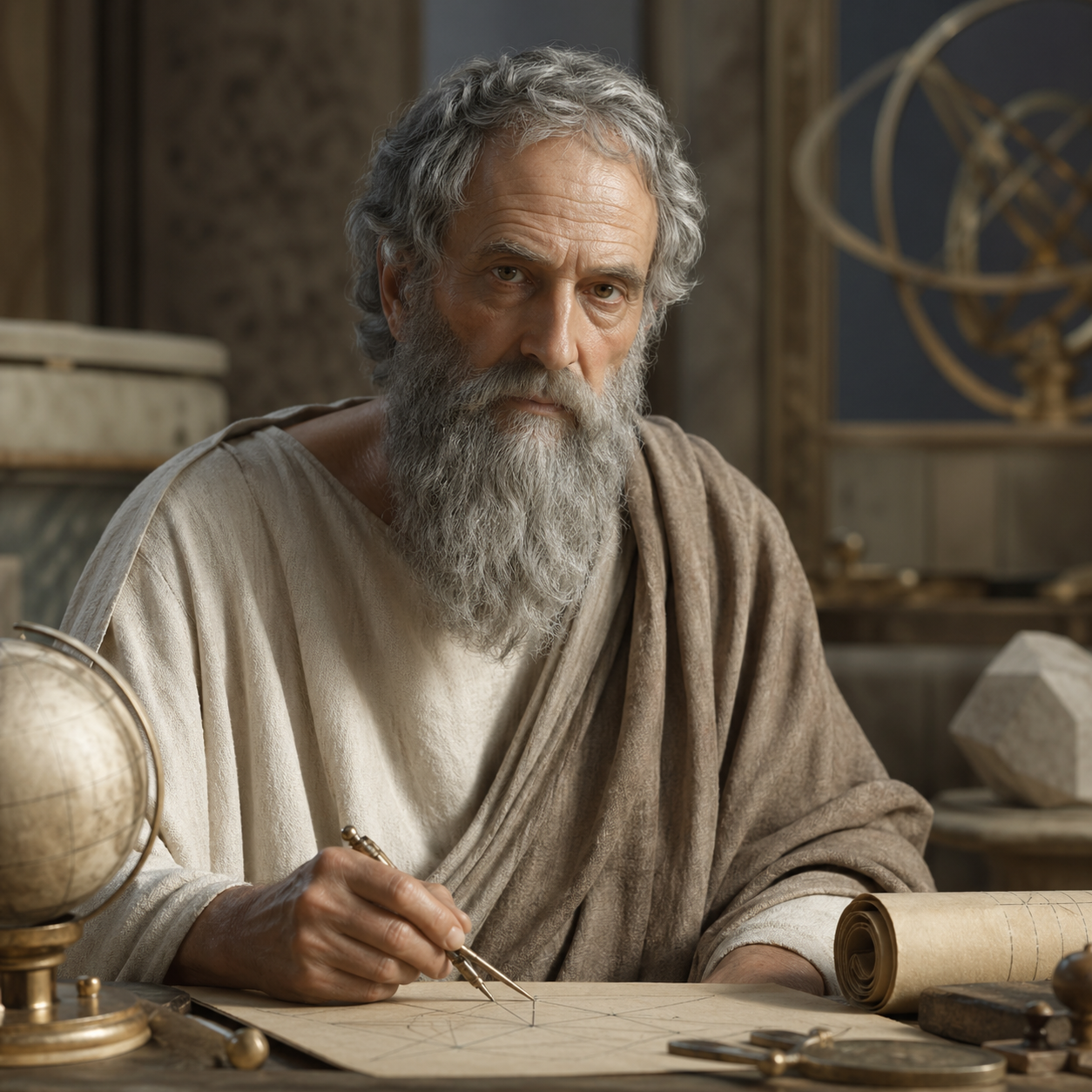
Euclid — "To inscribe a regular hexagon in a given circle."
To inscribe a regular hexagon in a given circle.
To inscribe a regular hexagon in a given circle.
Click any product to generate a realistic preview. Up to 3 at a time.
* Initial load can take up to 90 seconds — revising the preview in another color is nearly instant.
"If a straight line be cut into two equal parts and also into two unequal parts, the rectangle contained by the unequal parts together with the square on the line between the points of section is equal…"
"Give him threepence, since he must make a gain out of what he learns."
"Of trilateral figures, an equilateral triangle is that which has its three sides equal, an isosceles triangle that which has only two of its sides equal, and a scalene triangle that which has its thre…"
"The angles in the same segment are equal to one another."
"Things which coincide with one another are equal to one another."
Found in 1 providers: grok
1 source checked
This is a geometric construction problem: place a perfect six-sided figure inside a circle so every vertex touches the circle's edge and all sides are equal. The insight is that a regular hexagon's side length exactly equals the circle's radius, making this one of the most elegant constructions in all of mathematics — achievable with only a compass, no measurement required.
Euclid included this construction as Proposition 15 in Book IV of Elements, his systematic compilation of Greek mathematical knowledge. It exemplifies his method: building complex truths from simple axioms using compass and straightedge alone. For Euclid, geometry was about logical proof and pure construction, not approximation — this hexagon problem perfectly embodies that philosophy.
Around 300 BCE in Alexandria, Greek mathematics was being formalized into rigorous deductive systems. Egypt's Hellenistic culture prized both practical engineering and abstract reasoning. Regular polygons held philosophical significance — Plato linked them to cosmic elements. Euclid's Alexandria was the intellectual capital of the ancient world, where geometric knowledge was systematized for the first time into axiomatic foundations.
AI-generated insights based on extensive research and information for context. Factual errors? Email [email protected].
Your cart is empty