Louis Pasteur — "Life is a germ, and a germ is life. The living organism is the highest, the most…"
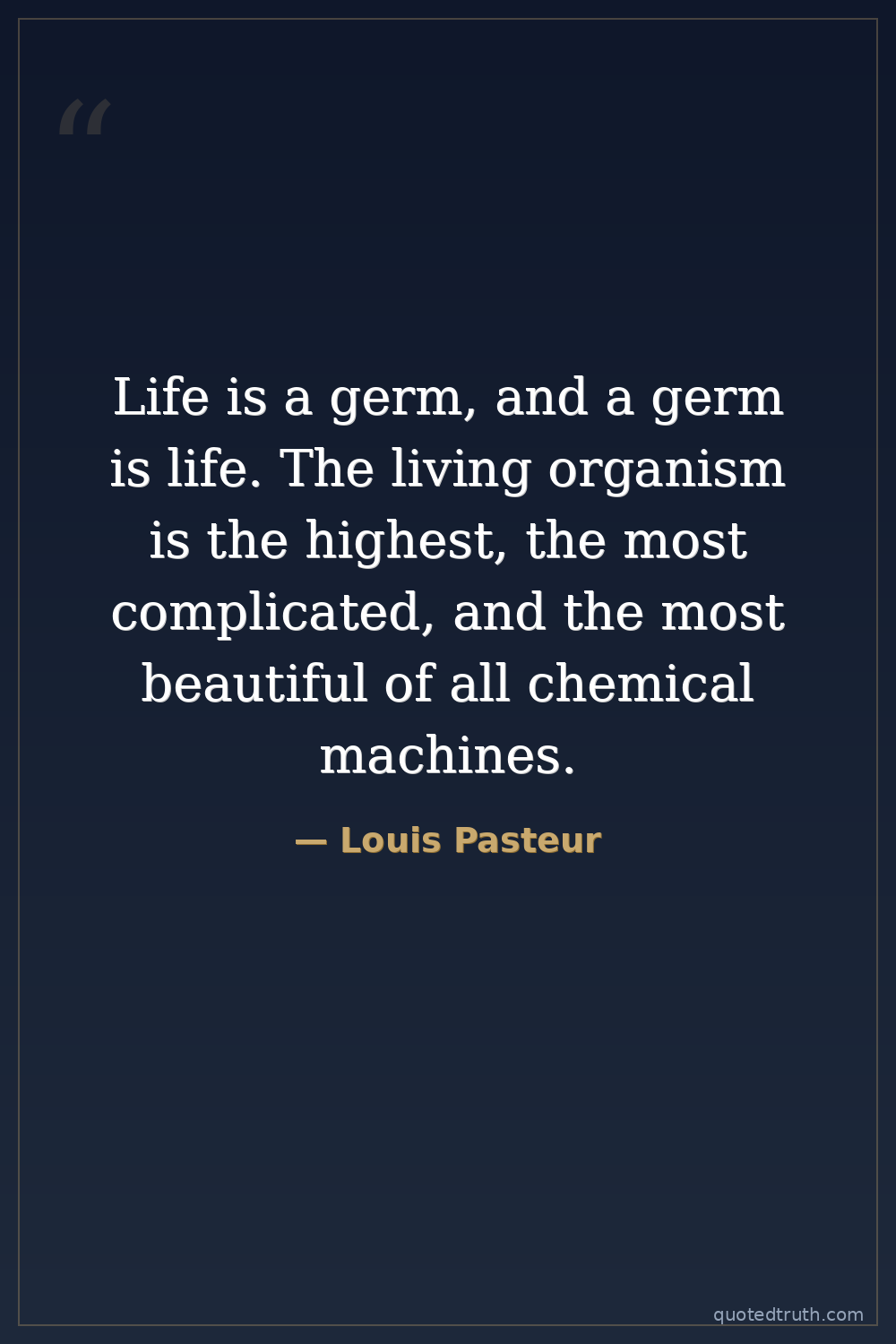
Life is a germ, and a germ is life. The living organism is the highest, the most complicated, and the most beautiful of all chemical machines.
Life is a germ, and a germ is life. The living organism is the highest, the most complicated, and the most beautiful of all chemical machines.
Click any product to generate a realistic preview. Up to 3 at a time.
* Initial load can take up to 90 seconds — revising the preview in another color is nearly instant.
"The cultivation of the soil is the noblest occupation of man."
"One must have a certain amount of daring to embark on a scientific career."
"It is not the strongest of the species that survives, nor the most intelligent that survives. It is the one that is most adaptable to change."
"My passion for truth was the only guide of my life."
"The more I study nature, the more I stand amazed at the work of the Creator."
Attributed, reflecting his views on vitalism and the nature of life.
Date: Late 19th Century (approx.)
WisdomFound in 1 providers: grok
1 source checked
Pasteur is saying living things and microscopic germs share the same essential nature: both are forms of life driven by chemistry. Every organism, from a bacterium to a human, operates as an elaborate chemical system. He frames biology as the most intricate and elegant branch of chemistry, where life itself emerges from the precise interactions of molecules rather than from some separate vital force.
This captures Pasteur's core identity as a chemist who revolutionized biology. Trained in crystallography, he proved microorganisms cause fermentation and disease, founding germ theory. Seeing organisms as chemical machines aligns with his lab-based approach, yet his reverence for life's complexity reflects his devout Catholic faith and belief that science revealed divine craftsmanship. It fuses his pasteurization, vaccine, and microbiology work into one unified worldview.
Pasteur worked in 19th-century France amid fierce debate between spontaneous generation and germ theory. Industrial brewing, silkworm plagues, and cholera epidemics demanded scientific answers. Mechanistic views of nature were rising alongside Darwin's evolution, while vitalists insisted life transcended chemistry. Pasteur's statement bridges both camps, affirming chemical mechanism without stripping life of grandeur, during an era when microbiology was literally being invented and transforming medicine, agriculture, and public health.
AI-generated insights based on extensive research and information for context. Factual errors? Email [email protected].
Your cart is empty