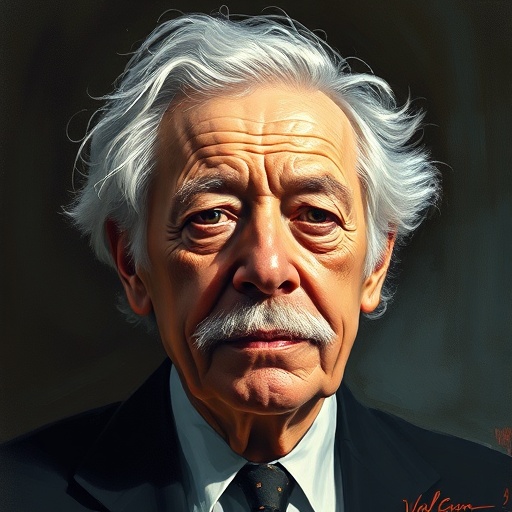
Linus Pauling — "Like thousands of other boys, I had a little chemical laboratory in our cellar a…"
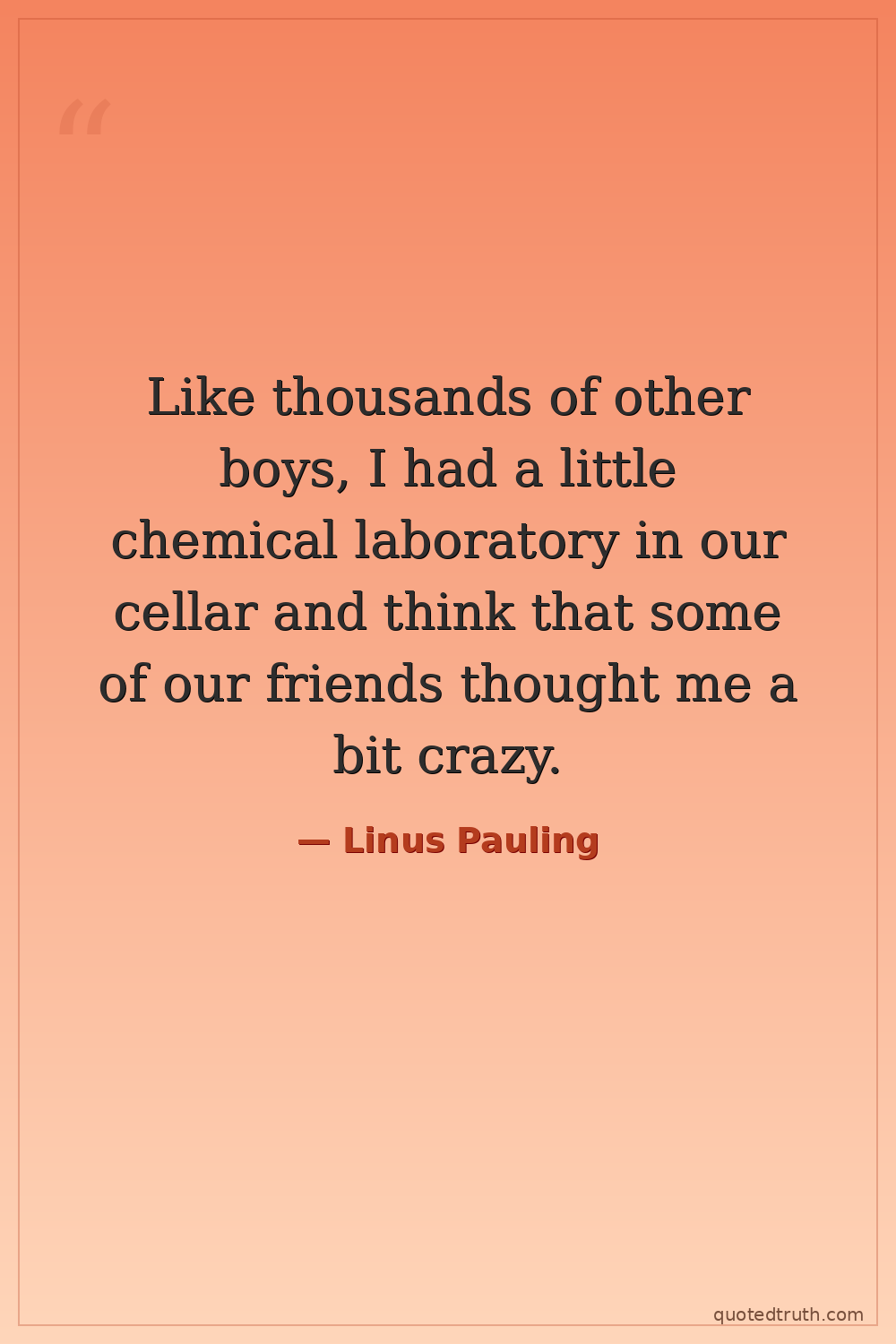
Like thousands of other boys, I had a little chemical laboratory in our cellar and think that some of our friends thought me a bit crazy.
Like thousands of other boys, I had a little chemical laboratory in our cellar and think that some of our friends thought me a bit crazy.
Click any product to generate a realistic preview. Up to 3 at a time.
* Initial load can take up to 90 seconds — revising the preview in another color is nearly instant.
"I believe that the world would be a better place if everyone took more vitamin C."
"You can't have a good idea unless you have a lot of ideas."
"The greatest discovery of all time is that a person can change his future by merely changing his attitude."
"The scientific method is a never-ending process of observation, hypothesis, experiment, and revision."
"The only thing that stands between a man and what he wants from life is often merely the will to try it and the faith to believe that it is possible."
Found in 1 providers: gemini
1 source checked
A speaker recalls joining countless other boys of his generation in running a homemade chemistry lab in the basement, while noting that acquaintances found this hobby eccentric. The quote normalizes early scientific obsession while acknowledging the social gap between the experimentally curious child and adults who couldn't see past the oddness. Curiosity and perceived craziness coexist as twin markers of a scientific mind in formation.
Pauling grew up in Portland, Oregon in the early 1900s, his basement experiments directly seeding a career that made him the only person to win two unshared Nobel Prizes — Chemistry in 1954 for chemical bond theory and Peace in 1962 for nuclear test ban activism. The self-deprecating humor masks a lifelong trait: pursuing ideas others dismissed as eccentric, from his orbital hybridization models to his controversial vitamin C megadosing claims.
In the early 1900s, amateur home science thrived alongside the rise of Edison, industrial chemistry, and mail-order chemical kits marketed to boys. Formal science education was sparse, and self-directed experimentation was how many future scientists trained. Yet basement labs carrying volatile chemicals alarmed neighbors. The era celebrated inventive tinkering in the abstract while viewing the specific neighborhood boy with acid burns and fumes as something between prodigy and hazard.
AI-generated insights based on extensive research and information for context. Factual errors? Email [email protected].
Your cart is empty