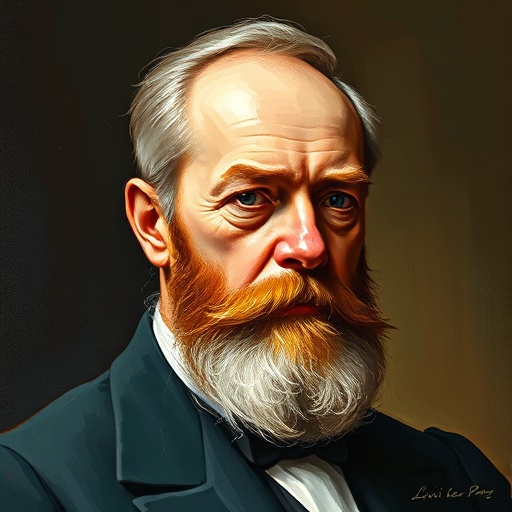
Louis Pasteur — "Little science takes you away from God but more of it takes you to Him."
Little science takes you away from God but more of it takes you to Him.
Little science takes you away from God but more of it takes you to Him.
Click any product to generate a realistic preview. Up to 3 at a time.
* Initial load can take up to 90 seconds — revising the preview in another color is nearly instant.
"The more I learn, the more I realize how much I don't know."
"My passion for truth was the only guide of my life."
"I have been for the past three years studying a disease which is called hydrophobia, or rabies. It is a disease which I believe to be caused by a microbe."
"I have great hopes that the vaccine against rabies will be a success."
"The world is full of wonders, but they are only visible to the eyes that know how to see them."
A philosophical statement with a touch of dry wit in its phrasing.
Date: 19th century (approximate)
GeneralFound in 1 providers: gemini
1 source checked
A shallow dip into science can make the world seem fully explainable by natural laws, pushing someone away from belief in God. But deeper study reveals such staggering complexity, order, and mystery in nature that many thinkers find materialism insufficient and return to faith. The quote argues that science and religion aren't enemies; surface-level knowledge breeds doubt, while genuine mastery breeds awe and often points back toward a creator.
Pasteur was a devout Catholic who saw no conflict between rigorous laboratory work and Christian faith. His discoveries in germ theory, vaccination, and fermentation gave him intimate knowledge of microscopic life's complexity, which deepened rather than weakened his belief. He famously prayed, attended Mass, and insisted his science never threatened religion. This quote distills his personal journey: the more microbes he studied, the more convinced he became of divine design.
Pasteur lived through 19th-century France's fierce clash between rising scientific materialism and traditional Catholicism. Darwin's 1859 Origin of Species, Comte's positivism, and anticlerical republican movements pushed many intellectuals toward atheism. Meanwhile, the Catholic Church felt besieged by modernity. Pasteur's public statements defending faith carried enormous weight because he was France's most celebrated scientist, offering proof that laboratory breakthroughs and religious devotion could coexist during an era demanding people choose sides.
AI-generated insights based on extensive research and information for context. Factual errors? Email [email protected].
Your cart is empty