Alan Turing — "Logic will get you from A to B. Imagination will take you everywhere."
Logic will get you from A to B. Imagination will take you everywhere.
Logic will get you from A to B. Imagination will take you everywhere.
Click any product to generate a realistic preview. Up to 3 at a time.
* Initial load can take up to 90 seconds — revising the preview in another color is nearly instant.
"It is not possible to produce a set of rules purporting to describe what a man should do in every conceivable set of circumstances."
"We are all stardust."
"A machine does not have to be conscious to be intelligent."
"Hyperboloids of wondrous light. Rolling for age through Space and Time Harbour there Waves which somehow Might Play out God's holy pantomime."
"Mathematical logic, as a subject, is going to have a great future."
Found in 1 providers: grok
1 source checked
Logic follows rules to reach predictable conclusions — it's a reliable engine for moving through known territory. Imagination breaks from those rails entirely, allowing you to conceive of destinations that don't yet exist and paths no one has mapped. The point is that rational problem-solving is necessary but insufficient; the truly transformative ideas require visionary thinking that escapes structured constraint and ventures into what hasn't been proven possible yet.
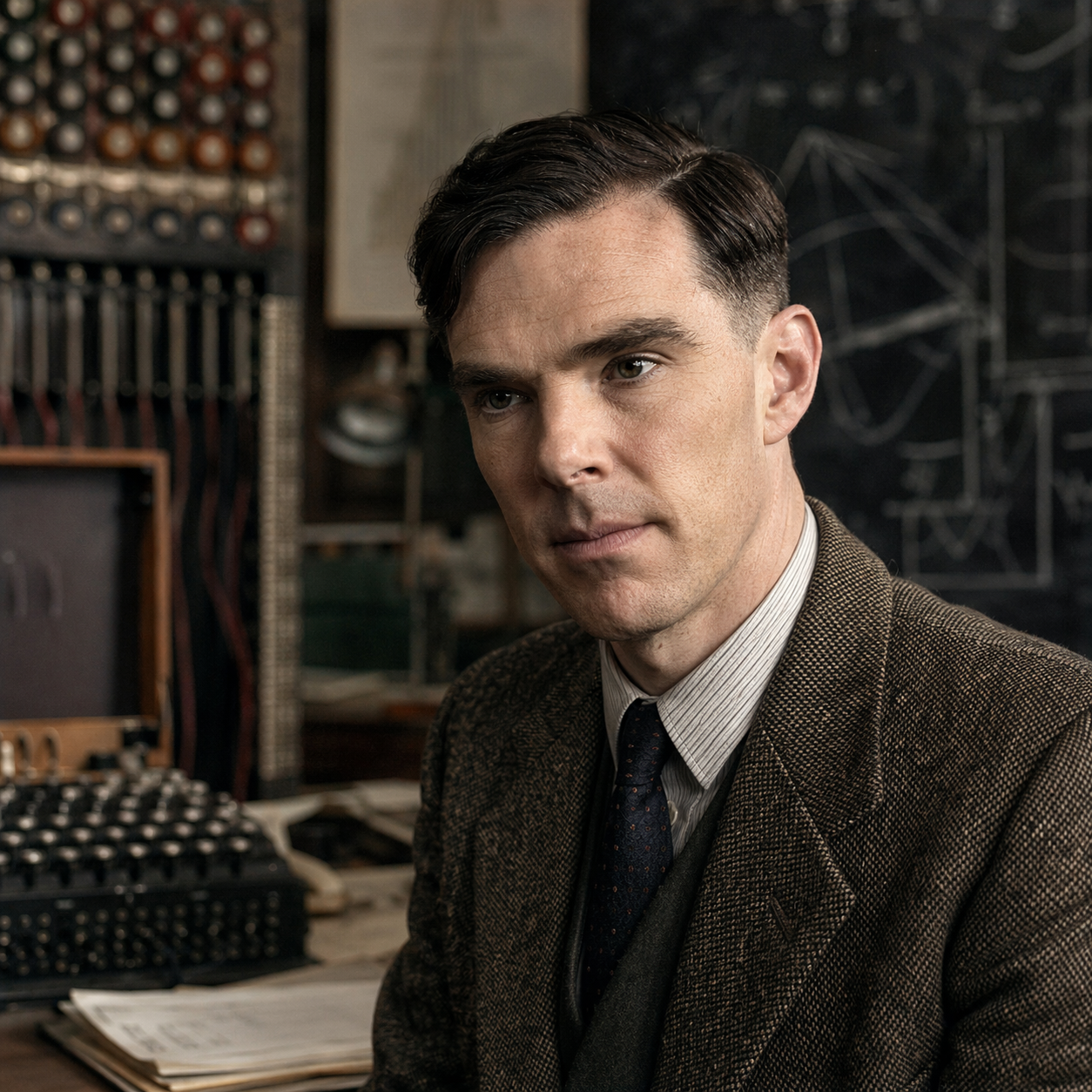
Turing's career embodied this tension. His 1936 paper on computable numbers — the logical bedrock of all modern computing — was precise, formal, and axiomatic. Yet his 1950 Computing Machinery and Intelligence paper, which posed the Turing Test, was an act of pure imagination: asking whether machines could think before any such machine existed. At Bletchley Park, breaking Enigma required imaginative leaps beyond brute logical analysis, including the inventive diagonal-board modification to the Bombe.
Turing worked from the 1930s through the early 1950s — a period when formal logic and mathematical rigor were reshaping science and warfare alike. WWII demonstrated that logical systems could crack codes and win battles. But postwar, pioneers had to imagine entirely new uses for electronic machines that society couldn't yet conceive of. The philosophical question of whether machines could think — radical imagination for 1950 — helped define the next century of technology.
AI-generated insights based on extensive research and information for context. Factual errors? Email [email protected].
Your cart is empty