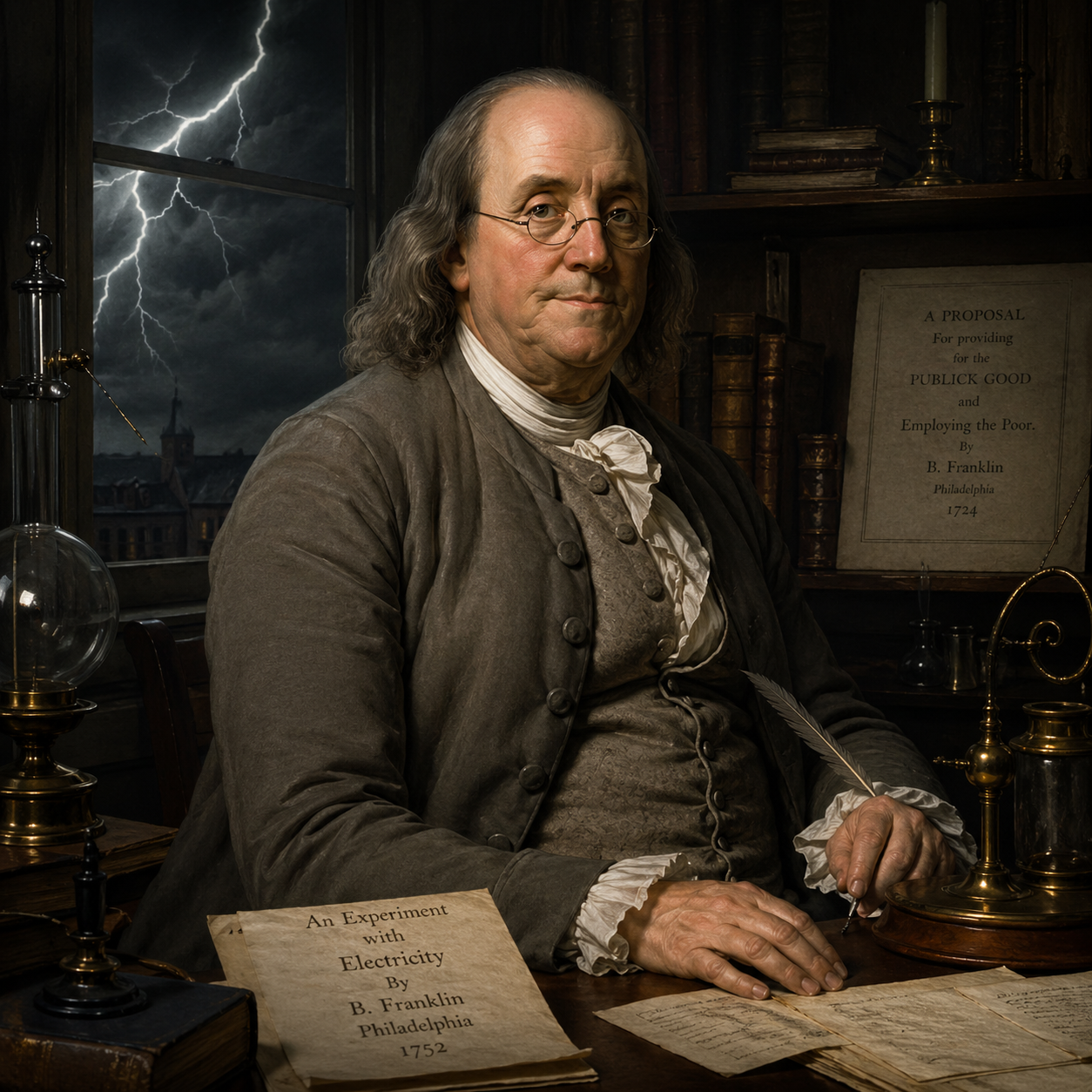
Benjamin Franklin — "Love your enemies, for they tell you your faults."
Love your enemies, for they tell you your faults.
Love your enemies, for they tell you your faults.
Click any product to generate a realistic preview. Up to 3 at a time.
* Initial load can take up to 90 seconds — revising the preview in another color is nearly instant.
"It is a grand mistake to think of being great without ever being good."
"The worship of God is a duty; the hearing and reading of sermons may be useful; but if men rest in hearing and praying, as too many do, it is as if a tree should value itself in being watered and putt…"
"The working man is fit and fed, and stabs the sluggard in his bed."
"The only way to keep a secret between two is to kill one of them."
"Were it not for the odiously offensive Smell accompanying such Escapes, polite People would probably be under no more Restraint in discharging such Wind in Company, than they are in spitting, or in bl…"
Polymath Founding Father, diplomat, and Poor Richard's Almanack author who helped draft the Declaration of Independence and the Constitution. Closely associated with John Adams (fellow Founder, Massachusetts statesman) and Thomas Jefferson (fellow Declaration drafter). For an intellectual contrast, see Thomas Hutchinson, last royal governor of colonial Massachusetts — Franklin leaked Hutchinson's loyalist correspondence to Boston in 1772 to inflame revolutionary sentiment — Hutchinson represented the colonial-aristocrat crown-loyalty that Franklin's revolution was organized to dismantle.
Found in 2 providers: grok,deepseek
2 sources checked
Enemies, unlike friends, have no reason to spare your feelings — they expose weaknesses honestly and without flattery. Rather than dismissing or resenting critics, value them as the most candid mirror available. Welcoming harsh criticism, even from adversaries, lets you identify real flaws and actually correct them. The practical payoff of goodwill toward enemies is self-knowledge and growth, not abstract moral virtue.
Franklin spent decades documenting his own faults — his Autobiography describes a systematic self-improvement project tracking 13 virtues, noting daily failures. As a diplomat in London and Paris, he faced scornful political enemies who questioned his legitimacy, yet he extracted lessons from their attacks. His pragmatic worldview treated criticism as data, not insult. Poor Richard's Almanack consistently reframed adversity as opportunity for practical wisdom.
In 18th-century colonial America and revolutionary Britain, political enemies were not abstract — they were pamphleteers, rival merchants, and Crown officials capable of ruining reputations overnight. Enlightenment philosophy simultaneously championed reason and rigorous self-examination as civic duties. Public life was brutal: press campaigns, personal attacks, and factional warfare were routine. Learning from adversaries rather than simply defeating them was a distinctly rational survival strategy for anyone navigating treacherous political waters.
AI-generated insights based on extensive research and information for context. Factual errors? Email [email protected].
Your cart is empty