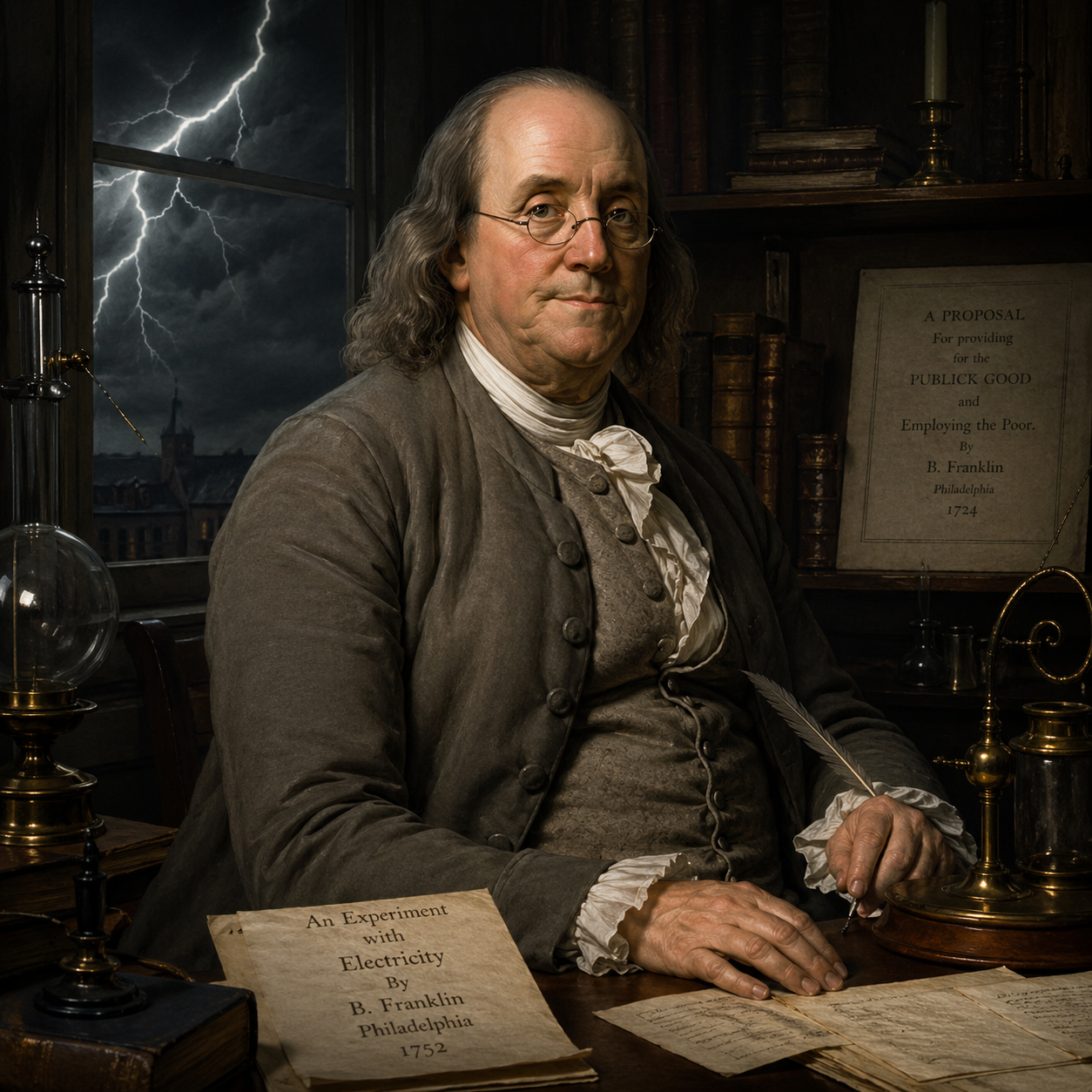
Benjamin Franklin — "The working man is fit and fed, and stabs the sluggard in his bed."
The working man is fit and fed, and stabs the sluggard in his bed.
The working man is fit and fed, and stabs the sluggard in his bed.
Click any product to generate a realistic preview. Up to 3 at a time.
* Initial load can take up to 90 seconds — revising the preview in another color is nearly instant.
"Experience keeps a dear school, but fools will learn in no other."
"I am for doing good to the poor, but... I think the best way of doing good to the poor, is not making them easy in poverty, but leading or driving them out of it. I observed...that the more public pro…"
"The way to be safe, is never to be secure."
"He that has a wife and children, has given hostages to fortune."
"One today is worth two tomorrows."
Polymath Founding Father, diplomat, and Poor Richard's Almanack author who helped draft the Declaration of Independence and the Constitution. Closely associated with John Adams (fellow Founder, Massachusetts statesman) and Thomas Jefferson (fellow Declaration drafter). For an intellectual contrast, see Thomas Hutchinson, last royal governor of colonial Massachusetts — Franklin leaked Hutchinson's loyalist correspondence to Boston in 1772 to inflame revolutionary sentiment — Hutchinson represented the colonial-aristocrat crown-loyalty that Franklin's revolution was organized to dismantle.
From 'Poor Richard's Almanack' (lesser-known wisdom)
Date: Unknown, likely 18th century
Work & MoneyFound in 1 providers: gemini
1 source checked
Those who labor consistently thrive physically and materially, while the lazy suffer defeat at the hands of the industrious. 'Stabs the sluggard' is blunt metaphor: the hardworking person doesn't merely outpace the idle — they decisively dominate them. The quote rewards action with fitness and food, punishes inaction with vulnerability. It frames work ethic not as virtue alone but as competitive survival advantage over those who remain passive.
Franklin embodied this maxim completely. Rising from printer's apprentice to diplomat, inventor, and founding father, he attributed his ascent entirely to disciplined industry. Poor Richard's Almanack overflows with nearly identical proverbs — 'Early to bed and early to rise makes a man healthy, wealthy, and wise.' His autobiography became America's first self-made-man narrative, and his famous thirteen virtues explicitly listed industry as essential to a well-lived life.
In 18th-century colonial America, physical labor literally determined survival — farming, trade, and craft work left no room for idleness. Protestant work ethic cast laziness as moral failure, not mere inconvenience. Simultaneously, Enlightenment ideals celebrated rational self-improvement. As tensions with Britain grew, American industriousness became political identity: hardworking colonists contrasted themselves against supposedly idle aristocrats, making pro-labor rhetoric simultaneously moral instruction, cultural pride, and revolutionary sentiment.
AI-generated insights based on extensive research and information for context. Factual errors? Email [email protected].
Your cart is empty