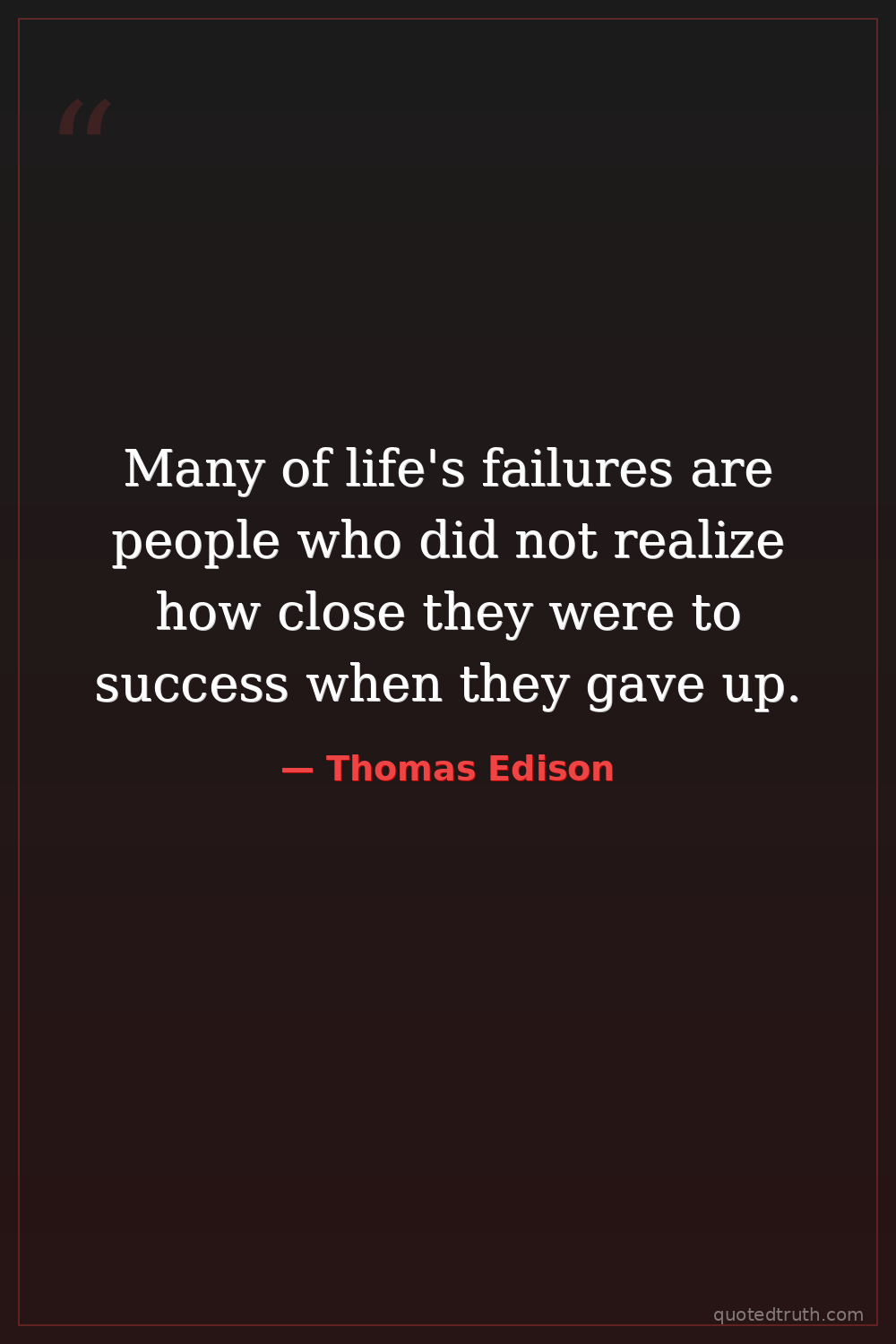
Thomas Edison — "Many of life's failures are people who did not realize how close they were to su…"
Many of life's failures are people who did not realize how close they were to success when they gave up.
Many of life's failures are people who did not realize how close they were to success when they gave up.
Click any product to generate a realistic preview. Up to 3 at a time.
* Initial load can take up to 90 seconds — revising the preview in another color is nearly instant.
"My main purpose in life is to make money so that I can afford to carry on more experiments."
"I never did a day's work in my life. It was all fun."
"I am more of a sponge than a scientist."
"I am not a spiritualist, but I am a firm believer in the fact that we can communicate with the beyond."
"We are like tenant farmers chopping down the fence around our house for fuel when we should be using Nature's inexhaustible sources of energy - sun, wind and tide. I'd put my money on the sun and sola…"
Found in 1 providers: grok
1 source checked
Most people who fail do so not because success was impossible, but because they quit right before breakthrough. Progress toward a goal often feels slowest and most discouraging at the final stretch, when the finish line is actually nearest. Persistence through the darkest, most frustrating moments is what separates those who achieve results from those who walk away empty-handed just steps from the outcome they wanted.
Edison famously tested thousands of filament materials before landing on carbonized bamboo for his practical incandescent bulb, and reportedly called each failed attempt a step toward the answer. He ran Menlo Park as a relentless iteration factory, producing the phonograph, motion picture camera, and over 1,000 patents. His career embodied brute-force persistence over flashes of genius, making this line a direct distillation of his working method.
Edison worked during the late 19th-century Second Industrial Revolution, when electricity, telegraphy, and mass manufacturing were reshaping American life. Inventors competed fiercely in an unregulated patent race, and financial backers abandoned projects quickly if results lagged. Self-made industrialists like Carnegie and Rockefeller glorified grit and perseverance as national virtues. In that climate, Edison's message reinforced the Gilded Age gospel that sustained effort, not luck or privilege, produced world-changing breakthroughs.
AI-generated insights based on extensive research and information for context. Factual errors? Email [email protected].
Your cart is empty