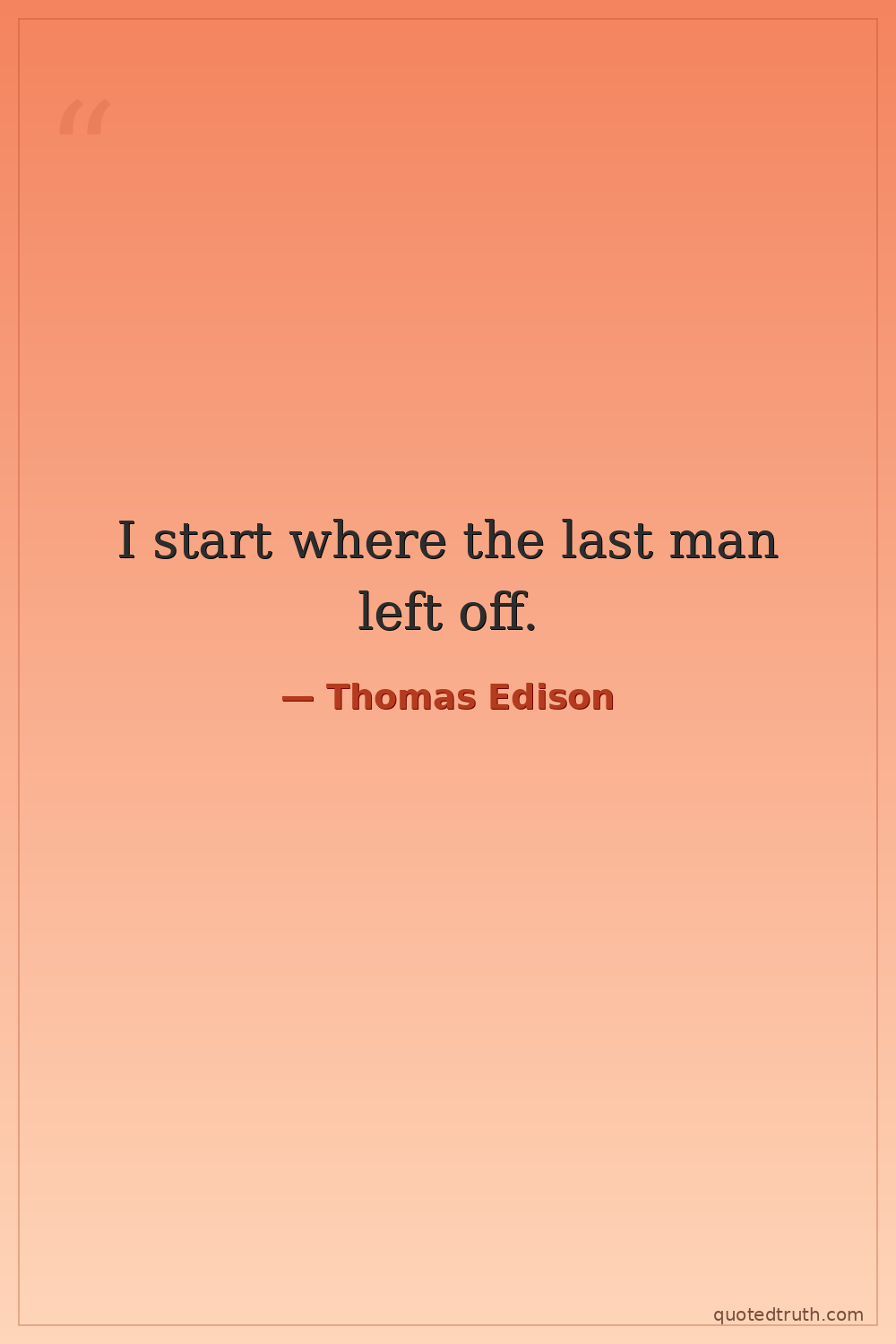
Thomas Edison — "I start where the last man left off."
I start where the last man left off.
I start where the last man left off.
Click any product to generate a realistic preview. Up to 3 at a time.
* Initial load can take up to 90 seconds — revising the preview in another color is nearly instant.
"I am not a scientist. I am an inventor."
"I have not failed 10,000 times. I have successfully found 10,000 ways that will not work."
"I told [John Kruesi] I was going to record talking, and then have the machine talk back. He thought it absurd. However, it was finished, the foil was put on; I then shouted 'Mary had a little lamb', e…"
"The first thing is to find out what the world needs; then proceed to invent it."
"You will have many opportunities in life to keep your mouth shut: You should take advantage of every one of them."
Found in 1 providers: grok
1 source checked
Progress doesn't require starting from scratch. Build on what others have already figured out, then push further. Treat existing knowledge, failed attempts, and partial solutions as a foundation rather than reinventing every wheel. The real work begins at the edge of what's currently known, not at the beginning. Every generation inherits tools, ideas, and dead ends from the last, and the smart move is to leverage all of it.
Edison ran an industrial research lab at Menlo Park where he systematically improved on prior inventions rather than conjuring them from nothing. The light bulb existed before him; he made it commercially viable by testing thousands of filaments. The phonograph built on acoustic research. He patented 1,093 inventions by studying what came before, hiring teams to iterate rapidly, and treating invention as cumulative engineering rather than solitary genius.
The late 1800s Second Industrial Revolution saw electricity, telegraphy, and mechanical engineering compounding rapidly. Inventors openly studied each other's patents, and the U.S. Patent Office was flooded. Edison competed with Tesla, Westinghouse, and Bell in a crowded field where incremental improvement meant market dominance. Research labs were a new concept, and the idea of standing on predecessors' shoulders matched an era when scientific knowledge was becoming publicly shared and industrially exploitable for the first time.
AI-generated insights based on extensive research and information for context. Factual errors? Email [email protected].
Your cart is empty