James Clerk Maxwell — "Mathematicians my flatter themselves that they possess new ideas which mere huma…"
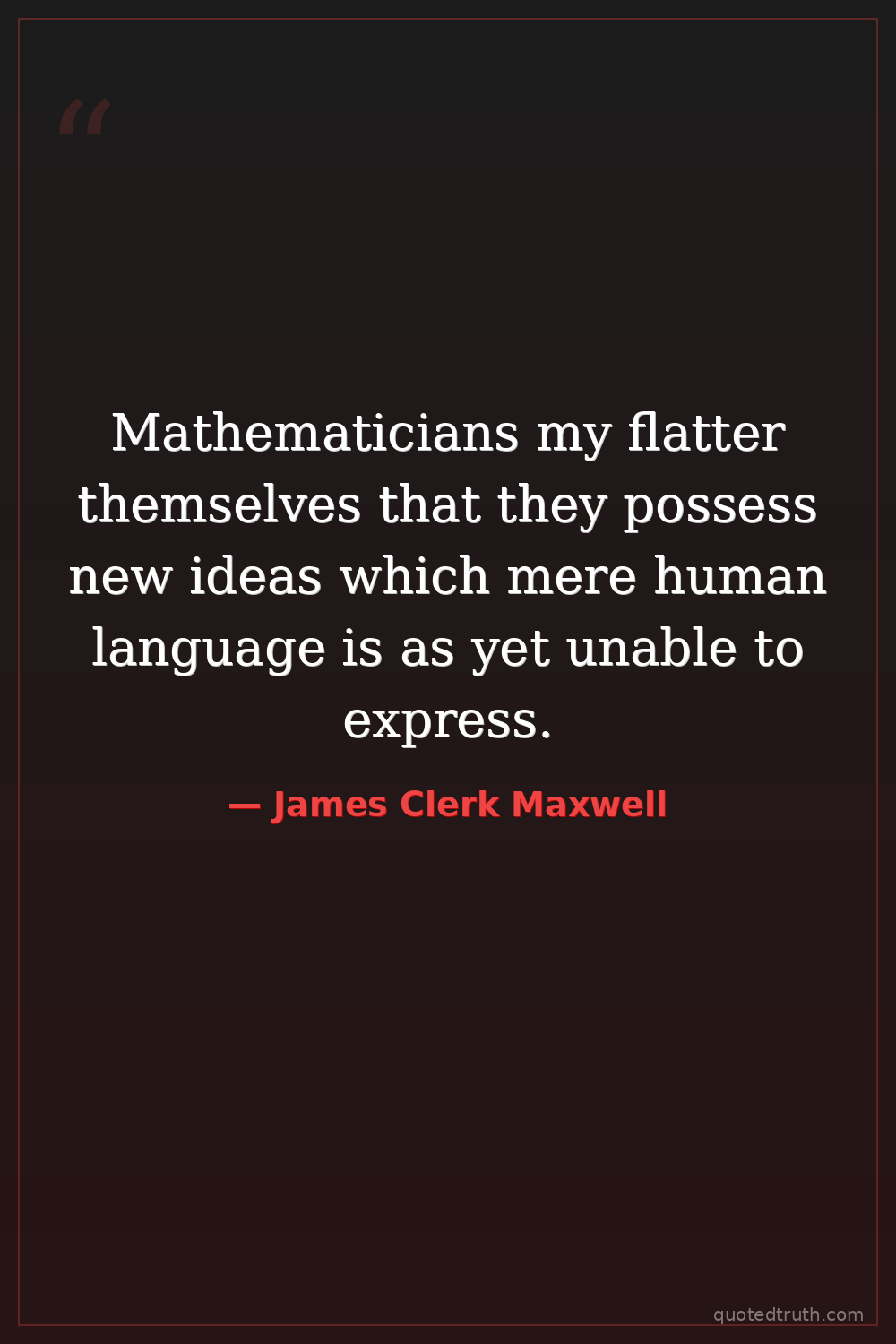
Mathematicians my flatter themselves that they possess new ideas which mere human language is as yet unable to express.
Mathematicians my flatter themselves that they possess new ideas which mere human language is as yet unable to express.
Click any product to generate a realistic preview. Up to 3 at a time.
* Initial load can take up to 90 seconds — revising the preview in another color is nearly instant.
"Every existence above a certain rank has its singular points; the higher the rank the more of them. At these points, influences whose physical magnitude is too small to be taken account of by a finite…"
"The human mind is in a state of perpetual oscillation between the actual and the possible."
"The mind of man is like a mirror, which reflects the images of things, but does not always reflect them truly."
"I think men of science as well as other men need to learn from Christ, and I think Christians whose minds are scientific are bound to study science that their view of the glory of God may be as extens…"
"The true beginning of all knowledge is the discovery of something we do not know."
From his collected works, a commentary on the nature of mathematical expression.
Date: Undated, but from his collected works.
GeneralFound in 1 providers: gemini
1 source checked
Mathematicians sometimes congratulate themselves on grasping concepts so novel that ordinary words cannot capture them. The quote suggests that mathematical notation reaches places plain language cannot follow, describing relationships, structures, and abstractions that resist translation into everyday speech. It is both a boast about mathematics' reach and a gentle warning that what cannot be put into words risks becoming private to its discoverers rather than shared knowledge.
Maxwell spent his career translating physical intuition into compact equations, most famously the four equations unifying electricity, magnetism, and light. He routinely pushed notation beyond what words could carry, using quaternions and field concepts that colleagues struggled to verbalize. As a devout thinker who also wrote poetry, he felt the tension between mathematical precision and human expression firsthand, making this observation a personal reflection on his own daily work.
Maxwell worked in mid-Victorian Britain (1831-1879), when mathematical physics was rapidly outpacing classical descriptive science. Faraday's field pictures were being recast into differential equations, vector calculus was emerging, and symbolic logic was taking shape under Boole and De Morgan. Scientists debated whether mathematics merely described nature or revealed truths beyond sensory grasp, and Maxwell's era marked the shift toward abstract formalism that would define twentieth-century physics.
AI-generated insights based on extensive research and information for context. Factual errors? Email [email protected].
Your cart is empty