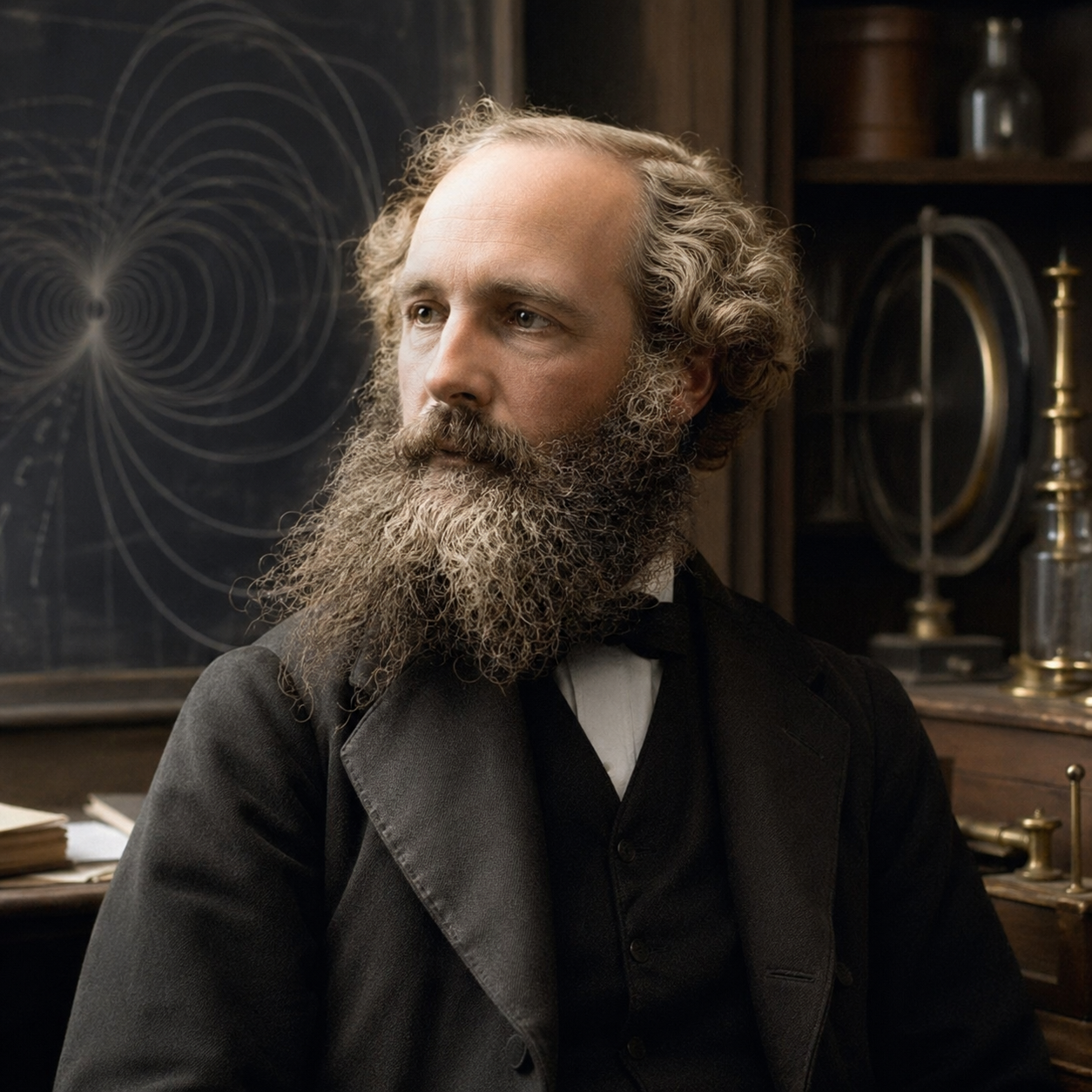
James Clerk Maxwell — "The only way to avoid being wrong is to say nothing."
The only way to avoid being wrong is to say nothing.
The only way to avoid being wrong is to say nothing.
Click any product to generate a realistic preview. Up to 3 at a time.
* Initial load can take up to 90 seconds — revising the preview in another color is nearly instant.
"Every existence above a certain rank has its singular points; the higher the rank the more of them. At these points, influences whose physical magnitude is too small to be taken account of by a finite…"
"I have no doubt that there are many persons who would be very glad to get rid of the ether."
"It is an unscientific habit to give names to things before we know what they are."
"The peculiar function of the scientific man is to make discoveries, not to talk about them."
"The present state of science is such that we cannot hope to explain all the phenomena of nature by means of a few simple laws."
Found in 1 providers: grok
1 source checked
Silence is the only guaranteed shield against error. Anyone who speaks, proposes ideas, or takes a position opens themselves to being mistaken, challenged, or refuted. To never be wrong requires refusing to contribute at all. The trade-off is clear: participation carries the risk of error, but withholding thought entirely is its own failure. Being wrong is the price of actually engaging with hard questions rather than hiding behind safe silence.
Maxwell built his career on bold theoretical leaps, unifying electricity, magnetism, and light into a single framework that many contemporaries initially resisted. His kinetic theory of gases and color-vision work invited constant scrutiny and revision. As a physicist proposing invisible fields and displacement currents, he knew firsthand that advancing science meant publishing ideas that might later be refined or overturned. He chose the risk of error over the safety of silence.
Maxwell worked in mid-Victorian Britain, a period of explosive scientific debate over Darwin's evolution, thermodynamics, and the nature of the ether. Royal Society meetings and journals like Philosophical Transactions subjected every claim to rigorous public critique. Careers could rise or fall on a single paper. In that environment, proposing field equations or statistical mechanics required intellectual courage, because being publicly wrong before peers carried real professional and social consequences.
AI-generated insights based on extensive research and information for context. Factual errors? Email [email protected].
Your cart is empty