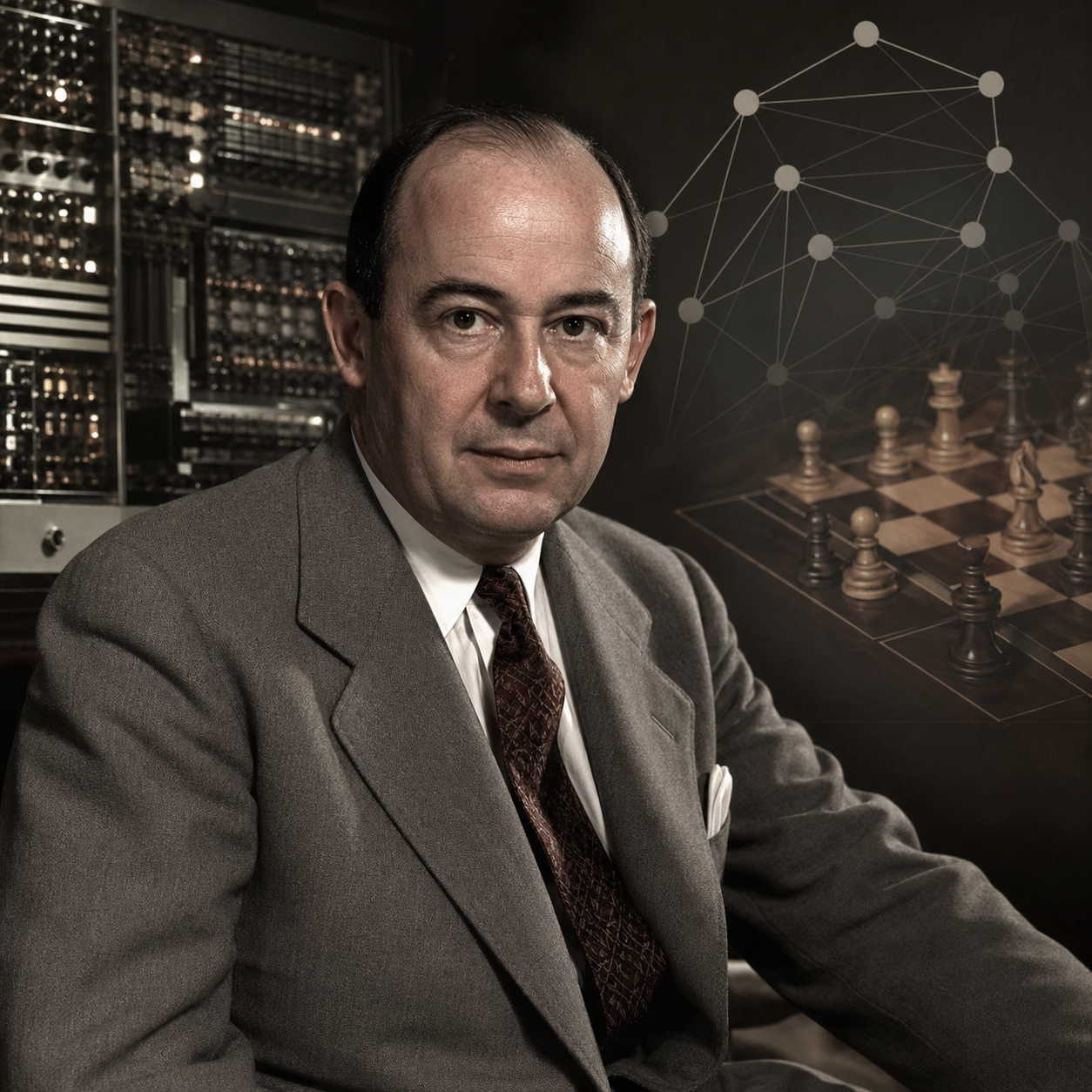
John von Neumann — "Mathematics is an experimental science, and definitions are its axioms."
Mathematics is an experimental science, and definitions are its axioms.
Mathematics is an experimental science, and definitions are its axioms.
Click any product to generate a realistic preview. Up to 3 at a time.
* Initial load can take up to 90 seconds — revising the preview in another color is nearly instant.
"The computer is the only machine that can be taught to do anything."
"Technological possibilities are irresistible to man. If man can go to the moon, he will. If he can control the climate, he will."
"The system 'logic' is not absolute, it is relative to the observer."
"All stable processes we shall predict. All unstable processes we shall control."
"There's no sense in being precise when you don't even know what you're talking about."
Found in 1 providers: grok
1 source checked
Mathematics isn't purely deductive reasoning built from eternal, fixed truths — it works experimentally, like any science. Mathematicians choose definitions, observe what structures emerge, and revise. Those definitions function as axioms: foundational assumptions that determine everything built on top of them. The creative act in math isn't just proving theorems but choosing what to define and how. A well-chosen definition unlocks entire fields; a poor one leads nowhere useful.
Von Neumann lived this principle. His 1932 axiomatization of quantum mechanics chose definitions that made the theory rigorous. His game theory breakthrough lay in defining strategy, utility, and zero-sum precisely enough to generate theorems. His stored-program computer architecture was itself a definition of what computation is. He understood that mathematical power comes from choosing the right abstractions, not just proving from existing ones. His career was a series of definitional revolutions.
Von Neumann worked through mathematics' foundational crisis — Russell's paradox, Hilbert's formalism, and Gödel's incompleteness theorems had shattered faith in fixed axiomatic truth. His era demanded pragmatic mathematics: WWII weapons design, quantum physics, and early computing all required inventing new mathematical frameworks rapidly. The question became not 'what are the true axioms?' but 'which definitions make this problem tractable?' His view reflected a generation that built math to solve problems, not to uncover eternal truth.
AI-generated insights based on extensive research and information for context. Factual errors? Email [email protected].
Your cart is empty