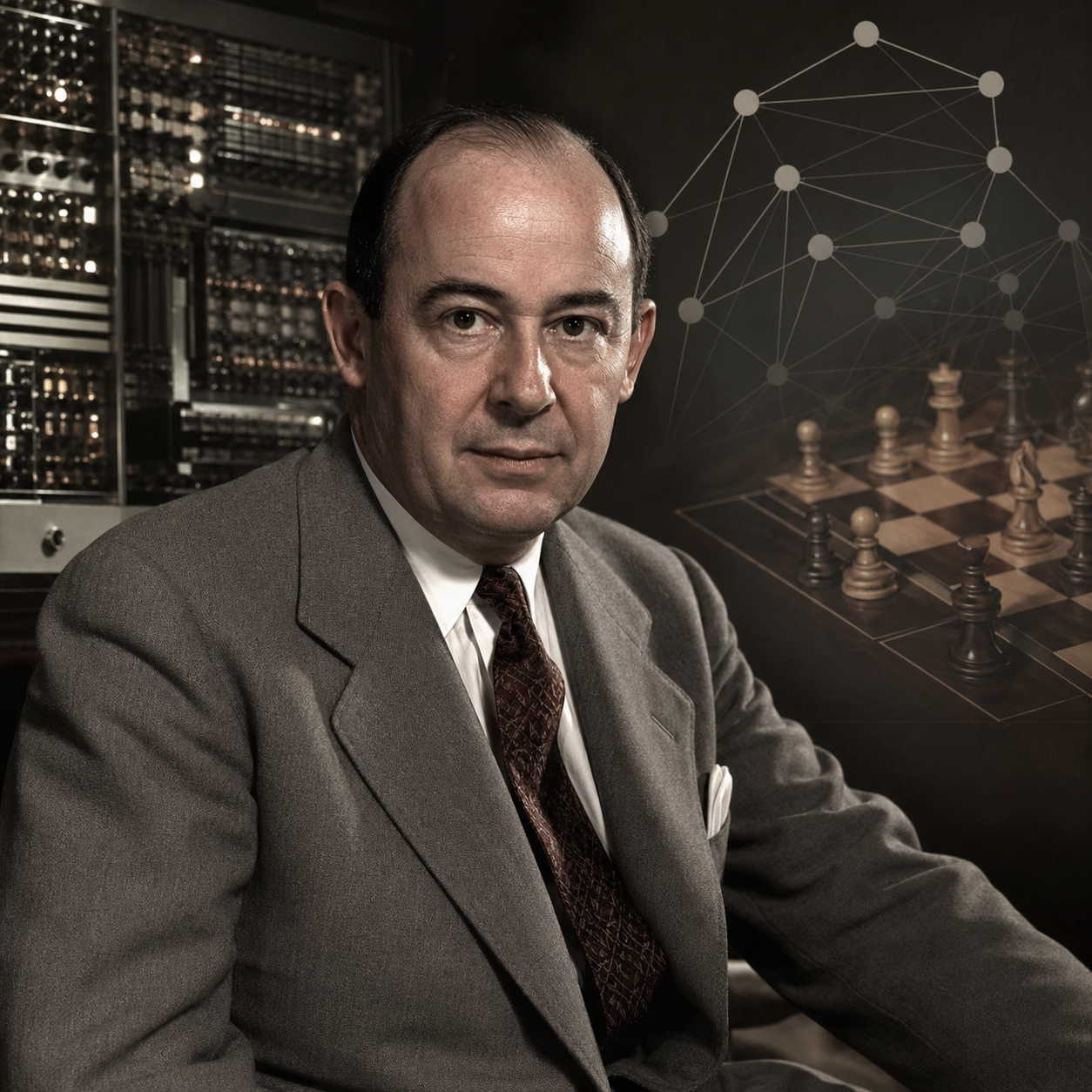
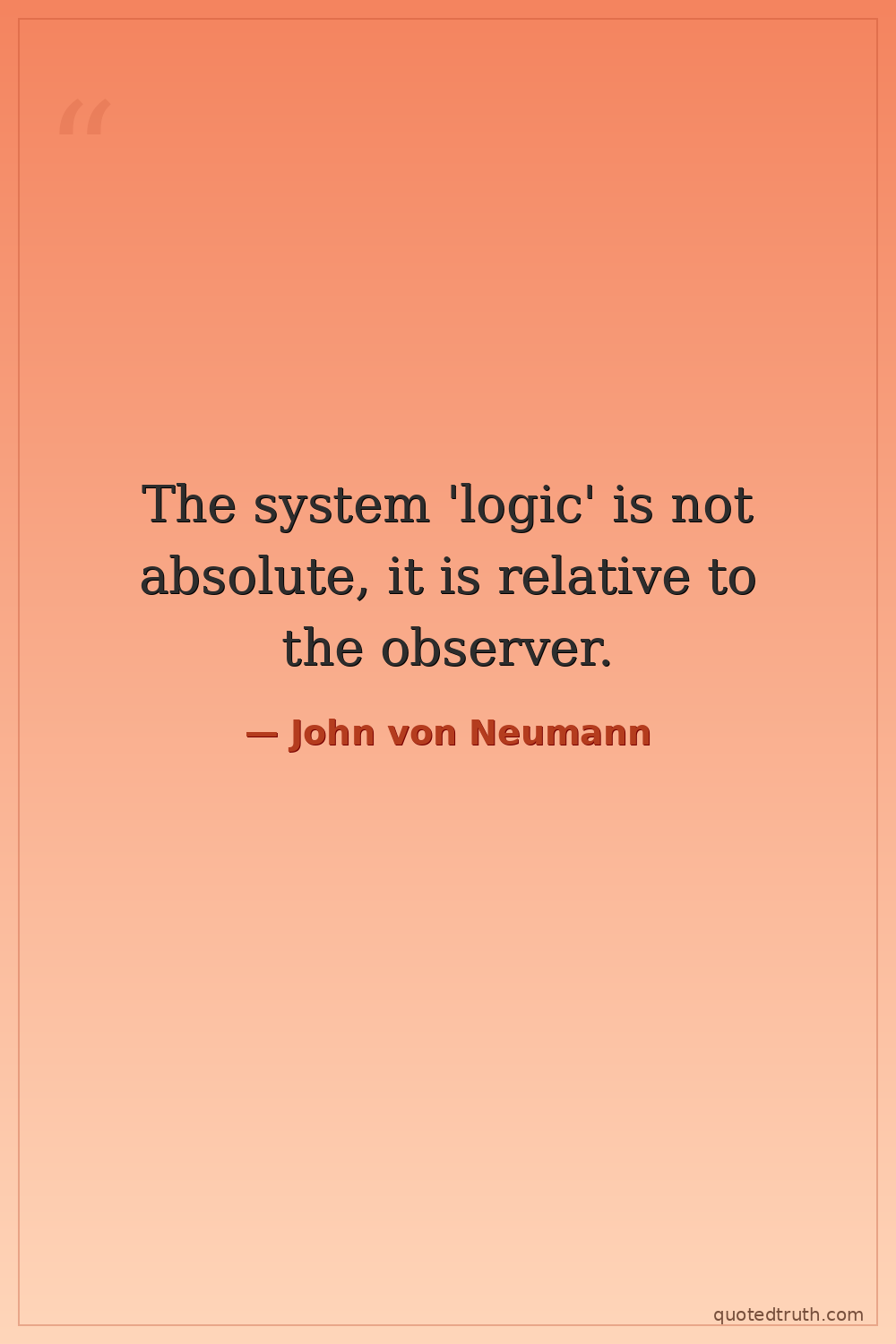
John von Neumann — "The system 'logic' is not absolute, it is relative to the observer."
The system 'logic' is not absolute, it is relative to the observer.
The system 'logic' is not absolute, it is relative to the observer.
Click any product to generate a realistic preview. Up to 3 at a time.
* Initial load can take up to 90 seconds — revising the preview in another color is nearly instant.
"Anyone who considers arithmetical methods of producing random digits is, of course, in a state of sin."
"Anyone who attempts to generate random numbers by deterministic means is, of course, living in a state of sin."
"The more precisely the position is determined, the less precisely the momentum is known in this instant, and vice versa."
"The more abstract a thing is, the more real it is."
"Mathematics is not a science. It is a language."
Found in 1 providers: grok
1 source checked
Logic isn't a single universal truth independent of context. Any logical system rests on chosen axioms and frameworks — change the starting assumptions and the conclusions change too. What appears logically valid from one vantage point may be incomplete or contradictory from another. Logic is a lens, not a mirror of absolute reality. The rules governing reasoning are constructed choices, not discovered absolutes floating free of human perspective or the system in which they operate.
Von Neumann helped rebuild mathematics on rigorous set-theoretic foundations, yet witnessed Gödel's 1931 incompleteness proof — which he grasped faster than nearly anyone — showing no consistent system proves all its own truths. In quantum mechanics he formalized how an observer's measurement collapses physical states, embedding subjectivity into physics itself. His game theory work showed rational strategy depends entirely on each player's information and assumptions, making logic inescapably perspectival rather than universal.
Von Neumann's career spanned radical intellectual disruption. Gödel overturned Hilbert's program, proving formal logic has irreducible limits. Einstein dissolved universal reference frames. Heisenberg made observation inseparable from outcome. Meanwhile the Manhattan Project forced scientists to confront how institutional logic — 'it can be built, therefore build it' — could lead to catastrophe. Absolute certainty in physics, mathematics, and ethics faced simultaneous assault, making the relativity of logical systems a lived scientific reality, not mere philosophy.
AI-generated insights based on extensive research and information for context. Factual errors? Email [email protected].
Your cart is empty