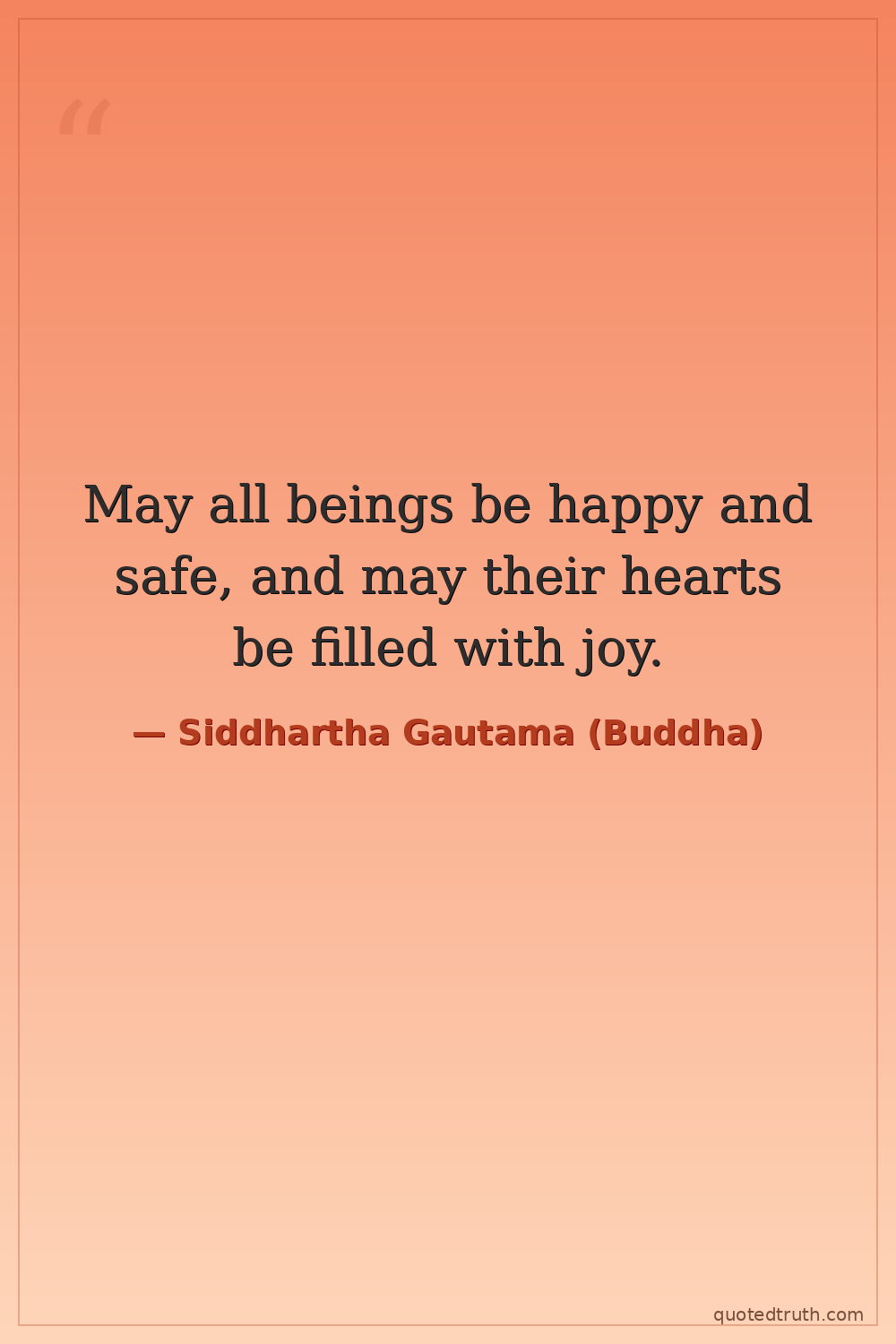
Siddhartha Gautama (Buddha) — "May all beings be happy and safe, and may their hearts be filled with joy."
May all beings be happy and safe, and may their hearts be filled with joy.
May all beings be happy and safe, and may their hearts be filled with joy.
Click any product to generate a realistic preview. Up to 3 at a time.
* Initial load can take up to 90 seconds — revising the preview in another color is nearly instant.
"The greatest gift is to give people your enlightenment, to share it. It has to be the greatest."
"The pleasant and the unpleasant, the agreeable and the disagreeable, are not in things themselves, but in us."
"Nothing can harm you as much as your own thoughts unguarded."
"Let them not do the slightest thing that the wise would later reprove."
"The virtues, like the Muses, are always seen in groups. A good principle was never found solitary in any breast."
A common translation of a phrase from the Metta Sutta (Snp 1.8), often used in metta meditation.
Date: c. 5th century BCE
GeneralFound in 1 providers: grok
1 source checked
This is a wish of unconditional goodwill extended to every living creature without exception. The speaker hopes everyone experiences well-being, physical safety from harm, and inner contentment. It is not limited to friends or family but reaches strangers, enemies, and even animals. The phrase expresses an attitude of universal kindness, asking that others thrive and feel genuine joy rather than fear, pain, or suffering in their daily existence.
This line comes directly from the Metta Sutta, a core teaching the Buddha gave on loving-kindness meditation. After abandoning his royal life in Kapilavastu and awakening under the Bodhi tree, he taught that cultivating boundless compassion toward all beings was essential to ending suffering. He rejected caste distinctions and extended moral concern to animals, which aligned with his refusal to sanction ritual sacrifice. The words reflect his lived practice of radical inclusivity and mental training.
In 5th-6th century BCE northern India, Vedic Brahmanism dominated with rigid caste hierarchies and animal sacrifices performed for spiritual merit. Society was stratified, and religious access was gated by birth. The Ganges plain was simultaneously undergoing the Second Urbanization, producing sixteen mahajanapadas and a class of wandering shramana ascetics who challenged orthodox authority. Extending unconditional goodwill to all beings, regardless of caste or species, was a direct counter to sacrificial religion and social exclusion.
AI-generated insights based on extensive research and information for context. Factual errors? Email [email protected].
Your cart is empty