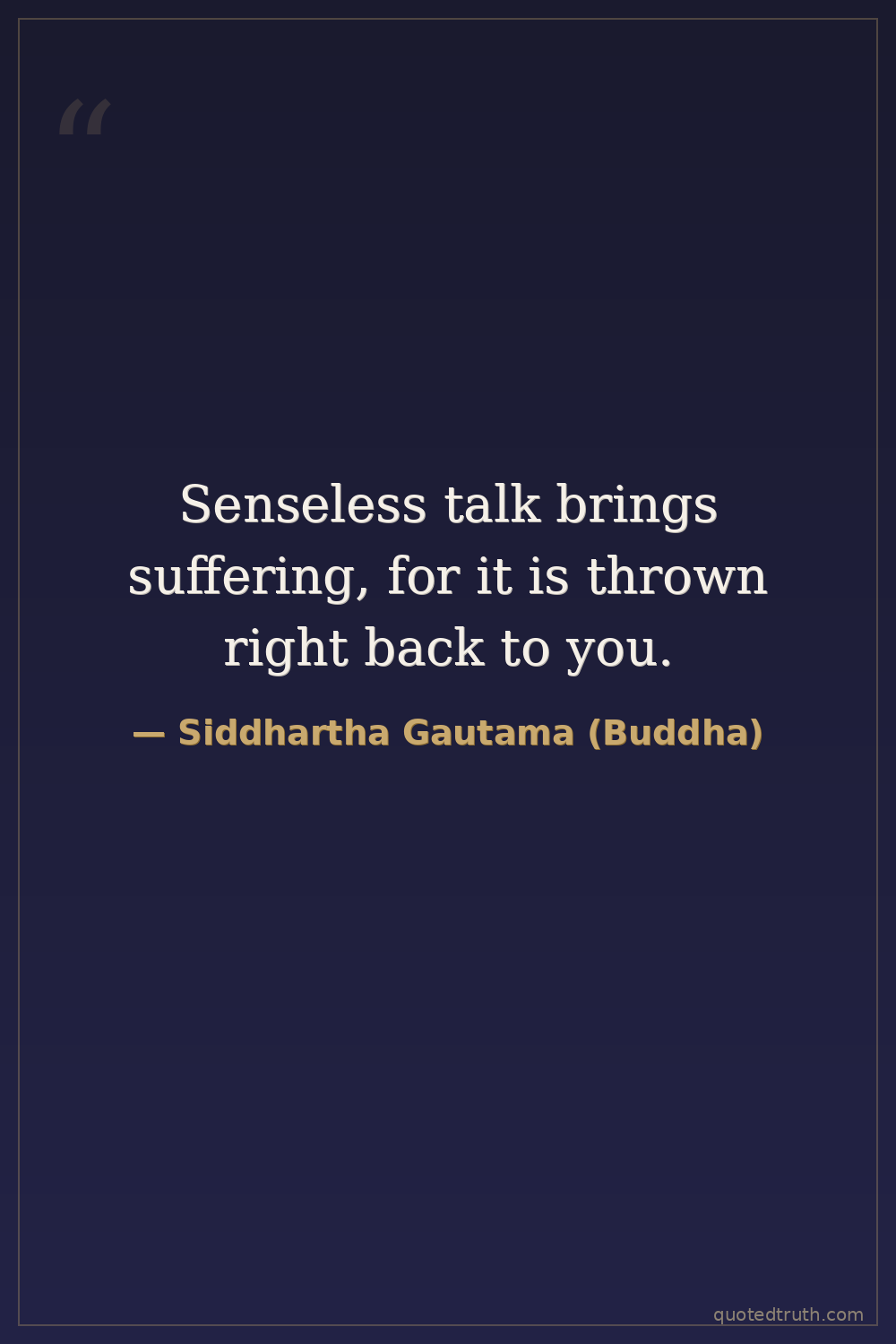
Siddhartha Gautama (Buddha) — "Senseless talk brings suffering, for it is thrown right back to you."
Senseless talk brings suffering, for it is thrown right back to you.
Senseless talk brings suffering, for it is thrown right back to you.
Click any product to generate a realistic preview. Up to 3 at a time.
* Initial load can take up to 90 seconds — revising the preview in another color is nearly instant.
"To abstain from all evil, to cultivate the good, and to purify one's mind — this is the teaching of all Buddhas."
"To be idle is a short road to death and to be diligent is a long road to life."
"Peace comes from within. Do not seek it without."
"When watching after yourself, you watch after others. When watching after others, you watch after yourself."
"The body, monks, is not self. If the body were the self, this body would not lend itself to dis-ease."
Found in 1 providers: gemini
1 source checked
Careless, thoughtless, or harmful speech creates consequences that circle back to the speaker. When you gossip, insult, or spread reckless words, the damage you cause eventually returns as damaged relationships, retaliation, lost trust, or inner turmoil. Words are not free actions; they plant seeds that grow into the conditions you later live inside. Speaking with awareness protects you as much as it protects those who hear you.
Right Speech is one of the eight limbs of Buddha's Noble Eightfold Path, requiring abstention from lying, divisive talk, harsh words, and idle chatter. After his enlightenment under the Bodhi tree, Siddhartha taught that karma operates through thought, word, and deed alike. As a wandering teacher who spent forty-five years guiding monks and laypeople through discourse, he understood speech as a primary spiritual discipline that shapes the speaker's own rebirth and suffering.
In 5th-century BCE northern India, the Buddha taught during the Shramana movement, when wandering ascetics debated Brahmin priests over ritual, caste, and liberation. Philosophical argument was a public sport, and reputations rose or fell on rhetorical skill. Oral transmission made speech sacred and dangerous: teachings, curses, and vows all carried binding weight. Against a culture of competitive debate and Vedic verbal ritual, Buddha's insistence that idle or harmful talk itself generates suffering was a radical ethical reframing.
AI-generated insights based on extensive research and information for context. Factual errors? Email [email protected].
Your cart is empty