Archimedes — "My mind is not limited by the bounds of the earth."
My mind is not limited by the bounds of the earth.
My mind is not limited by the bounds of the earth.
Click any product to generate a realistic preview. Up to 3 at a time.
* Initial load can take up to 90 seconds — revising the preview in another color is nearly instant.
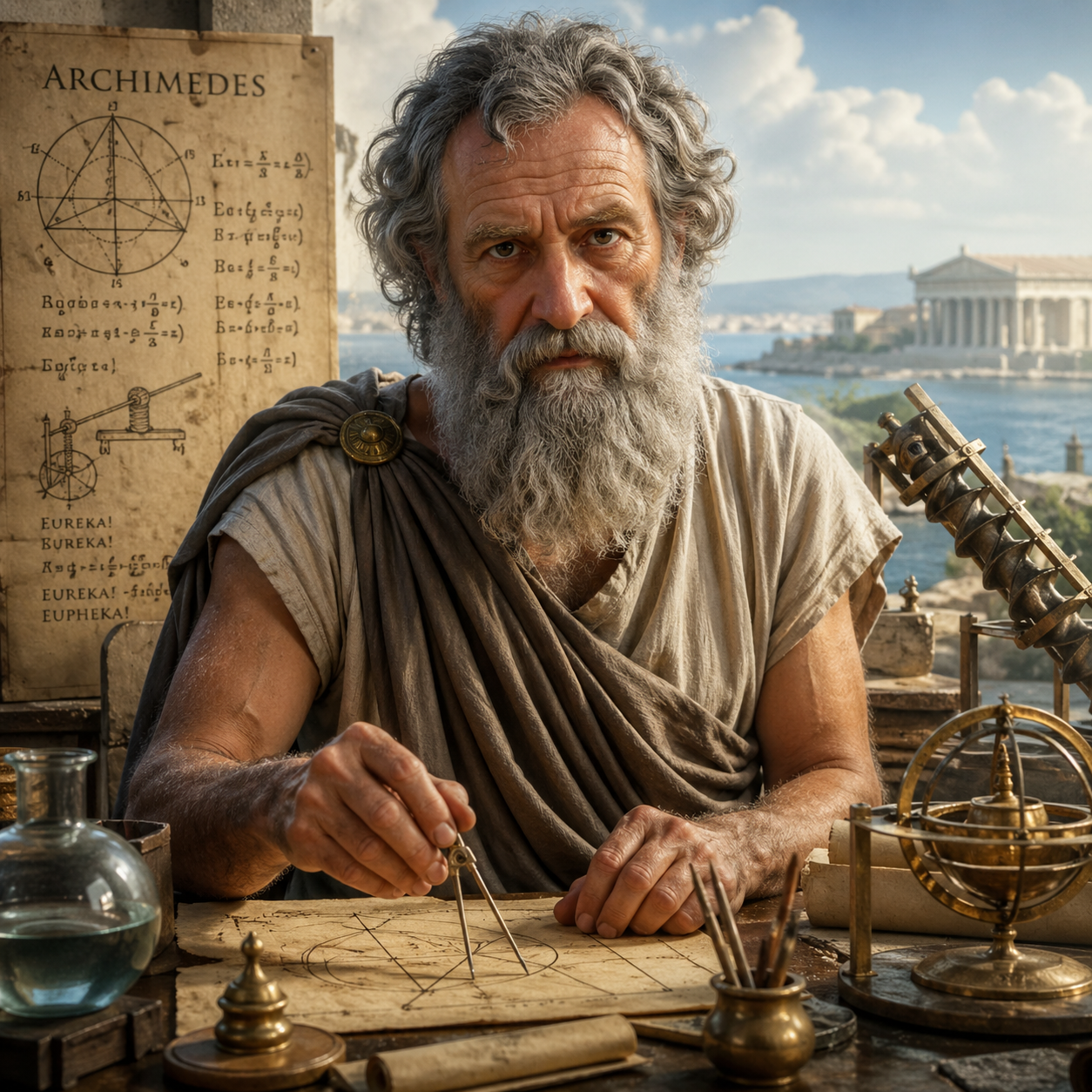
"The center of gravity of any triangle is the point of intersection of its medians."
"Eureka!"
"The surface of any segment of a sphere is equal to a circle whose radius is the straight line drawn from the vertex of the segment to any point on the circumference of its base."
"The value of pi is more than 3 10/71 and less than 3 1/7."
"I will show you how to calculate the number of grains of sand that would fit into the universe."
Found in 1 providers: grok
1 source checked
Human thought can transcend physical limits — it can reach beyond what the body experiences or the senses perceive. The mind explores abstract truths, infinite space, and mathematical realities that have no physical boundary. Pure reasoning operates in a realm where geography, gravity, and earthly constraints are irrelevant. This is an assertion that intellectual freedom is absolute, that curiosity and logic can probe any corner of reality regardless of where one physically exists.
Archimedes spent his life proving this true. He calculated pi, derived surface area and volume formulas for spheres and cylinders, and invented techniques prefiguring calculus — all through pure abstract reasoning. His law of the lever and buoyancy principle came from thinking beyond the obvious. Living in Syracuse while corresponding with Alexandria's scholars, his ideas traveled the ancient world, demonstrating that one man's mind could reshape human understanding of physics and mathematics forever.
In 3rd-century BC Greece, human knowledge was still largely bounded by Mediterranean coastlines and earthly observation. Philosophers debated whether the earth was spherical, astronomers tracked stars without telescopes, and Aristarchus had just proposed a heliocentric model few accepted. The Hellenistic era celebrated intellectual ambition — the Library of Alexandria was amassing all human knowledge — yet most believed divine forces controlled nature. Claiming the mind could reach beyond earthly bounds was quietly radical in that context.
AI-generated insights based on extensive research and information for context. Factual errors? Email [email protected].
Your cart is empty