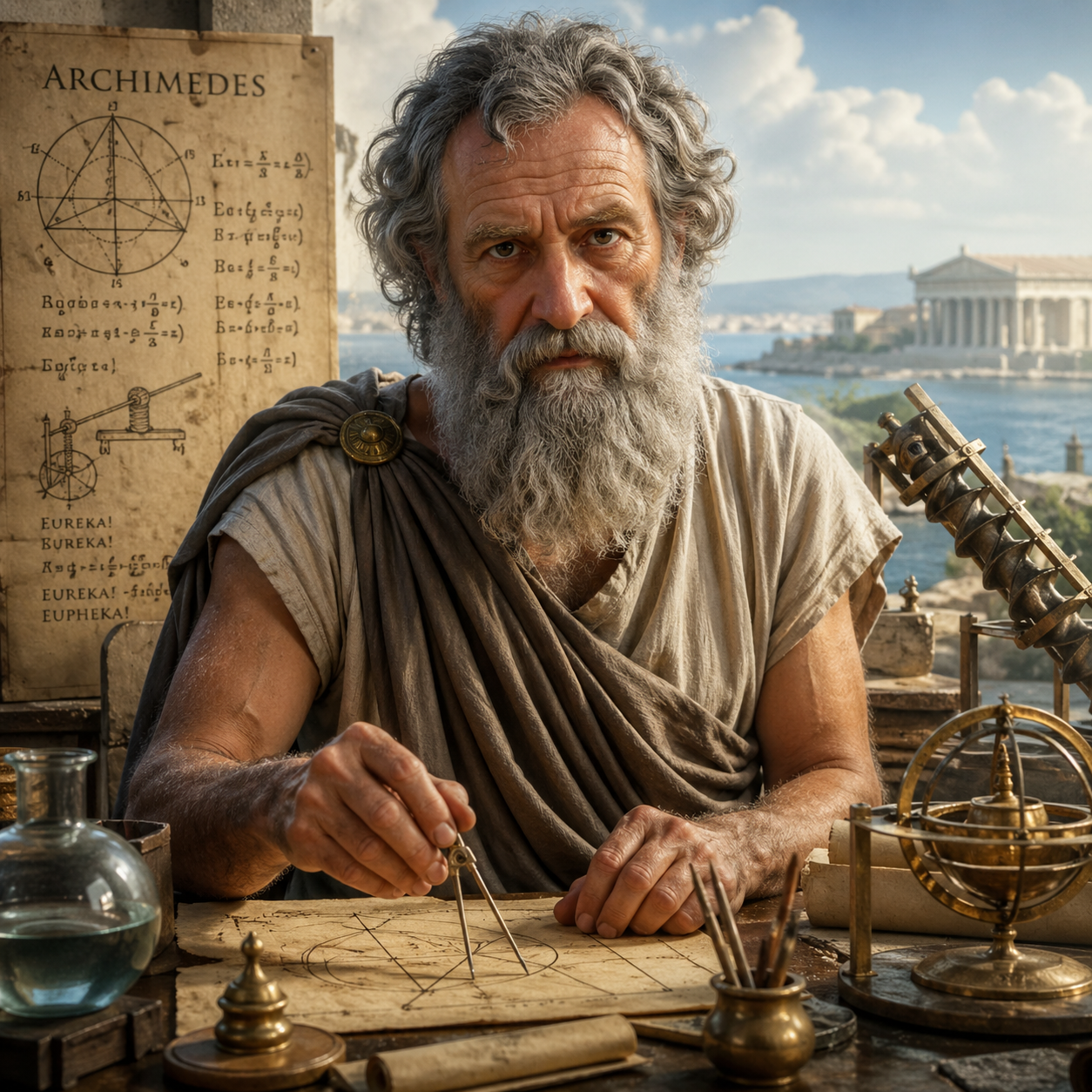
Archimedes — "Do not disturb my circles!"
Do not disturb my circles!
Do not disturb my circles!
Click any product to generate a realistic preview. Up to 3 at a time.
* Initial load can take up to 90 seconds — revising the preview in another color is nearly instant.
"No difficulty can be too great for the human mind, if it applies itself with diligence and skill."
"My inventions are not for war, but for the glory of science."
"He who understands the world well will not find it difficult to understand the laws that govern it."
"By a method of mechanical reasoning, I first discovered that the area of a segment of a parabola is four-thirds of the triangle with the same base and equal height."
"I have discovered a way to measure the circumference of the Earth."
Allegedly said to a Roman soldier before being killed during the Siege of Syracuse
Date: 212 BCE
GeneralFound in 2 providers: deepseek,grok
2 sources checked
A demand to be left alone at the moment of deepest intellectual concentration. The quote expresses that the life of the mind — specifically, an unfinished proof — outweighs all external interruption, even mortal danger. In modern terms: the ultimate 'do not disturb,' spoken not from rudeness but from total absorption in work that feels more real and urgent than the physical world pressing in around it.
Archimedes spent his life mastering circles — calculating pi to unprecedented precision, proving the sphere-cylinder volume ratio, using circular geometry to derive areas and volumes via exhaustion. These were literally sand diagrams he drew and redrew. His reported last words before a Roman soldier killed him reveal his defining trait: a mathematician so consumed by geometric truth that protecting an unfinished diagram mattered more to him than preserving his own life.
Spoken during the Roman sack of Syracuse in 212 BC, after Archimedes' war machines — catapults, cranes, burning mirrors — had held Rome's legions at bay for two years. In antiquity, mathematical knowledge lived only in physical diagrams scratched in sand or wax; no printing, no widespread manuscripts. Erasing those circles meant erasing irreplaceable thought. The Roman soldier who ignored the plea destroyed one of the ancient world's greatest mathematical minds mid-proof.
AI-generated insights based on extensive research and information for context. Factual errors? Email [email protected].
Your cart is empty