Thomas Edison — "My principal business is to be a failure. I fail in a great many things. Every t…"
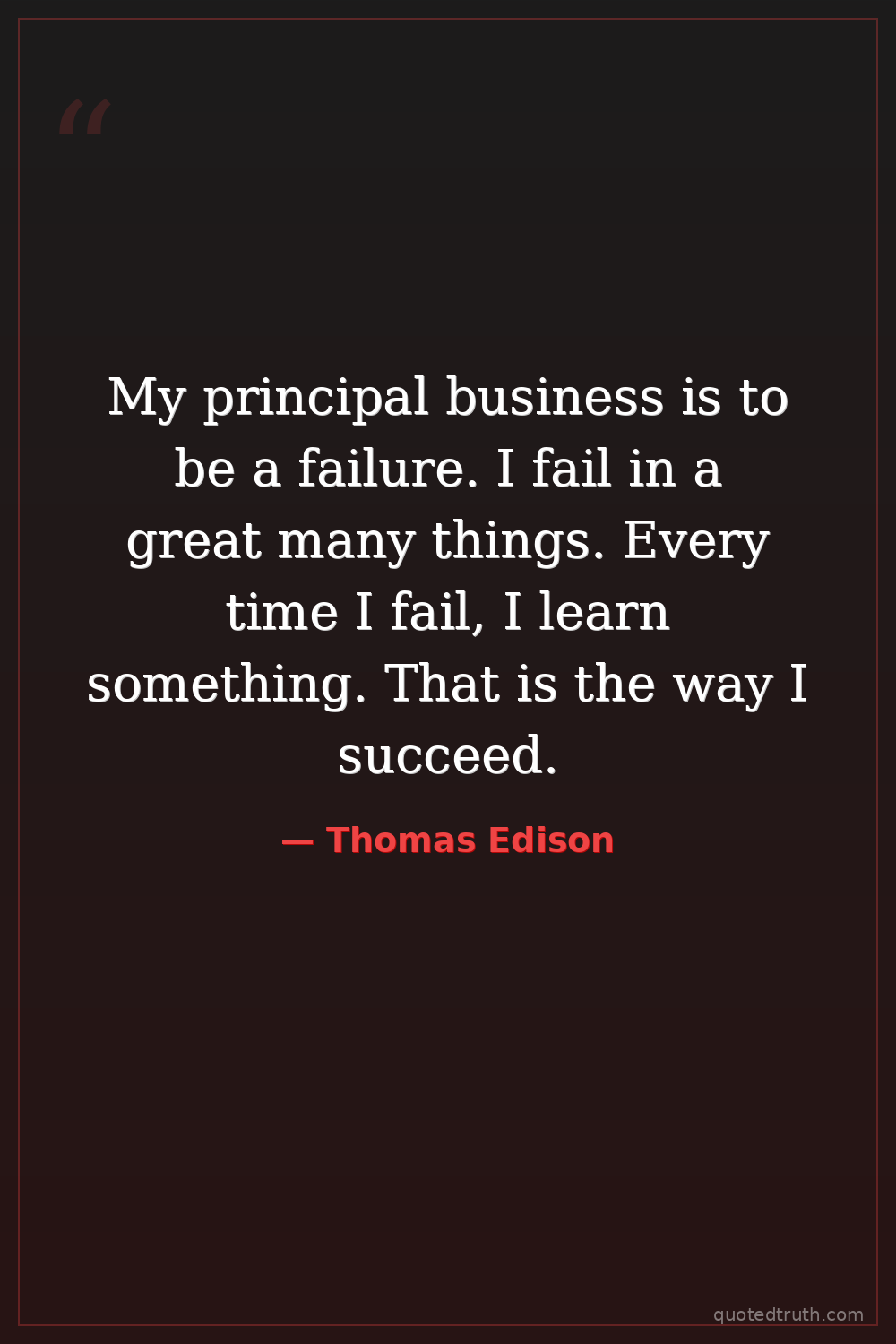
My principal business is to be a failure. I fail in a great many things. Every time I fail, I learn something. That is the way I succeed.
My principal business is to be a failure. I fail in a great many things. Every time I fail, I learn something. That is the way I succeed.
Click any product to generate a realistic preview. Up to 3 at a time.
* Initial load can take up to 90 seconds — revising the preview in another color is nearly instant.
"I don't believe in the supernatural. I believe in nature, and I believe in science."
"The greatest invention of all time is the human mind."
"It is not because things are difficult that we do not dare; it is because we do not dare that they are difficult."
"There's a way to do it better - find it."
"I can hire half of the people in the country to do the thinking for me, but I can't hire people to be enthusiastic."
Found in 1 providers: grok
1 source checked
Edison reframes failure as the actual engine of progress. Rather than treating setbacks as evidence of inadequacy, he claims them as his primary occupation, because each unsuccessful attempt eliminates a wrong path and teaches something concrete. Success, in this view, is not the opposite of failure but the accumulated result of it. Keep trying, keep losing, extract the lesson, and eventually the working answer emerges from the pile of discarded ones.
Edison famously tested thousands of filament materials before landing on carbonized bamboo for the incandescent bulb, and ran his Menlo Park lab on systematic trial-and-error rather than theory. He held 1,093 US patents, many built atop earlier dead ends. His quip that genius is 'one percent inspiration, ninety-nine percent perspiration' captures the same ethos: iterative persistence, not flashes of brilliance, is what produced the phonograph, the motion picture camera, and the electrical grid.
Edison worked during the late-19th-century Second Industrial Revolution, when electricity, telegraphy, and mass manufacturing were being invented in real time. Menlo Park, opened in 1876, was arguably the world's first industrial research lab, inventing the process of invention itself. There were no textbooks for what he was attempting; progress meant thousands of empirical tests. His framing of failure as tuition fit an era where inventors raced rivals like Tesla and Westinghouse to commercialize entirely new physical phenomena.
AI-generated insights based on extensive research and information for context. Factual errors? Email [email protected].
Your cart is empty