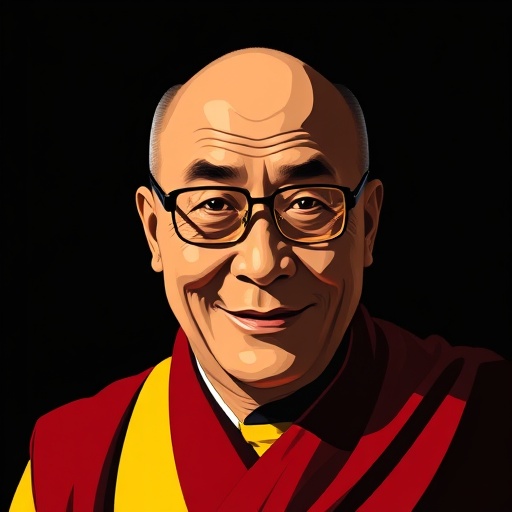
Dalai Lama (14th) — "My whole life has been dedicated to the cause of peace and non-violence."
My whole life has been dedicated to the cause of peace and non-violence.
My whole life has been dedicated to the cause of peace and non-violence.
Click any product to generate a realistic preview. Up to 3 at a time.
* Initial load can take up to 90 seconds — revising the preview in another color is nearly instant.
"I consider myself a son of India."
"My father was a farmer, my mother was a farmer. My family was very poor."
"I am an old man, but I still have a lot of energy. I think it's because I have a lot of hope."
"If scientific analysis were conclusively to demonstrate certain claims in Buddhism to be false, then we must accept the findings of science and abandon those claims."
"Sometimes I think I am a little bit naughty, a little bit mischievous."
Found in 1 providers: grok
1 source checked
A personal declaration of total, lifelong commitment to peace and non-violence — not as abstract ideals but as the organizing principles of an entire existence. It signals that every decision, sacrifice, and action was filtered through these two values. Dedicating a whole life implies consistency under pressure: staying true even when circumstances made it costly, politically inconvenient, or when others demanded a harder response.
Tenzin Gyatso has lived this literally. Enthroned at 15 during China's invasion of Tibet, he fled to Indian exile in 1959 and spent over six decades advocating his 'Middle Way' — genuine autonomy through dialogue, not armed resistance. Despite occupation, cultural erasure, and mass suffering of Tibetans, he refused to endorse violence against China. The 1989 Nobel Peace Prize explicitly recognized this sustained commitment maintained under extraordinary and ongoing political pressure.
The 14th Dalai Lama's lifetime spans history's most violent century into the present — Cold War proxy conflicts, nuclear brinksmanship, the Cultural Revolution's systematic destruction of Tibetan monasteries, Tiananmen Square, and post-9/11 counterterrorism normalization. Non-violence as a political strategy faced its harshest tests against states wielding modern military force. His sustained advocacy proved globally influential, helping legitimize peaceful resistance movements and contributing to Buddhist ethics entering mainstream Western political and humanitarian discourse.
AI-generated insights based on extensive research and information for context. Factual errors? Email [email protected].
Your cart is empty