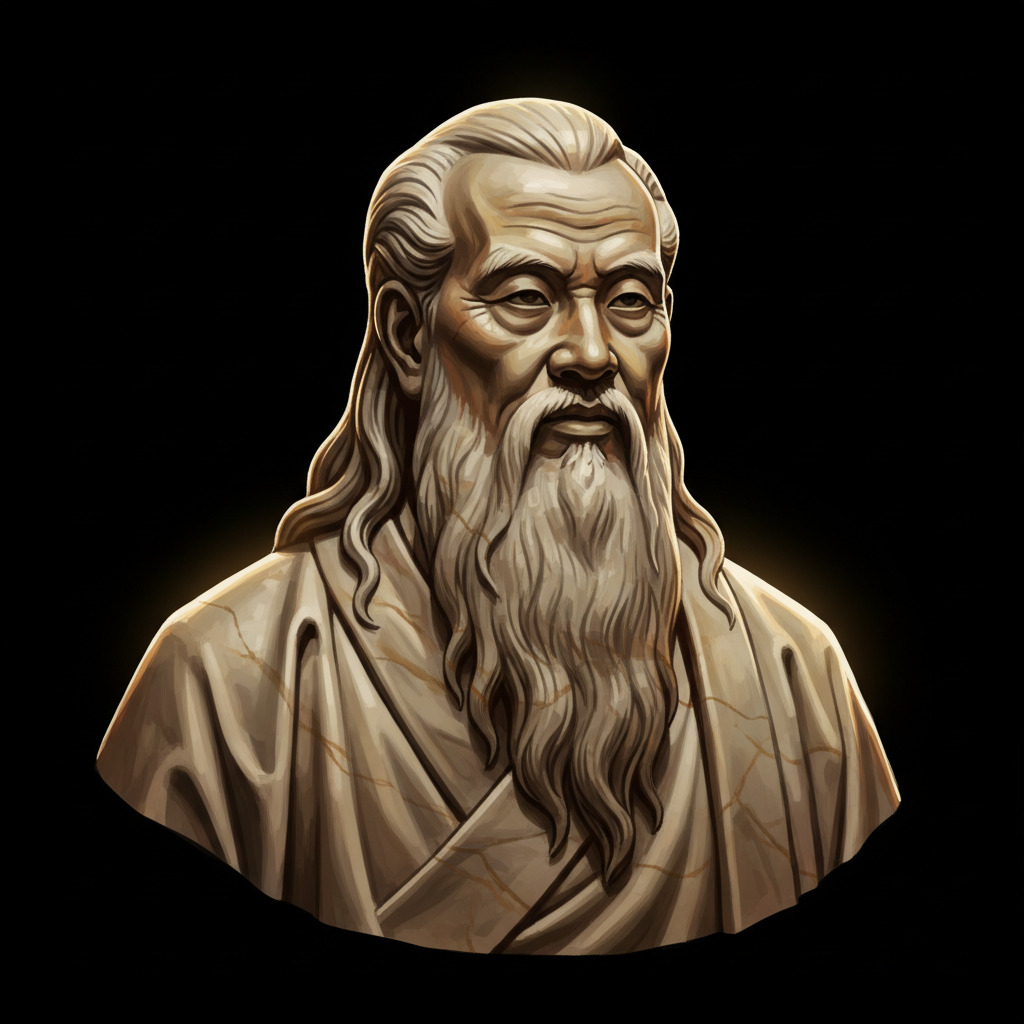
Laozi — "Nature does not hurry, yet everything is accomplished."
Nature does not hurry, yet everything is accomplished.
Nature does not hurry, yet everything is accomplished.
Click any product to generate a realistic preview. Up to 3 at a time.
* Initial load can take up to 90 seconds — revising the preview in another color is nearly instant.
"Careful, like crossing a river in the winter. Wary, as if surrounded by strangers."
"To lead people, walk behind them."
"The sage knows without traveling, perceives without looking, completes without acting."
"Because of the great love, one is courageous."
"The best way to manage is to manage very little."
Reputed founder of Taoism and author of the Tao Te Ching, whose wu wei (effortless action) shaped East Asian philosophy. Closely associated with Zhuangzi (later Taoist who extended Laozi's framework). For an intellectual contrast, see Confucius, near-contemporary Chinese sage of social ritual and duty — Confucius systematized social order through ritual and hierarchy; Laozi argued that all such systems were the disease, not the cure — the two founding poles of Chinese moral philosophy.
Attributed, a summary of a Taoist principle rather than a direct quote.
Date: Unknown
GeneralFound in 1 providers: grok
1 source checked
Real progress does not require rushing or forcing outcomes. Natural systems operate at their own pace, allowing seasons, growth, and change to unfold without strain, yet still reach completion. The saying urges people to stop equating speed with productivity. Patience, steady effort, and trust in timing often produce better results than frantic activity. Slowing down is not laziness; it is alignment with how things actually get done.
Laozi taught wu wei, or effortless action, the idea that aligning with the natural flow beats forcing outcomes. Traditionally described as a quiet archivist in the Zhou royal court, he valued humility, simplicity, and withdrawal from political striving. Legend says he left civilization on a water buffalo after dictating the Tao Te Ching. This quote distills his core belief that the Tao, the way of nature, accomplishes everything without hurry or ego.
Laozi lived during China's late Zhou dynasty, likely the 6th century BCE, an era of collapsing feudal order and constant warfare among rival states. Rulers chased power through armies, laws, and Confucian ritual reform. Against that anxious striving, Taoism offered a counter-philosophy: retreat, observe nature, stop meddling. Farmers still lived by seasonal rhythms, so comparing human effort to nature's unhurried accomplishment resonated deeply in a society exhausted by ambition and war.
AI-generated insights based on extensive research and information for context. Factual errors? Email [email protected].
Your cart is empty