Laozi — "Fill your bowls to the brim and they will spill. Sharpen your blade to the sharp…"
Fill your bowls to the brim and they will spill. Sharpen your blade to the sharpest and it will soon blunt.
Fill your bowls to the brim and they will spill. Sharpen your blade to the sharpest and it will soon blunt.
Click any product to generate a realistic preview. Up to 3 at a time.
* Initial load can take up to 90 seconds — revising the preview in another color is nearly instant.
"The Tao is always nameless. When it is carved, it becomes names. As soon as there are names, know that it is time to stop. Knowing when to stop, one can be free from danger."
"The sage is like water, which flows to the lowest places and yet is the strongest."
"Those who know when to halt are unharmed."
"Simplicity, patience, compassion. These three are your greatest treasures."
"To yield is to be preserved whole."
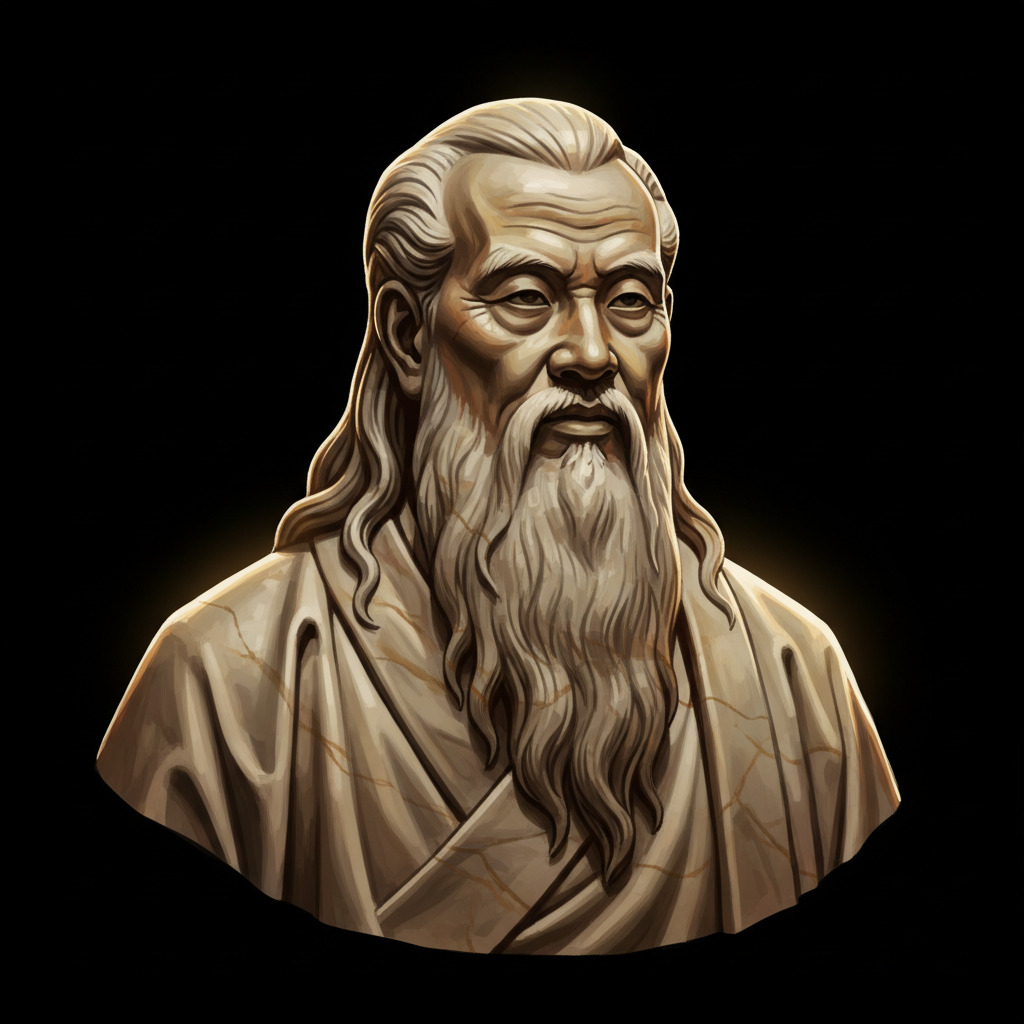
Reputed founder of Taoism and author of the Tao Te Ching, whose wu wei (effortless action) shaped East Asian philosophy. Closely associated with Zhuangzi (later Taoist who extended Laozi's framework). For an intellectual contrast, see Confucius, near-contemporary Chinese sage of social ritual and duty — Confucius systematized social order through ritual and hierarchy; Laozi argued that all such systems were the disease, not the cure — the two founding poles of Chinese moral philosophy.
Found in 1 providers: gemini
1 source checked
Pushing anything to its absolute limit guarantees loss. A bowl filled past capacity overflows; a blade honed to maximum sharpness chips and dulls faster than a moderately sharp one. The lesson is that excess and extremes are self-defeating. Moderation preserves what you have, while striving for perfection or accumulation beyond what's needed invites the very failure you were trying to avoid. Knowing when to stop is itself a form of mastery.
Laozi served as a royal archivist in the Zhou court, observing firsthand how rulers who grasped for more power, wealth, and control often triggered their own downfall. His philosophy of wu wei, effortless action, and his preference for softness over rigidity directly shaped this saying. Legend holds he left civilization disillusioned by its striving, writing the Tao Te Ching as a final testament to restraint, humility, and returning to natural simplicity rather than accumulation.
Laozi lived during the late Zhou dynasty, likely the 6th century BCE, as centralized authority crumbled into the Warring States period. Feudal lords hoarded armies, land, and grain, sharpening every advantage against rivals, and most collapsed from overreach. Confucius was codifying rigid social hierarchy as the answer, while Laozi offered the opposite: hollow out ambition, yield, and endure. The imagery of overfilled bowls and over-honed blades spoke directly to princes watching neighbors destroy themselves through excess.
AI-generated insights based on extensive research and information for context. Factual errors? Email [email protected].
Your cart is empty