Francis Crick — "No important discovery is ever made without a 'mad' guess."
No important discovery is ever made without a 'mad' guess.
No important discovery is ever made without a 'mad' guess.
Click any product to generate a realistic preview. Up to 3 at a time.
* Initial load can take up to 90 seconds — revising the preview in another color is nearly instant.
"The purpose of science is to make the mysterious obvious."
"If you want to get ahead in science, you have to be a bit of a maverick."
"We are nothing but a pack of neurons."
"The universe is a cold, dark, indifferent place."
"The future of biology is in the brain."
Found in 1 providers: grok
1 source checked
Crick argues that genuine breakthroughs require leaps of intuition that seem irrational or reckless at the time. Pure logic and incremental reasoning rarely produce revolutionary insight; instead, scientists must risk a bold, almost wild speculation that goes beyond available evidence. The 'mad' guess is not carelessness but creative daring, the willingness to entertain an idea everyone else dismisses, and then chase it until evidence either confirms or kills it.
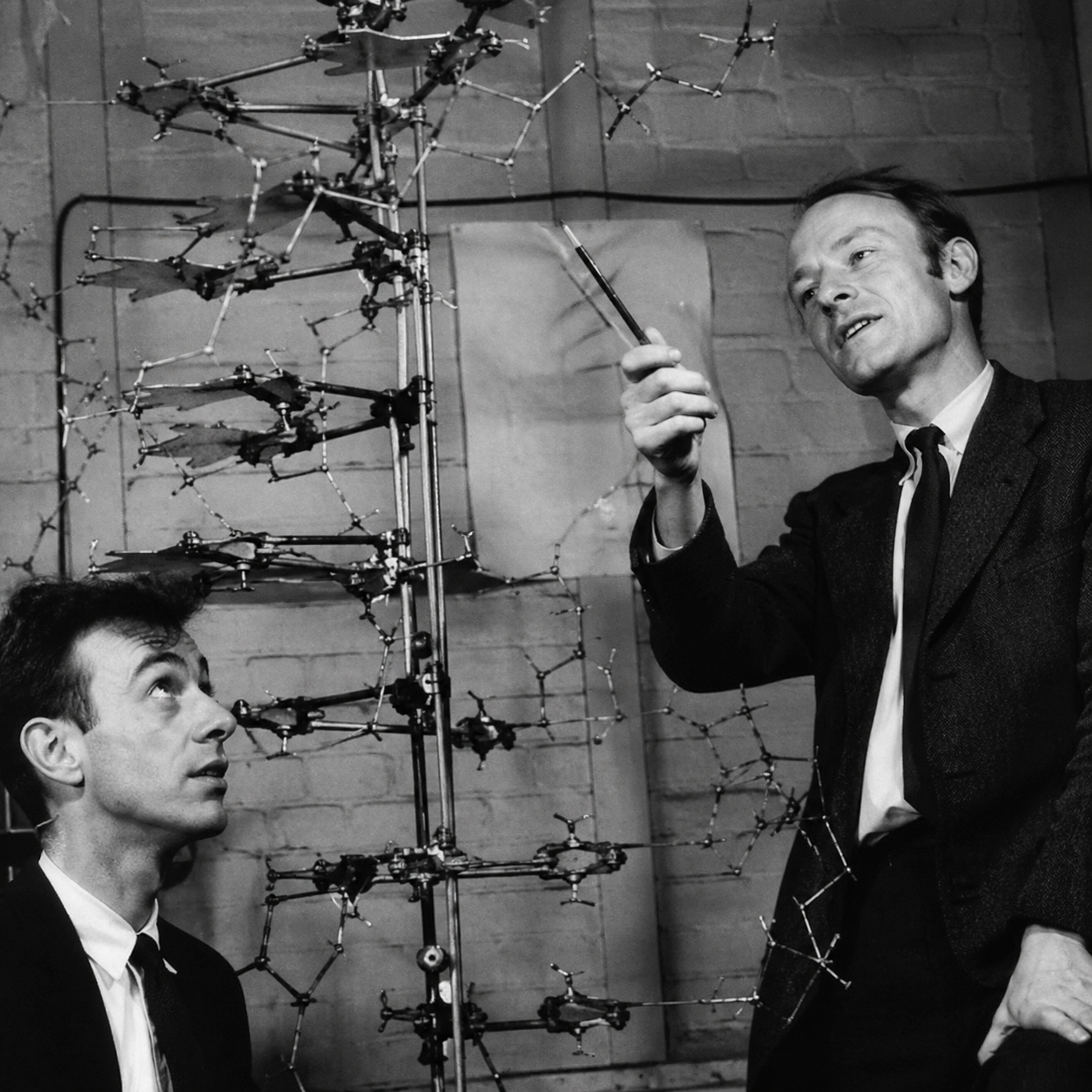
Crick lived this principle. With James Watson in 1953, he proposed the double-helix structure of DNA partly through audacious model-building rather than waiting for complete crystallographic proof. He later made another speculative leap proposing the central dogma of molecular biology, and in his final decades pivoted entirely to consciousness research, again gambling reputation on territory most biologists considered untouchable. Bold conjecture, then rigorous testing, defined his method.
Crick worked in postwar Britain as molecular biology was being invented at Cambridge's Cavendish Laboratory. X-ray crystallography, Linus Pauling's chemistry, and Schrödinger's 'What Is Life?' had primed scientists to crack the gene's physical basis. The race was crowded and underfunded, and competing teams at King's College and Caltech were closing in. In that climate, careful incrementalism risked losing priority entirely, rewarding researchers willing to guess boldly and verify fast.
AI-generated insights based on extensive research and information for context. Factual errors? Email [email protected].
Your cart is empty