Francis Crick — "We were searching for a structure so simple and beautiful that it had to be true…"
We were searching for a structure so simple and beautiful that it had to be true.
We were searching for a structure so simple and beautiful that it had to be true.
Click any product to generate a realistic preview. Up to 3 at a time.
* Initial load can take up to 90 seconds — revising the preview in another color is nearly instant.
"The central dogma of molecular biology."
"The idea that man was created in God's image is a myth."
"The origin of life is a scientific problem."
"I'm not a philosopher, I'm a scientist."
"The universe is a strange place."
Found in 1 providers: deepseek
1 source checked
Science often reaches truth through elegance. When a solution is so clean and internally consistent that it feels inevitable, that aesthetic rightness becomes evidence of correctness. It's the conviction that nature operates through simple, symmetrical principles — and that a model's beauty, its parsimony and harmony, validates it before experiments confirm it. Complexity signals you're wrong; elegance signals you're getting warm.
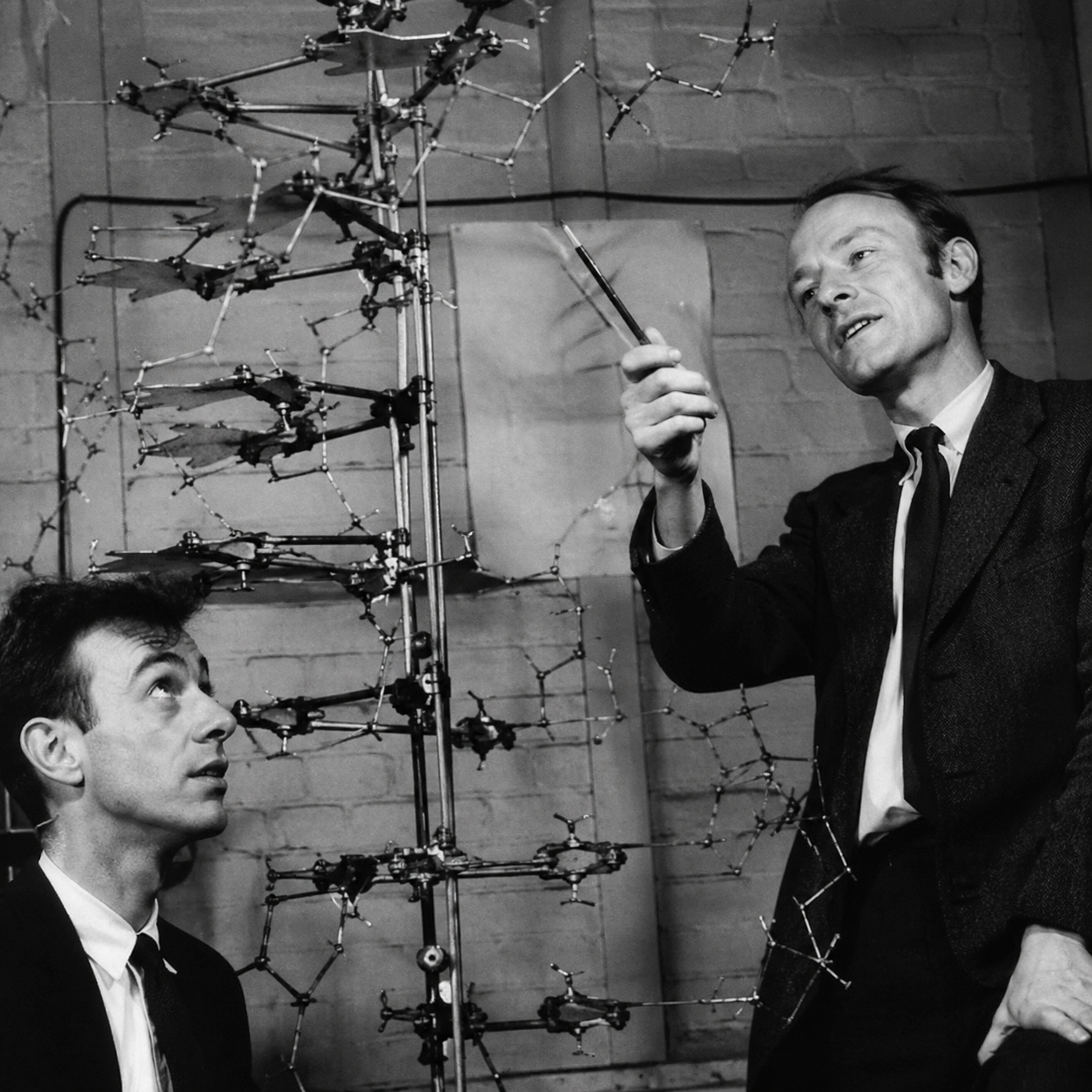
Francis Crick, working with James Watson in 1953, was driven by a conviction that DNA's structure would be geometrically beautiful — and the double helix proved exactly that. Crick had a physicist's instinct that biological mechanisms would obey elegant rules. He prioritized model-building over raw data collection, trusting that the right architecture would reveal itself through structural logic. His later work on consciousness similarly sought deep, simple principles beneath complex phenomena.
The early 1950s were the dawn of molecular biology. Scientists were racing to explain how hereditary information was stored and copied — a problem that had stumped biology for decades. Cold War competition accelerated the race between British and American labs. X-ray crystallography had just made atomic structures visible. The discovery of the double helix in 1953 was a paradigm shift, revealing that life's most fundamental mechanism ran on a breathtakingly simple geometric code.
AI-generated insights based on extensive research and information for context. Factual errors? Email [email protected].
Your cart is empty