Dmitri Mendeleev — "No law of nature, however general, has been established all at once; its recogni…"
No law of nature, however general, has been established all at once; its recognition has always been preceded by many presentiments.
No law of nature, however general, has been established all at once; its recognition has always been preceded by many presentiments.
Click any product to generate a realistic preview. Up to 3 at a time.
* Initial load can take up to 90 seconds — revising the preview in another color is nearly instant.
"The most important thing for a scientist is to be honest with himself and with others."
"The future of the Russian nation lies in the hands of the schoolmaster and the priest."
"The invisible world of chemical atoms is still waiting for the creator of chemical mechanics."
"I think that scientific predictions, if they are to be truly scientific, must be capable of being disproven."
"I have achieved neither fame nor wealth, but I have learned to know the human heart."
Describing the gradual and intuitive nature of scientific discovery.
Date: Undated
PhilosophicalFound in 1 providers: gemini
1 source checked
Big scientific truths don't arrive in a single flash of insight. Before any universal principle gets accepted, countless thinkers have already sensed pieces of it, guessed at patterns, and made partial attempts. Recognition comes only after this long buildup of hunches, near-misses, and incomplete theories. The final person who states the law clearly stands on a foundation built by many predecessors whose intuitions pointed toward the same underlying reality.
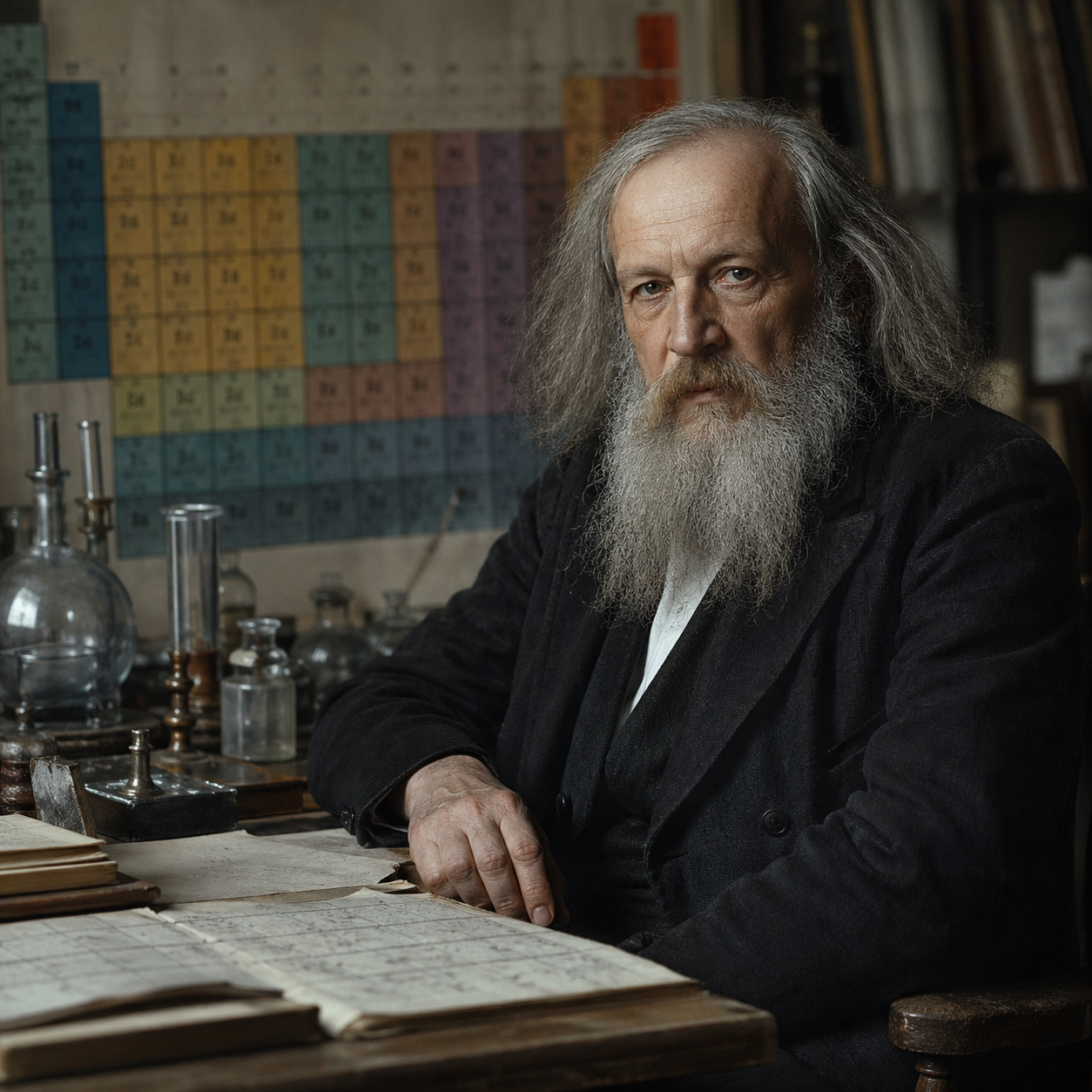
Mendeleev lived this truth when formulating the periodic table in 1869. Chemists before him—Döbereiner's triads, Newlands' octaves, Meyer's curves—had glimpsed elemental patterns without fully grasping them. Mendeleev synthesized these presentiments into a coherent law, even predicting undiscovered elements like gallium and germanium. His humility here acknowledges that his breakthrough rested on decades of partial insights from colleagues whose work he respected and built upon.
The 19th century was chemistry's great cataloging era. Dozens of new elements had been isolated, atomic weights measured, and spectroscopy born, but the discipline lacked organizing principles. Scientists across Europe—Russia, Germany, England, France—raced to find patterns in elemental behavior. This was also the age of Darwin and Maxwell, when grand unifying laws were transforming every science, making Mendeleev's reflection on cumulative discovery especially resonant.
AI-generated insights based on extensive research and information for context. Factual errors? Email [email protected].
Your cart is empty