Dmitri Mendeleev — "The progress of science is a series of corrections."
The progress of science is a series of corrections.
The progress of science is a series of corrections.
Click any product to generate a realistic preview. Up to 3 at a time.
* Initial load can take up to 90 seconds — revising the preview in another color is nearly instant.
"I saw in a dream a table where all the elements fell into place as required. Awakening, I immediately wrote it down on a piece of paper, only in one place did a correction later seem necessary."
"I have been called a charlatan, a madman, and a dreamer, but I have always pursued the truth."
"It is easier to make a scientific discovery than to explain it to the common man."
"My main interest is to help my country, Russia, develop its industrial capacity."
"I have always been a practical man, and my science is for the benefit of mankind."
Found in 1 providers: grok
1 source checked
Science does not advance by sudden leaps to final truths. Instead, it moves forward when researchers notice errors in existing ideas, test them, and revise what was previously accepted. Every new discovery usually amends or refines something earlier thinkers believed. Knowledge is built incrementally through this ongoing process of checking, challenging, and updating. What counts as progress is really the willingness to admit mistakes and replace flawed understanding with better-supported explanations.
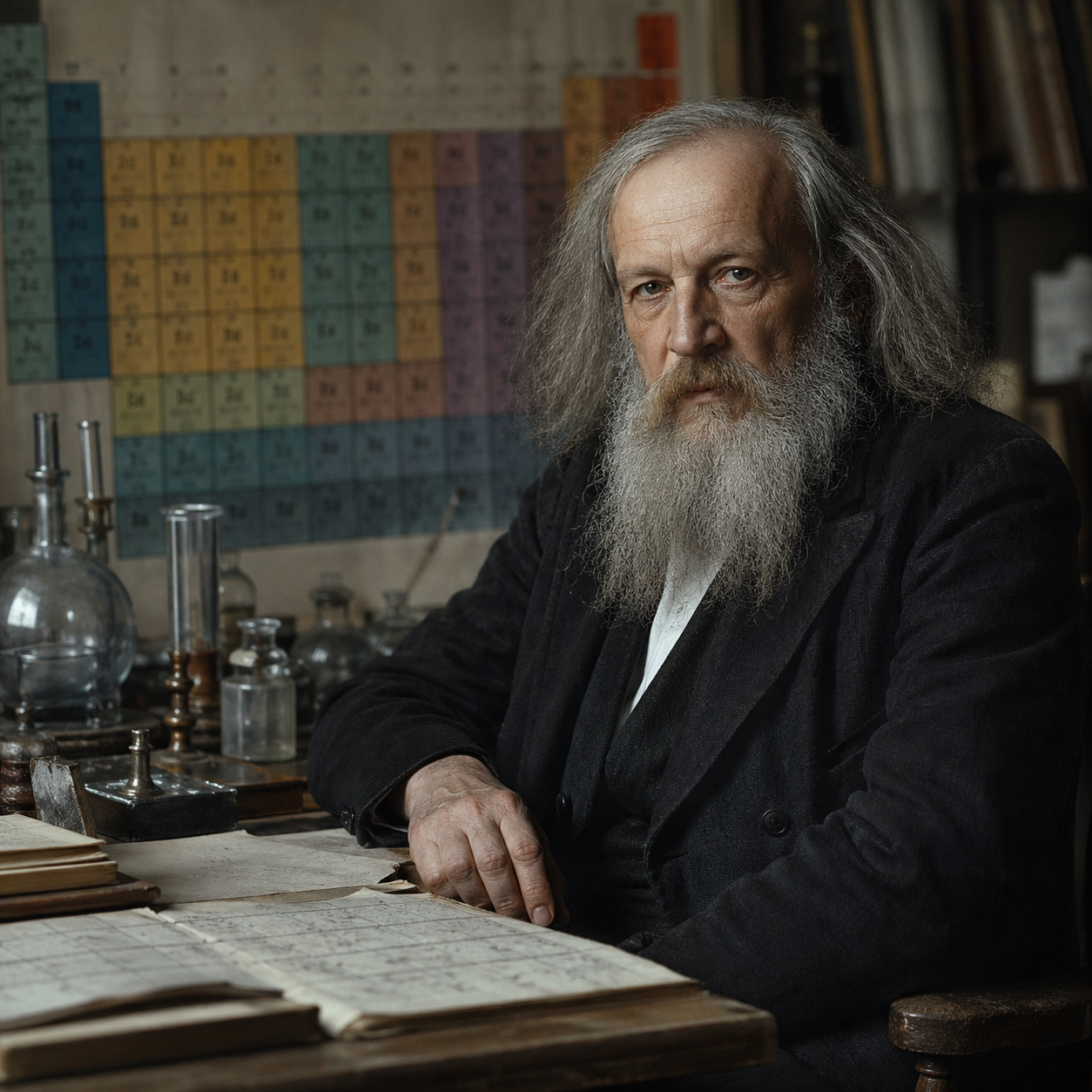
Mendeleev lived this principle when constructing the periodic table in 1869. He deliberately left gaps for undiscovered elements and predicted their properties, knowing his arrangement would need adjustment as evidence accumulated. He also corrected accepted atomic weights of elements like beryllium and uranium when they conflicted with periodic patterns. His willingness to revise established data and expect future refinement embodied the view that chemistry advances through disciplined self-correction rather than fixed dogma.
Mendeleev worked during the nineteenth-century chemical revolution, when atomic weights were disputed, element discoveries arrived constantly, and competing classification schemes circulated across Europe. The 1860 Karlsruhe Congress had just standardized atomic weight conventions, enabling systematic comparison. Industrialization demanded reliable chemistry for metallurgy, dyes, and agriculture. Within this turbulent landscape of shifting data and rival theories, scientists routinely overturned each other's conclusions, making correction and revision the visible engine of genuine progress.
AI-generated insights based on extensive research and information for context. Factual errors? Email [email protected].
Your cart is empty