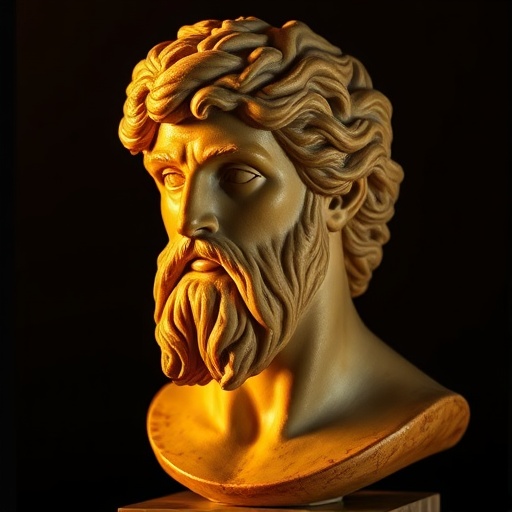
Pythagoras — "Number is the within of all things."
Number is the within of all things.
Number is the within of all things.
Click any product to generate a realistic preview. Up to 3 at a time.
* Initial load can take up to 90 seconds — revising the preview in another color is nearly instant.
"All is number."
"Hate and fear breed a poison in the blood, which if continued, affects eyes, ears, nose, and the organs of digestion."
"Number is the ruler of forms and ideas, and the cause of gods and daemons."
"Sacrifice an odd number to the celestial gods, and to the infernal an even."
"Geometry is knowledge of the eternally existent."
Greek philosopher and mathematician whose school in Croton combined geometry (the Pythagorean theorem), number-mysticism, and a religious-vegetarian way of life. Closely associated with Thales of Miletus (earlier pre-Socratic and the first philosopher). For an intellectual contrast, see Heraclitus, pre-Socratic Greek philosopher of flux — Heraclitus called Pythagoras 'the chief of swindlers' — among the founding insults of the philosophical-rivalry tradition. Their 'all is flux' vs 'all is number' poles still organize the philosophy of mathematics today (Platonist vs anti-realist).
Found in 2 providers: deepseek,gemini
2 sources checked
Everything that exists has number as its deepest nature — not as a label applied from outside, but as what things fundamentally are. Harmony, shape, motion, and proportion all reduce to numerical relationships. This isn't mysticism; it's the claim that reality is structured mathematically, that understanding something means grasping its numerical ratios and patterns. Modern physics, which describes the universe through equations, echoes this exact conviction.
Pythagoras discovered that musical consonance — octaves, fifths, fourths — maps precisely to simple integer ratios, convincing him numbers govern nature itself. His theorem revealed an eternal numerical truth about triangles. He founded a brotherhood in Croton treating mathematics as sacred philosophy, not mere calculation. He likely coined 'cosmos' to mean ordered universe. For Pythagoras, number wasn't a human invention but the universe's native language, shaping every aspect of his community's beliefs.
In 6th-century BCE Greece, pre-Socratic thinkers competed to name reality's single underlying substance — water, air, fire. Pythagoras proposed something unprecedented: not a material but an abstract principle. This coincided with Greek mathematics maturing from practical land-measurement into theoretical geometry, and with trade economies making numerical precision commercially vital. His claim that the cosmos is numerical order gave philosophy a mathematical foundation that Plato later amplified and that still underlies modern science.
AI-generated insights based on extensive research and information for context. Factual errors? Email [email protected].
Your cart is empty