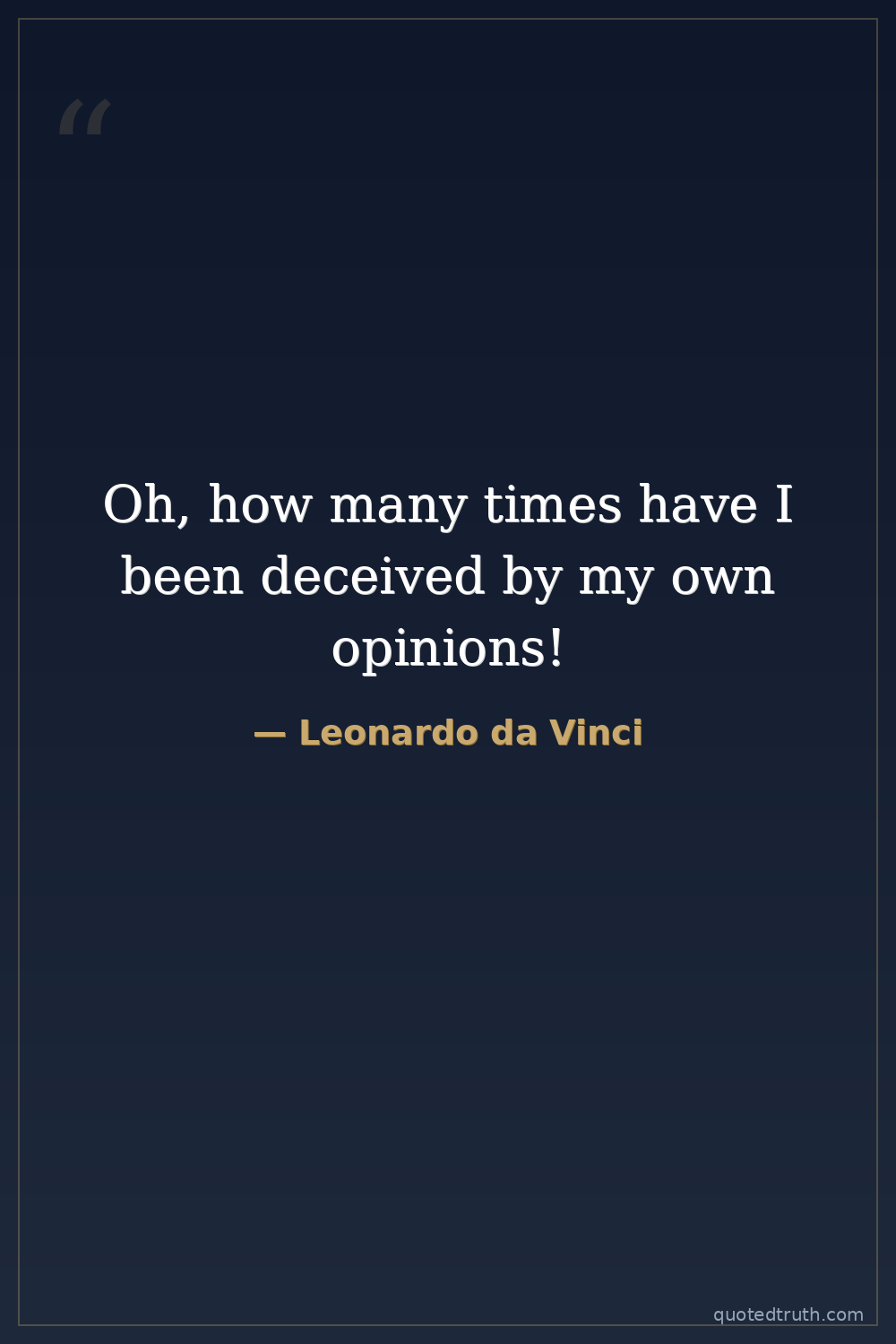
Leonardo da Vinci — "Oh, how many times have I been deceived by my own opinions!"
Oh, how many times have I been deceived by my own opinions!
Oh, how many times have I been deceived by my own opinions!
Click any product to generate a realistic preview. Up to 3 at a time.
* Initial load can take up to 90 seconds — revising the preview in another color is nearly instant.
"Poor is the pupil who does not surpass his master."
"To develop a complete mind: Study the art of science; Study the science of art. Learn how to see. Realize that everything connects to everything else."
"Blind ignorance misleads us and makes us content with this empty life."
"He who possesses most must be most afraid of loss."
"The greatest pleasure and the greatest knowledge is to understand how we are born."
Found in 1 providers: grok
1 source checked
Personal opinions and intuitions can mislead us even when we trust them completely. This is a raw admission that assumptions we hold confidently — about how the world works, what we observe, what we believe to be true — regularly turn out wrong. Self-deception isn't only lies we tell others; it's the bias baked into our own perception and reasoning that distorts what we see before we can even question it.
Leonardo filled thousands of notebook pages correcting his own earlier drawings and theories — his anatomical studies alone went through multiple revisions as dissection exposed errors in prior assumptions. He rejected inherited authority yet remained equally suspicious of his own interpretations. His empirical philosophy — 'experience is the mother of all knowledge' — demanded constant self-correction. This quote captures the frustrating flip side: even firsthand observation, filtered through his own mind, could betray him.
In the early 1500s, European thinkers were abandoning medieval reliance on ancient authorities — Aristotle, Galen, Church doctrine — and turning to direct observation. But the scientific method hadn't yet been codified; Bacon's inductive framework came a century later. Without established protocols for testing ideas, thinkers like Leonardo navigated a treacherous gap: they'd rejected external authority but had no systematic protection against their own biases. Admitting personal fallibility was itself a quietly radical intellectual act.
AI-generated insights based on extensive research and information for context. Factual errors? Email [email protected].
Your cart is empty