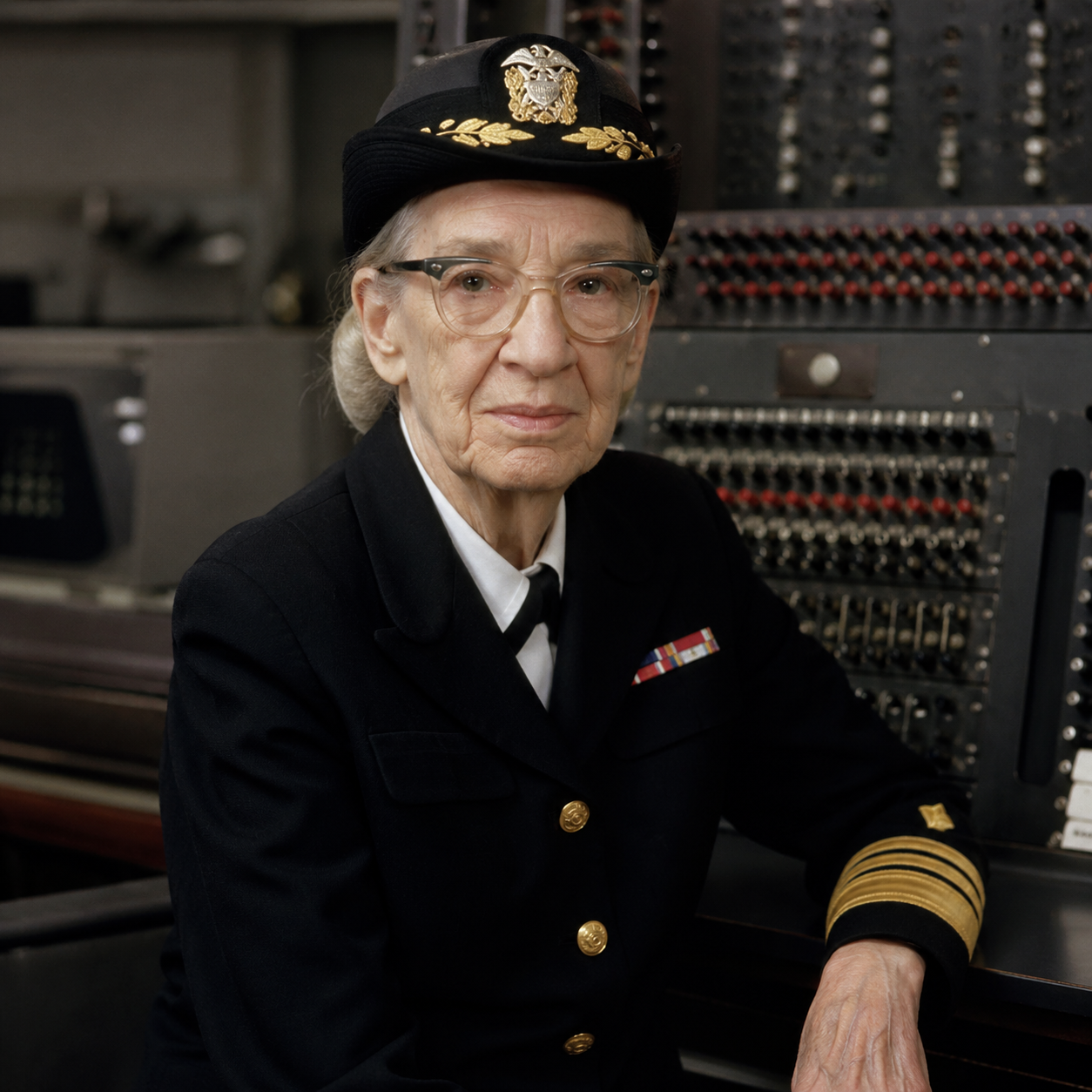
Grace Hopper — "One accurate measurement is worth a thousand expert opinions."
One accurate measurement is worth a thousand expert opinions.
One accurate measurement is worth a thousand expert opinions.
Click any product to generate a realistic preview. Up to 3 at a time.
* Initial load can take up to 90 seconds — revising the preview in another color is nearly instant.
"The computer is a tool, not a master."
"If it isn't bolted down, bring it home."
"I don't believe in taking no for an answer."
"We're all going to be replaced by a computer. You'll be sitting around and the computer will say, 'Oh, I'm sorry, you're not needed today.'"
"The greatest danger is not in failure, but in succeeding too easily."
Found in 2 providers: grok,gemini
2 sources checked
Hard data beats collective guesswork. One verified, precise measurement — a test result, a metric, an observed fact — is more reliable than the pooled opinions of a thousand specialists. Experts can be wrong, biased, or reasoning from incomplete information. Measurement is direct evidence of reality. When you can actually observe and quantify something, do that instead of debating what people think might be true.
Hopper spent decades proving experts wrong through results. When she proposed the first compiler in the early 1950s, colleagues insisted computers couldn't process symbolic code — she built it anyway and the data spoke. She famously distributed physical nanoseconds — wire snippets showing light's travel distance — to make abstract specs concrete and measurable. As a Navy Rear Admiral and COBOL architect, her career embodied replacing assumption with empirical proof.
Hopper's career spanned the 1940s–1980s, when computing was dominated by theoretical debate among mathematicians and engineers. Early programmers relied heavily on expert consensus about what machines could or couldn't do, often without testing assumptions. The Cold War intensified pressure for reliable, measurable data in military and scientific systems. In an era where computer science lacked established benchmarks, Hopper's insistence on measurement over opinion was both radical and foundational.
AI-generated insights based on extensive research and information for context. Factual errors? Email [email protected].
Your cart is empty