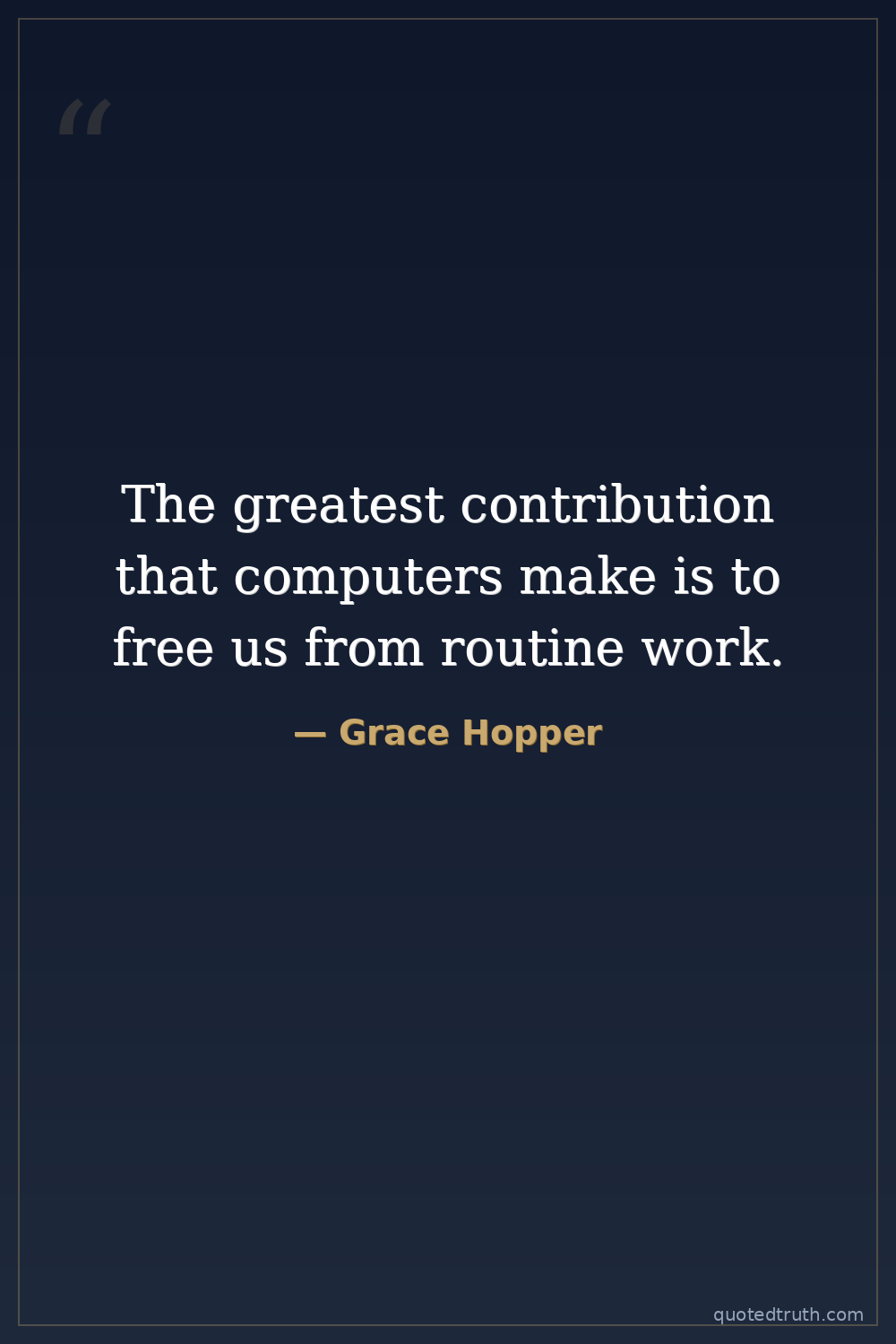
Grace Hopper — "The greatest contribution that computers make is to free us from routine work."
The greatest contribution that computers make is to free us from routine work.
The greatest contribution that computers make is to free us from routine work.
Click any product to generate a realistic preview. Up to 3 at a time.
* Initial load can take up to 90 seconds — revising the preview in another color is nearly instant.
"Humans are allergic to change. They love to say, 'We've always done it this way.' I try to fight that."
"If we're going to have computers, we're going to have to have programmers."
"The difficulty lies, not in the new ideas, but in escaping from the old ones."
"That's why I'm still here. I enjoy it."
"One accurate measurement is worth a thousand expert opinions."
Found in 1 providers: grok
1 source checked
Computers matter most not because they're fast, but because they eliminate repetitive, mindless work. When machines handle mechanical tasks — calculations, sorting, filing, data entry — humans are freed to think, create, and solve harder problems. The true value of technology is cognitive liberation: shifting human effort away from what machines do effortlessly toward the judgment, creativity, and insight that only people can provide.
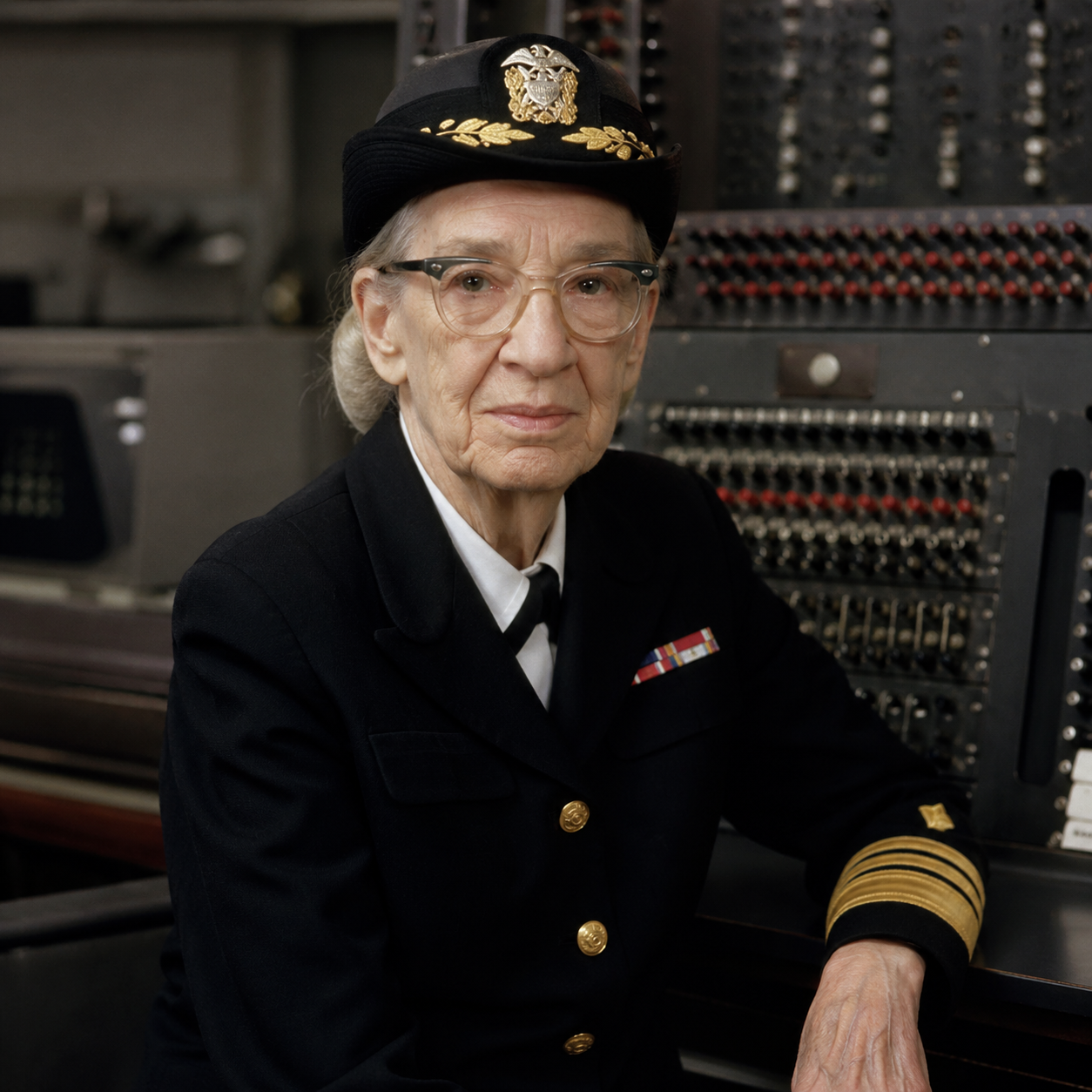
Hopper invented the first compiler in 1952 precisely to eliminate routine hand-translation of code — humans shouldn't have to think like machines. She championed COBOL so business professionals could write programs in plain English rather than cryptic assembly. A U.S. Navy Rear Admiral, she spent her career making computers do more so people did less busywork. This belief — that humans should delegate drudgery to machines — drove every major contribution of her life.
Hopper spoke during the 1950s–70s, when offices ran on manual ledgers, typewriters, and armies of human 'computers' performing repetitive calculations by hand. The postwar economy created massive administrative workloads, and early mainframes were being deployed to automate exactly this drudgery. There was widespread fear that machines would destroy jobs. Hopper's framing was deliberate counternarrative: computers don't eliminate people — they elevate them, freeing human minds for work that actually requires thinking.
AI-generated insights based on extensive research and information for context. Factual errors? Email [email protected].
Your cart is empty