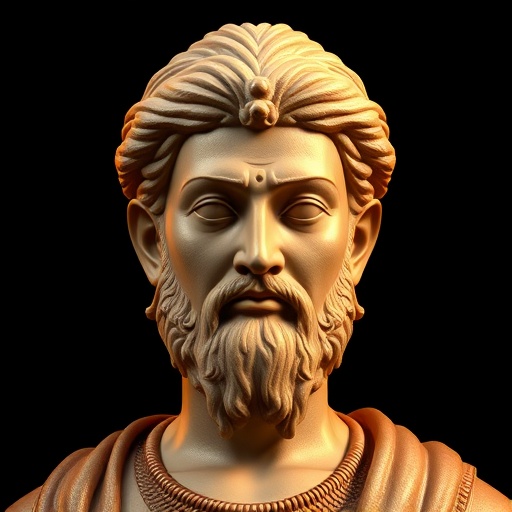
Mahavira — "One who knows himself, knows God."
One who knows himself, knows God.
One who knows himself, knows God.
Click any product to generate a realistic preview. Up to 3 at a time.
* Initial load can take up to 90 seconds — revising the preview in another color is nearly instant.
"One should always speak the truth, but not utter an unpleasant truth."
"Man's true nature is divine."
"One who neglects the supreme art of living, which is self-knowledge, knows nothing of life."
"A man who is averse from harming even the wind knows the sorrow of all things living."
"One who is pure in thought, word, and deed is truly happy."
24th and last Tirthankara of Jainism, whose teachings of strict ahimsa (non-violence), aparigraha (non-attachment), and karma reshaped ancient Indian religion. Closely associated with The Buddha (near-contemporary moral revolutionary, also reacting against Vedic ritualism). For an intellectual contrast, see Vedic Brahmanical ritual sacrifice, the animal-sacrifice-centered Vedic religion of his era — Mahavira's ahimsa demanded total non-violence, including not eating root vegetables that kill the plant — a maximum-distance ethical move from the Vedic priestly tradition that ritually sacrificed cattle and horses. The two cleanest poles of ancient Indian religious ethics.
Found in 1 providers: grok
1 source checked
Self-knowledge is the ultimate spiritual attainment — understanding your own consciousness, motivations, and nature leads directly to understanding the divine. The divine isn't a separate external force requiring priestly mediation; it's accessed through rigorous inner examination. This collapses the distance between human and sacred: when you fully know what you are — your soul stripped of illusion — you arrive at the same understanding that defines enlightenment or God-consciousness.
Mahavira spent 12 years in silent, solitary asceticism — no possessions, no shelter, enduring physical extremes — engaged in pure self-examination before achieving kevala jnana (omniscience). Jainism centers on the soul (jiva): liberation comes not from worshipping external gods but from purifying one's own consciousness. Mahavira himself was the proof of this teaching — through knowing himself completely, he became a Tirthankara, the perfected divine being Jains revere.
In 6th-century BCE India, Brahmanical priests monopolized access to the divine through elaborate Vedic rituals and sacrifices — ordinary people depended on external intermediaries to reach the gods. Mahavira emerged during the Shramana movement alongside the Buddha, both rejecting priestly authority and external ritual. The Upanishads were simultaneously asking 'Who am I?' This quote was radical: it claimed every individual's own consciousness, not hereditary priests or temple offerings, was the direct path to the sacred.
AI-generated insights based on extensive research and information for context. Factual errors? Email [email protected].
Your cart is empty