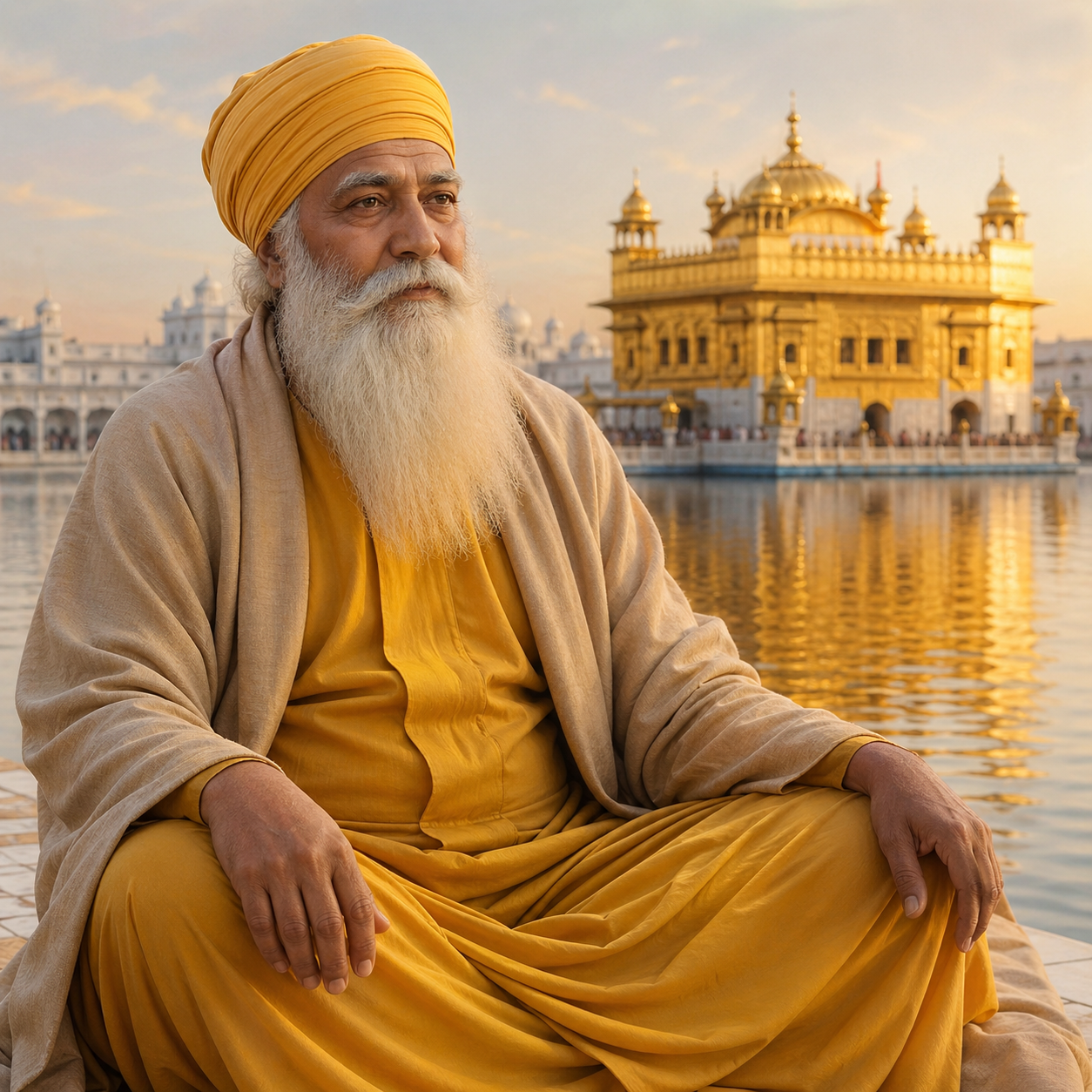
Guru Nanak — "Only by His Grace, can one be saved."
Only by His Grace, can one be saved.
Only by His Grace, can one be saved.
Click any product to generate a realistic preview. Up to 3 at a time.
* Initial load can take up to 90 seconds — revising the preview in another color is nearly instant.
"The world is a garden, O Nanak, and the Gardener is God."
"The Lord Himself is the enjoyer, and He Himself is the enjoyed."
"He who considers himself humble, he alone is worthy of praise."
"Do not wish evil for others. Do not speak ill of others. Do not obstruct anyone's activities."
"There is but one God. His name is Truth; He is the Creator. He fears none; He is without hate. He never dies; He is beyond the cycle of births and death. He is self-illuminated. He is realized by the …"
Founder of Sikhism and the first of the Ten Sikh Gurus, whose teachings of one universal God and rejection of caste shaped Punjab. Closely associated with Kabir (mystical poet whose verses appear in the Sikh Guru Granth Sahib). For an intellectual contrast, see Brahmanical orthodoxy, the Hindu caste-and-ritual establishment of his era — Sikhism was founded as a deliberate alternative to both Hindu ritual hierarchy and Islamic exclusivism — Nanak's universalism was a structural rejection of caste and priestly mediation.
Found in 1 providers: grok
1 source checked
No amount of ritual, social status, or personal effort alone guarantees liberation. Salvation comes through divine grace — an unearned gift from God — not through human achievement or religious performance. This challenges the idea that people can work their way to spiritual freedom, instead centering humility and surrender as the only true path to being rescued from ego and suffering.
Guru Nanak rejected Brahminical ritualism and caste-based religious authority throughout his life, traveling thousands of miles across South Asia, the Middle East, and beyond to spread this message. His own spiritual awakening came as a direct divine experience — he disappeared into a river and emerged declaring God's truth. Grace, not lineage or ceremony, defined his entire theology.
In 15th–16th century Punjab, religious life was dominated by rigid Hindu caste hierarchies and Islamic orthodoxy, both emphasizing prescribed ritual, law, and social station as paths to God's favor. Guru Nanak's emphasis on divine grace was radically egalitarian — it dismantled clerical gatekeeping and declared every person, regardless of caste or creed, equally dependent on and accessible to God's mercy.
AI-generated insights based on extensive research and information for context. Factual errors? Email [email protected].
Your cart is empty