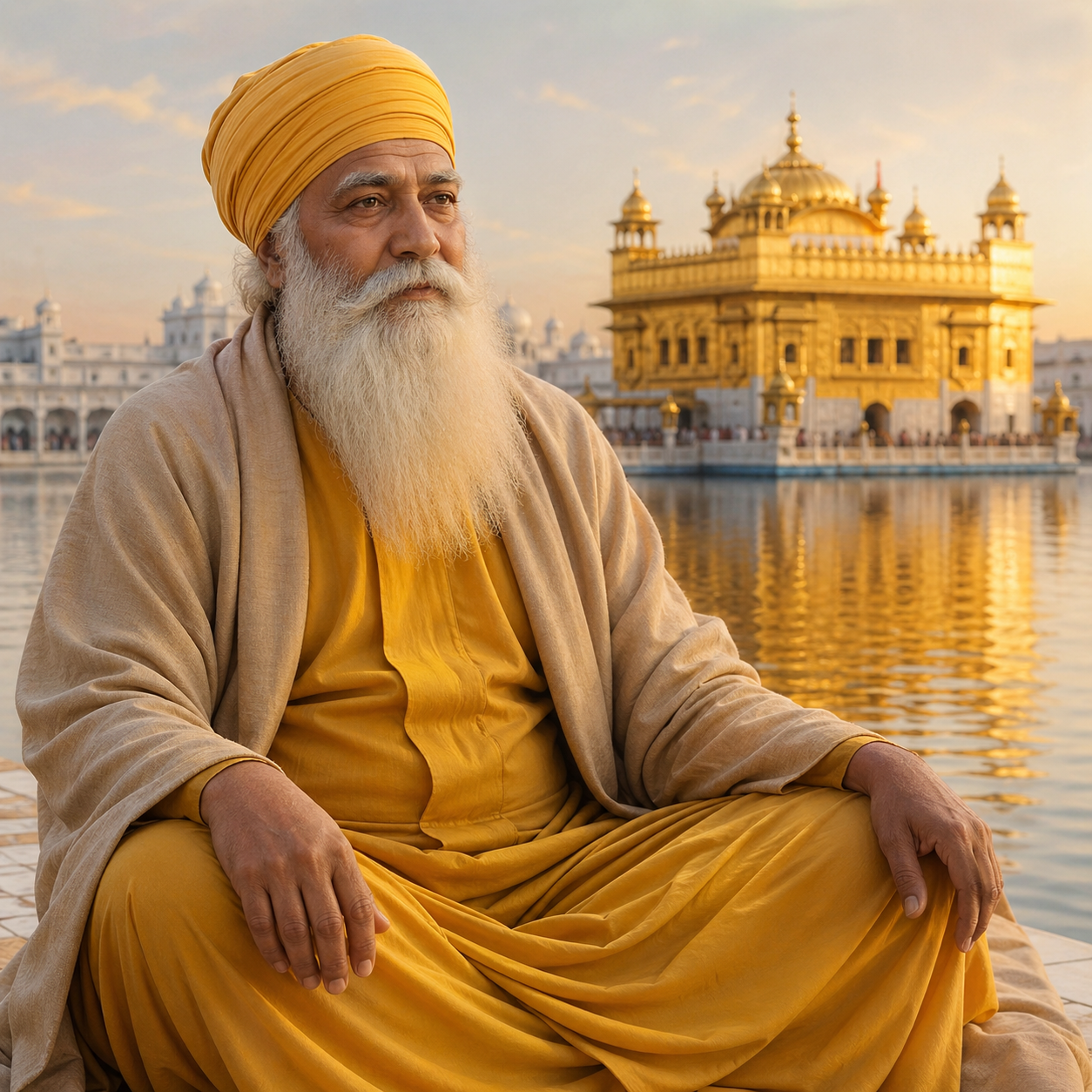
Guru Nanak — "The Lord is neither male nor female, neither does He have any form or color."
The Lord is neither male nor female, neither does He have any form or color.
The Lord is neither male nor female, neither does He have any form or color.
Click any product to generate a realistic preview. Up to 3 at a time.
* Initial load can take up to 90 seconds — revising the preview in another color is nearly instant.
"Even if you have a hundred thousand friends, you are alone if you don't have a good cup of tea."
"There is but one God. And sometimes, He has a very subtle sense of humor."
"May your mind be pure and your phone battery be full."
"He who practices truth, contentment, and kindness, and who is free from ego, he is truly a Brahmin."
"When the corn is ripe, it is cut down; when the mortal becomes old, death dances over his head."
Founder of Sikhism and the first of the Ten Sikh Gurus, whose teachings of one universal God and rejection of caste shaped Punjab. Closely associated with Kabir (mystical poet whose verses appear in the Sikh Guru Granth Sahib). For an intellectual contrast, see Brahmanical orthodoxy, the Hindu caste-and-ritual establishment of his era — Sikhism was founded as a deliberate alternative to both Hindu ritual hierarchy and Islamic exclusivism — Nanak's universalism was a structural rejection of caste and priestly mediation.
Found in 1 providers: grok
1 source checked
This statement rejects the idea that God fits into human categories like gender, shape, or appearance. The divine cannot be pictured as a bearded father, a mother figure, or any specific image carved in stone. God transcends physical form entirely and exists beyond the limits of human imagination. Trying to box the Creator into a body, a face, or a color misses what God actually is: formless, infinite, and beyond anything the human mind can fully capture.
Guru Nanak built Sikhism on this exact principle, summarized in his foundational Mul Mantar declaring God as Ik Onkar, one formless reality. Born in 1469 in Punjab, he rejected idol worship, caste hierarchy, and ritualism after his reported divine revelation at the Kali Bein river. He spent decades traveling across India, Tibet, and Arabia preaching a direct, imageless relationship with the divine that sidestepped both Hindu iconography and human-shaped conceptions of God.
Nanak lived during the early Mughal era in a Punjab torn between Hindu polytheism with its elaborate pantheon of gendered deities and Islamic monotheism enforced by new rulers. Religious violence, caste oppression, and ritual exploitation by Brahmin priests and Muslim clerics were widespread. By declaring God formless and genderless, Nanak cut through both traditions simultaneously, offering villagers and outcastes a radical middle path that belonged to neither establishment and required no temple, mosque, idol, or intermediary to access.
AI-generated insights based on extensive research and information for context. Factual errors? Email [email protected].
Your cart is empty