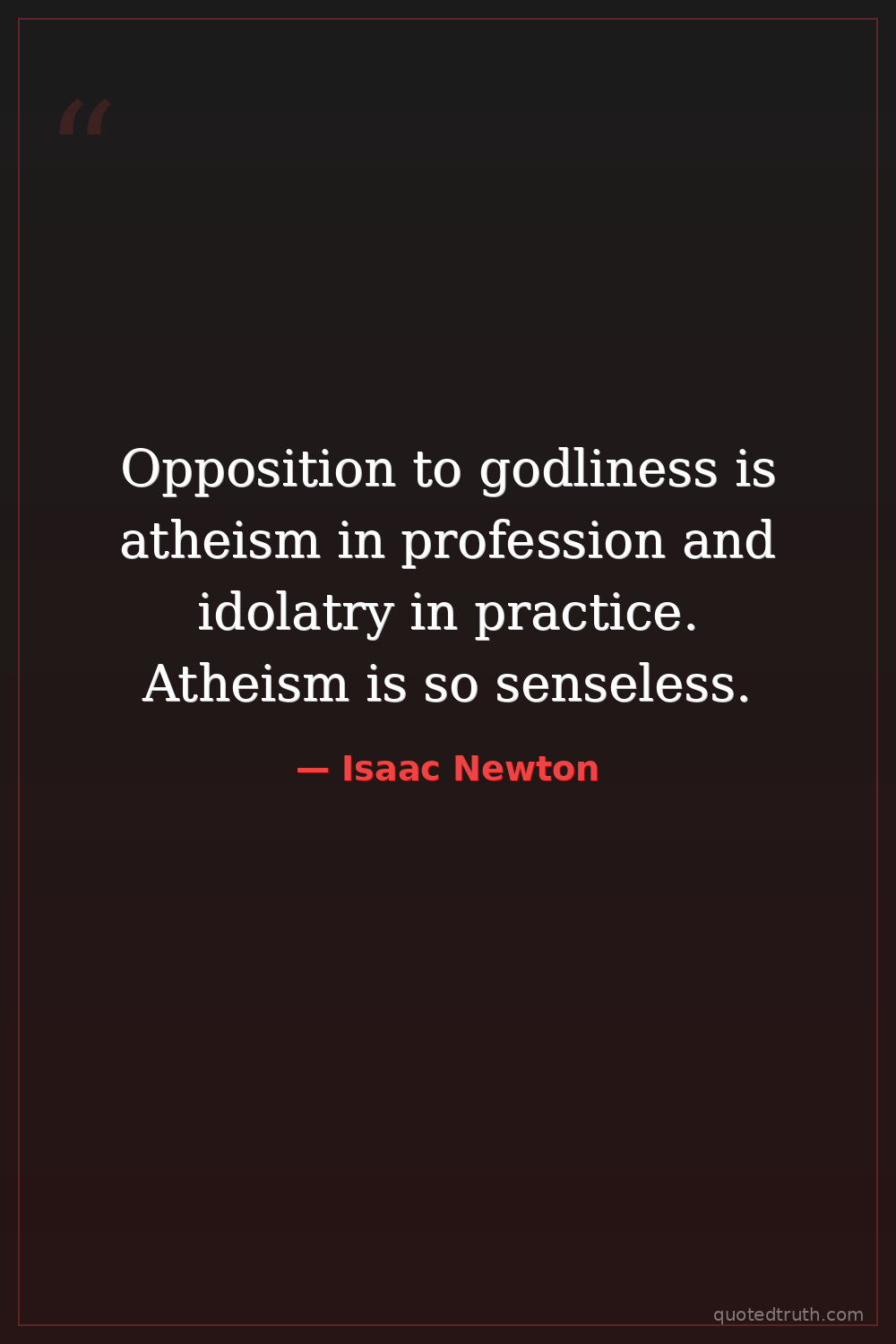
Isaac Newton — "Opposition to godliness is atheism in profession and idolatry in practice. Athei…"
Opposition to godliness is atheism in profession and idolatry in practice. Atheism is so senseless.
Opposition to godliness is atheism in profession and idolatry in practice. Atheism is so senseless.
Click any product to generate a realistic preview. Up to 3 at a time.
* Initial load can take up to 90 seconds — revising the preview in another color is nearly instant.
"I have not been able to discover the cause of those properties of gravity from phenomena, and I frame no hypotheses."
"God in the beginning formed matter in solid, massy, hard, impenetrable, moveable particles, of such sizes and figures, and with such other properties, and in such proportion to space, as most conduced…"
"Every body continues in its state of rest, or of uniform motion in a right line, unless it is compelled to change that state by forces impressed upon it."
"Nature is pleased with simplicity."
"I can calculate the motion of heavenly bodies, but not the madness of people."
Found in 1 providers: deepseek
1 source checked
Newton argues that rejecting godliness takes two forms: openly declaring atheism or practicing idolatry — worshipping the wrong things. He considers atheism fundamentally irrational, not just morally wrong. The universe's intricate order constitutes overwhelming evidence of a Creator, so denying God requires willful blindness rather than reasoned thought. True opposition to God manifests either through explicit creed or through misplaced devotion to lesser things.
Newton wrote more on theology than on science — his private papers contain millions of words on biblical prophecy and divine nature. He viewed the Principia's mathematical laws as revealing God's architecture directly. Though an Arian who rejected the Trinity, his faith was fierce and personal. His scientific method was inseparable from theology: discovering cosmic order meant discovering God's mind. Atheism contradicted everything his own research demonstrated to him.
Newton lived during the Scientific Revolution, when Hobbes and Spinoza were accused of dangerous atheism and pantheism. In 17th-century England, atheism was legally punishable and socially ruinous. Yet the era's new rational inquiry created genuine theological anxiety: could a mechanical universe still need God? Newton's circle — Boyle, Locke, the Royal Society — actively argued science proved divine design. This quote reflects that contested moment when natural philosophy and Christian faith were vigorously defended as mutually reinforcing.
AI-generated insights based on extensive research and information for context. Factual errors? Email [email protected].
Your cart is empty