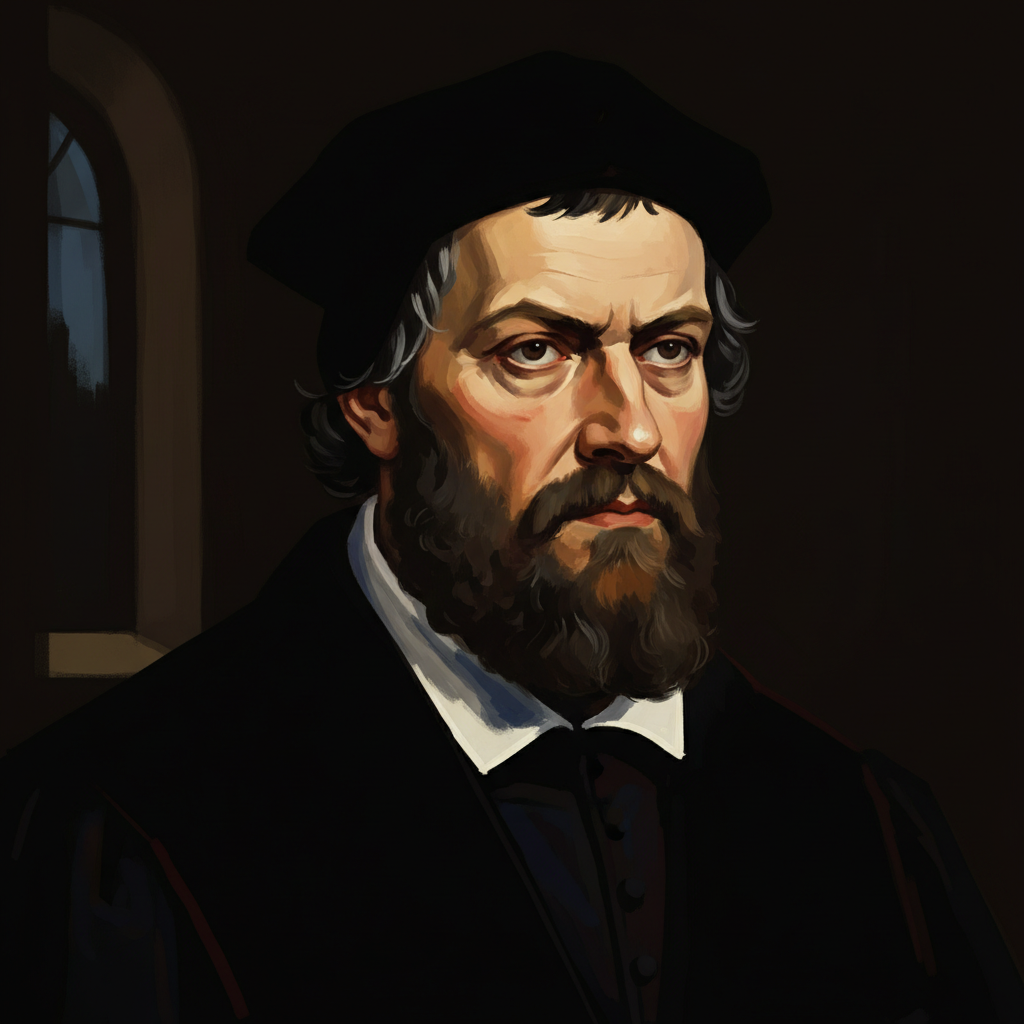
Martin Luther — "Our Lord has written the promise of the resurrection, not in books alone, but in…"
Our Lord has written the promise of the resurrection, not in books alone, but in every leaf in springtime.
Our Lord has written the promise of the resurrection, not in books alone, but in every leaf in springtime.
Click any product to generate a realistic preview. Up to 3 at a time.
* Initial load can take up to 90 seconds — revising the preview in another color is nearly instant.
"Their rabbis should be forbidden to teach on pain of loss of life and limb."
"You have as much laughter as you have faith."
"I am like a ripe nut; I am ready to fall."
"I am a worm and no man."
"The greatest vice is pride."
German theologian whose 95 Theses (1517) launched the Protestant Reformation and broke the Catholic Church's monopoly on Western Christianity. Closely associated with Philipp Melanchthon (Lutheran systematizer) and John Calvin (later Reformer who built on Luther's break). For an intellectual contrast, see Pope Leo X, Renaissance pope (1513-1521) — Leo X's indulgence sales triggered Luther's break and Leo excommunicated him in 1521 — Luther's entire Reformation is structured as a direct answer to the indulgence-funded Vatican Leo represented.
Found in 1 providers: grok
1 source checked
The hope that life continues after death isn't just something you find in religious writings. Every spring, when leaves burst back from bare branches, nature itself demonstrates the same pattern: apparent death followed by renewed life. Creation constantly preaches this message if you pay attention. You don't need to be literate or have access to scripture to encounter this promise, because the natural world itself is a living sermon available to everyone.
Luther spent his life arguing that God's truth should be accessible to ordinary people, not locked inside Latin texts controlled by clergy. He translated the Bible into German precisely so plain folk could read it. This quote extends that democratizing impulse beyond books, finding divine teaching in something every peasant could observe. It also reflects his deep appreciation for creation as God's handiwork, a theme running through his sermons and table talk.
In early 1500s Europe, literacy was rare and Bibles existed mainly in Latin, controlled by the Catholic Church. Luther's 1517 Reformation shattered that monopoly, and his German Bible translation plus the printing press put scripture into common hands. Against this backdrop, pointing to springtime leaves as divine revelation was radical: it meant God's promises weren't gatekept by priests or scholars. Ordinary believers walking through fields could read theology directly from creation.
AI-generated insights based on extensive research and information for context. Factual errors? Email [email protected].
Your cart is empty