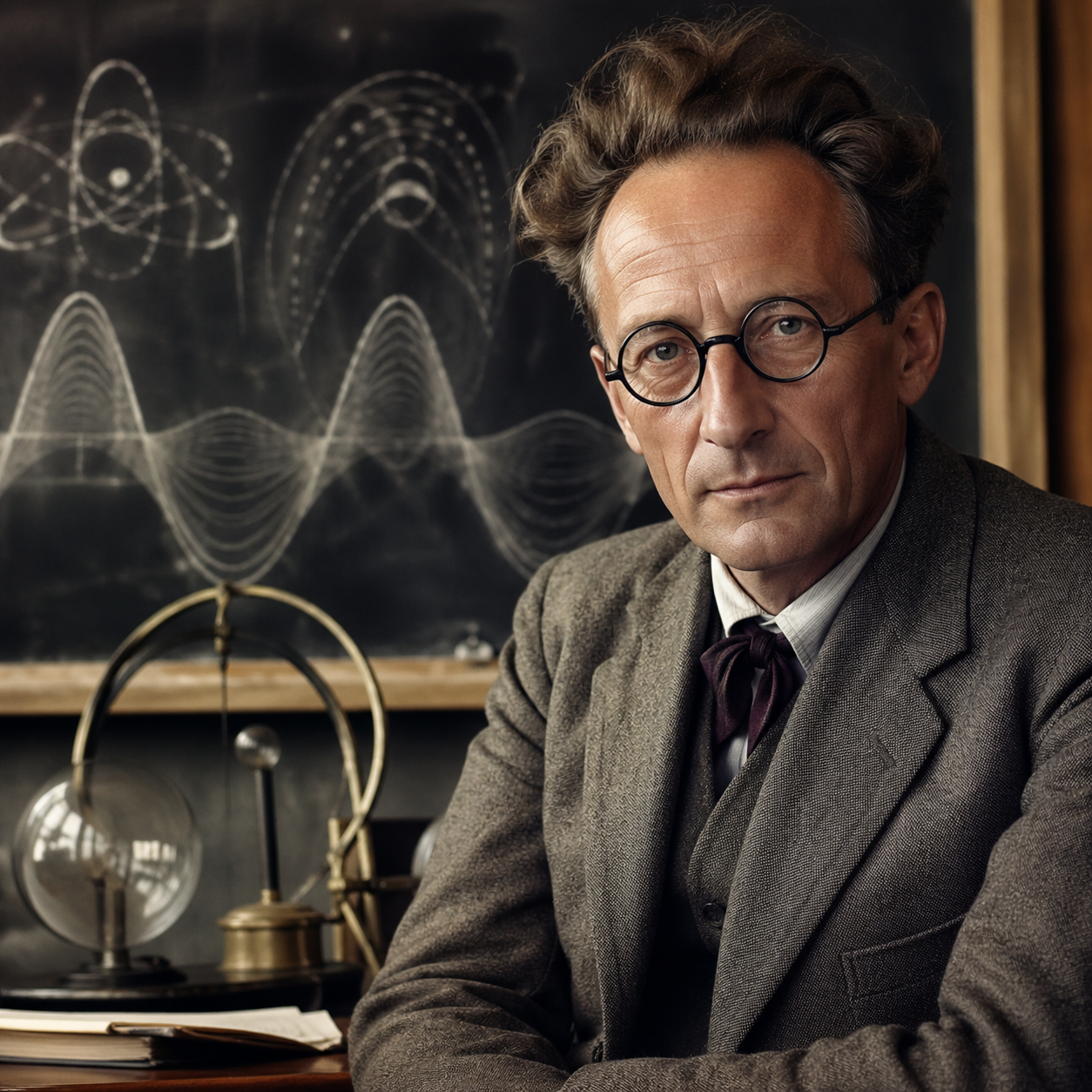
Erwin Schrodinger — "Our [Western] science has cut itself off from an adequate understanding of the S…"
Our [Western] science has cut itself off from an adequate understanding of the Subject of Cognizance, of the mind.
Our [Western] science has cut itself off from an adequate understanding of the Subject of Cognizance, of the mind.
Click any product to generate a realistic preview. Up to 3 at a time.
* Initial load can take up to 90 seconds — revising the preview in another color is nearly instant.
"I am enough of an artist to draw freely upon my imagination."
"The more precisely the position is determined, the less precisely the momentum is known in this instant, and vice versa."
"But the truth is that we are not living in a world of objects, but in a world of events."
"If we were to take the wave function to be a complete description of reality, then the living and dead cat would indeed be equally real."
"The scientific picture of the world is very successful, but it is incomplete. It leaves out something essential, something that is very close to us, namely, our own consciousness."
Austrian physicist who shared the 1933 Nobel for the wave equation that bears his name and the famous cat thought-experiment. Closely associated with Werner Heisenberg (matrix-mechanics rival who reached the same physics by different math) and Albert Einstein (his pen-pal on quantum interpretation). For an intellectual contrast, see Niels Bohr, Danish physicist and architect of the Copenhagen interpretation — Schrödinger's cat thought-experiment was specifically designed to ridicule Bohr's 'observer-dependent reality' reading of quantum mechanics — Schrödinger thought the Copenhagen interpretation was absurd; the cat was meant as reductio ad absurdum.
A critique of Western scientific methodology and its perceived limitations in understanding consciousness.
Date: Unknown, likely from his philosophical writings
ShockingFound in 1 providers: gemini
1 source checked
Western science, by focusing exclusively on objective, measurable phenomena, has abandoned the very thing doing the knowing — the conscious mind itself. Science describes the external world with precision but treats the observer as irrelevant. This leaves a critical blind spot: we have no scientific account of consciousness, perception, or subjective experience — the 'I' that observes everything else. The knower is excluded from scientific knowledge.
Schrödinger developed wave mechanics and the cat thought experiment — both centering on how observation shapes quantum outcomes. This paradox forced him to take consciousness seriously as a scientific problem. His later works, including Mind and Matter and My View of the World, drew on Vedantic philosophy to argue that the observing subject cannot be reduced to physics. His career made the conscious observer professionally inescapable.
Mid-20th century physics was dominated by logical positivism — if unmeasurable, it wasn't real. Behaviorism ruled psychology, dismissing inner experience as unscientific. Quantum mechanics was increasingly reduced to 'shut up and calculate.' Yet the observer problem made consciousness impossible to fully dismiss. Neuroscience barely existed, AI was purely theoretical. Schrödinger's warning that materialism's blind spot would haunt science proved prescient — the hard problem of consciousness remains entirely unsolved today.
AI-generated insights based on extensive research and information for context. Factual errors? Email [email protected].
Your cart is empty