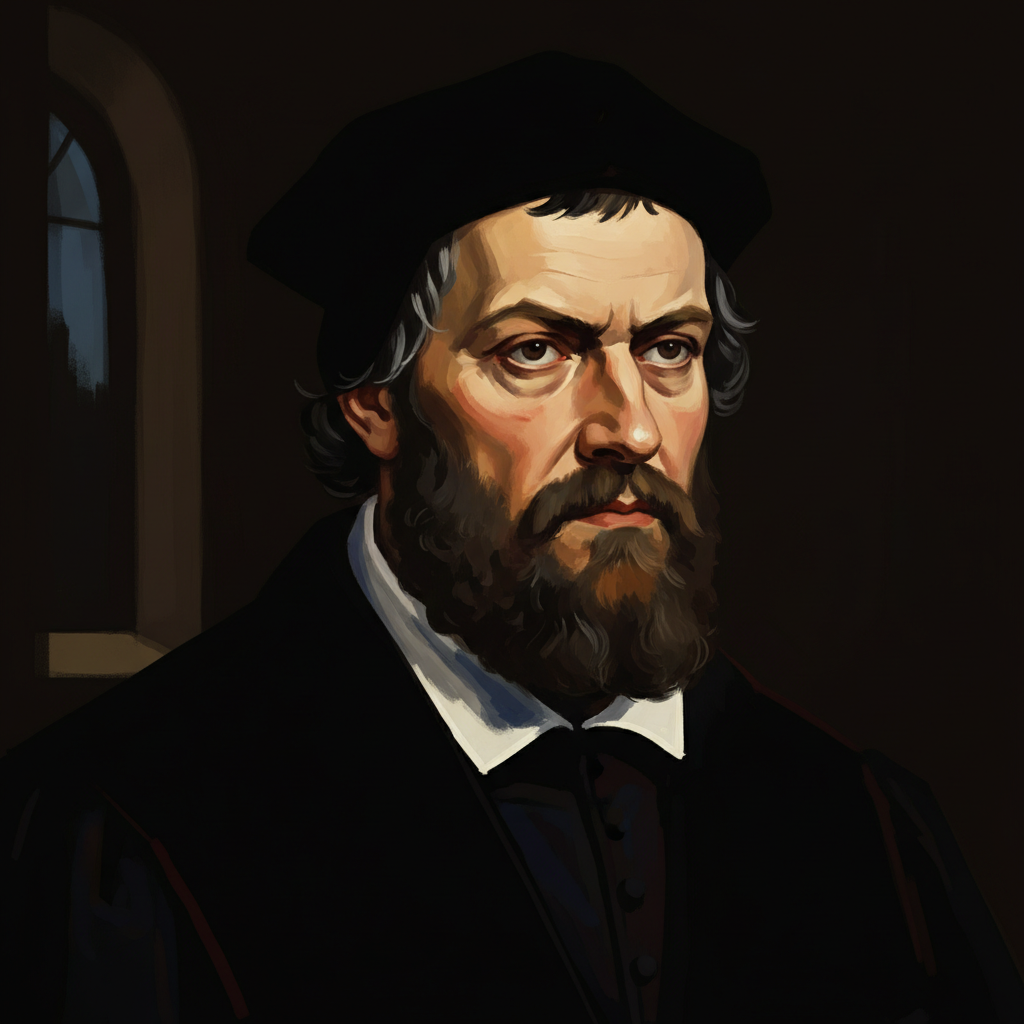
Martin Luther — "Peasants are no better than pigs."
Peasants are no better than pigs.
Peasants are no better than pigs.
Click any product to generate a realistic preview. Up to 3 at a time.
* Initial load can take up to 90 seconds — revising the preview in another color is nearly instant.
"I am a peasant, a son of a peasant; my father, grandfather, all my ancestors were genuine peasants."
"God has created men with broad chests and shoulders, not broad hips, so that men can understand wisdom. But the place where the filth flows out is small. With women it's the other way around. That's w…"
"I would rather be ruled by a wise Turk than by a foolish Christian."
"Printing is the ultimate gift of God and the greatest one. Indeed, the invention of printing is the work of God."
"Reason is the Devil's greatest whore."
German theologian whose 95 Theses (1517) launched the Protestant Reformation and broke the Catholic Church's monopoly on Western Christianity. Closely associated with Philipp Melanchthon (Lutheran systematizer) and John Calvin (later Reformer who built on Luther's break). For an intellectual contrast, see Pope Leo X, Renaissance pope (1513-1521) — Leo X's indulgence sales triggered Luther's break and Leo excommunicated him in 1521 — Luther's entire Reformation is structured as a direct answer to the indulgence-funded Vatican Leo represented.
Found in 1 providers: grok
1 source checked
This statement bluntly dehumanizes rural laborers, comparing them to livestock. It expresses a harsh view that common farmers lack dignity, reason, or moral worth and should be treated as beasts rather than people deserving respect or rights. In modern terms, it is a brutal class insult denying the humanity of the working poor and justifying treating them with contempt rather than compassion or equality.
Luther said this during the 1525 German Peasants' War, when farmers cited his reform ideas to demand freedom from serfdom. Horrified that his theology was fueling revolt, he wrote Against the Murderous, Thieving Hordes of Peasants, urging princes to slaughter rebels. Though he championed spiritual equality before God, he defended strict social hierarchy, revealing the tension between his radical religious vision and deeply conservative politics.
In early-modern Europe, roughly 85% of people were peasants bound by feudal obligations to nobility and clergy. The 1525 Peasants' War saw over 100,000 killed after commoners demanded abolition of serfdom, citing Reformation principles. Luther's reforms had shattered Catholic authority, but rulers feared total social collapse. Princes needed reassurance that challenging the Pope did not mean challenging them, making Luther's brutal condemnation of peasants politically essential for the Reformation's survival.
AI-generated insights based on extensive research and information for context. Factual errors? Email [email protected].
Your cart is empty