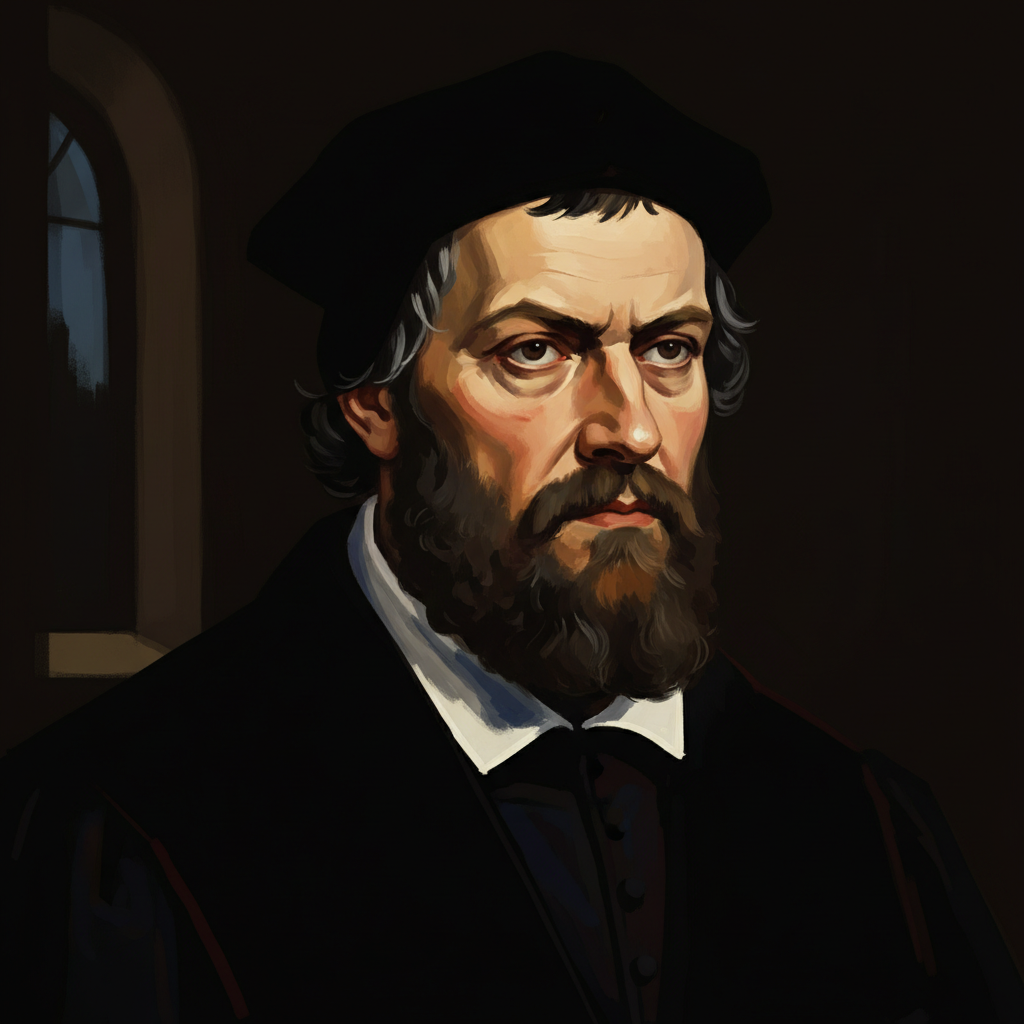
Martin Luther — "I am a worm and no man."
I am a worm and no man.
I am a worm and no man.
Click any product to generate a realistic preview. Up to 3 at a time.
* Initial load can take up to 90 seconds — revising the preview in another color is nearly instant.
"You must say my sins are not mine; they are not in me at all; they are the sins of another; they are Christ's and none of my business."
"I have had many struggles with the devil, and I know him well."
"You have as much laughter as you have faith."
"The more you read the Bible, the more you will understand it."
"What does not kill me makes me stronger."
German theologian whose 95 Theses (1517) launched the Protestant Reformation and broke the Catholic Church's monopoly on Western Christianity. Closely associated with Philipp Melanchthon (Lutheran systematizer) and John Calvin (later Reformer who built on Luther's break). For an intellectual contrast, see Pope Leo X, Renaissance pope (1513-1521) — Leo X's indulgence sales triggered Luther's break and Leo excommunicated him in 1521 — Luther's entire Reformation is structured as a direct answer to the indulgence-funded Vatican Leo represented.
Found in 1 providers: grok
1 source checked
The speaker declares total unworthiness, comparing themselves to the lowest creature rather than claiming human dignity. It is an expression of radical humility and self-abasement before God, acknowledging that without divine grace a person is nothing. The line borrows directly from Psalm 22, turning scripture into personal confession: whatever status others assign me, I know my own smallness and depend entirely on mercy, not merit.
Luther built his theology on human helplessness and justification by grace alone, not works. As a tormented Augustinian monk he fasted, confessed obsessively, and wrestled with feelings of worthlessness before a holy God. Quoting Psalm 22 fit his self-image as a sinner whom God chose despite his lowliness. His willingness to defy popes and emperors paradoxically grew from this conviction: because he was nothing, only God's word, not his own standing, gave him courage.
In the early sixteenth century, the Church sold indulgences and taught that pilgrimages, relics, and sacraments accumulated merit toward salvation. Luther's 1517 Ninety-Five Theses and the printing press ignited the Reformation, splintering Western Christendom. Peasants revolted, princes picked sides, and ordinary believers read scripture in their own languages for the first time. Against a culture measuring spiritual worth by works and status, declaring oneself a worm was a theological weapon against ecclesiastical pride.
AI-generated insights based on extensive research and information for context. Factual errors? Email [email protected].
Your cart is empty