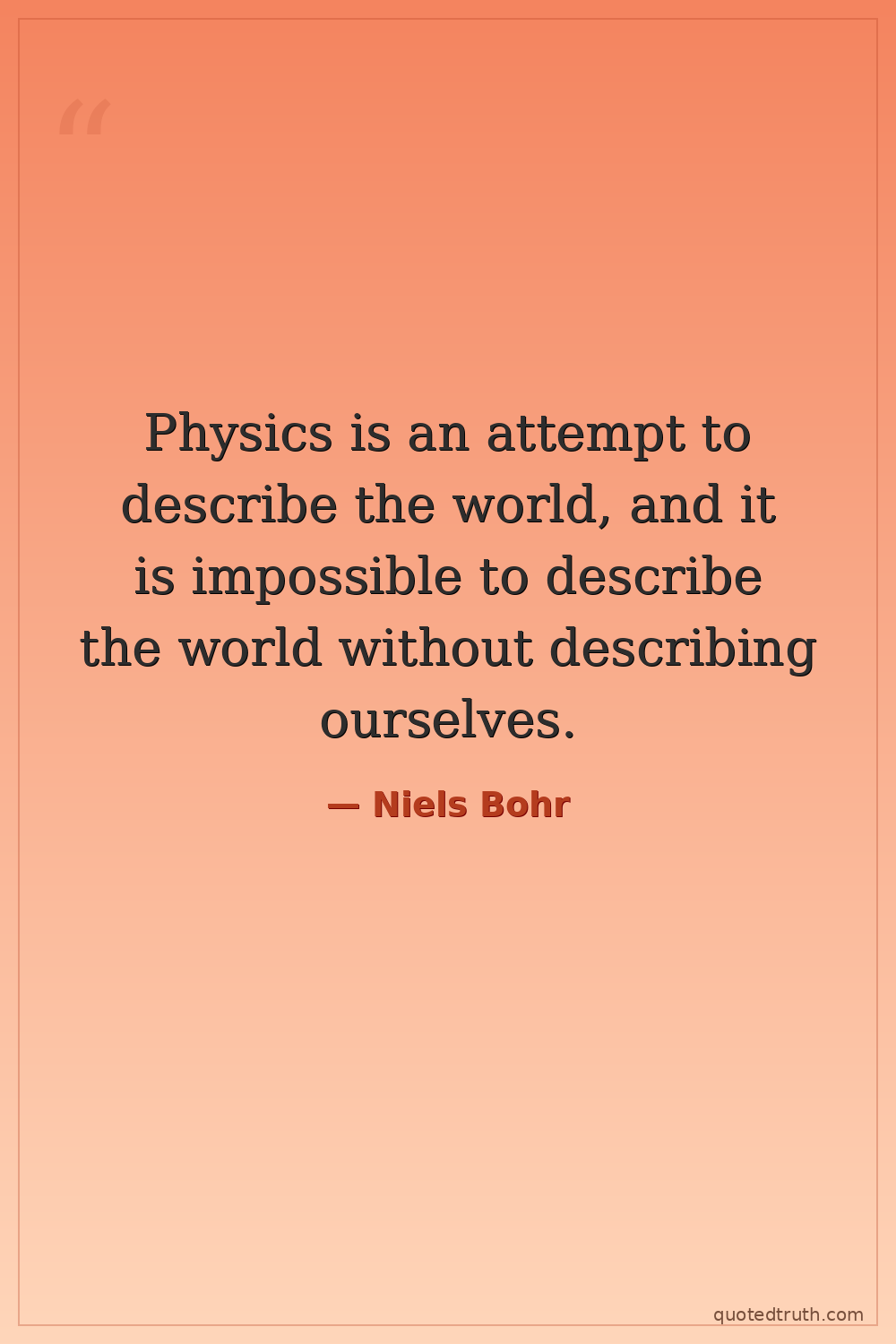
Niels Bohr — "Physics is an attempt to describe the world, and it is impossible to describe th…"
Physics is an attempt to describe the world, and it is impossible to describe the world without describing ourselves.
Physics is an attempt to describe the world, and it is impossible to describe the world without describing ourselves.
Click any product to generate a realistic preview. Up to 3 at a time.
* Initial load can take up to 90 seconds — revising the preview in another color is nearly instant.
"The atom is a tiny planetary system. The electrons revolve around the nucleus just as the planets revolve around the sun."
"The aim of science is to purify our notions, not to increase the number of facts."
"Our task is not to penetrate the essence of things, but to develop concepts which allow us to talk in a productive way about phenomena."
"Your theory is crazy, but it's not crazy enough to be true."
"I often say that there is no quantum world. There is only an abstract quantum physical description. It is wrong to think that the task of physics is to find out how nature is. Physics concerns what we…"
From his philosophical reflections on the role of the observer in quantum mechanics.
Date: Mid 20th century
GeneralFound in 1 providers: grok
1 source checked
Science cannot be separated from the scientist. When we study the physical world, our tools, perceptions, and consciousness inevitably shape what we observe and how we understand it. The observer is never truly outside the system being studied. Knowledge of the universe is inseparable from self-knowledge — studying nature is simultaneously studying the nature of human perception and thought.
Bohr pioneered quantum mechanics and the Copenhagen interpretation, which placed the observer at the center of measurement. His atomic model and complementarity principle directly challenged classical physics' assumption of a detached, objective observer. Bohr spent decades arguing that the act of measurement disturbs quantum systems, making the physicist an inextricable part of any physical description — this quote is the philosophical core of his life's work.
Bohr worked through quantum mechanics' revolutionary 1920s-1930s birth, when physics shattered centuries of Newtonian certainty. Einstein's relativity already upended absolute space and time. Quantum mechanics went further, suggesting reality itself was probabilistic and observer-dependent. This era forced physicists to confront philosophy: what does 'objective reality' even mean? Bohr's insight captured the profound epistemological crisis reshaping science and human self-understanding simultaneously.
AI-generated insights based on extensive research and information for context. Factual errors? Email [email protected].
Your cart is empty