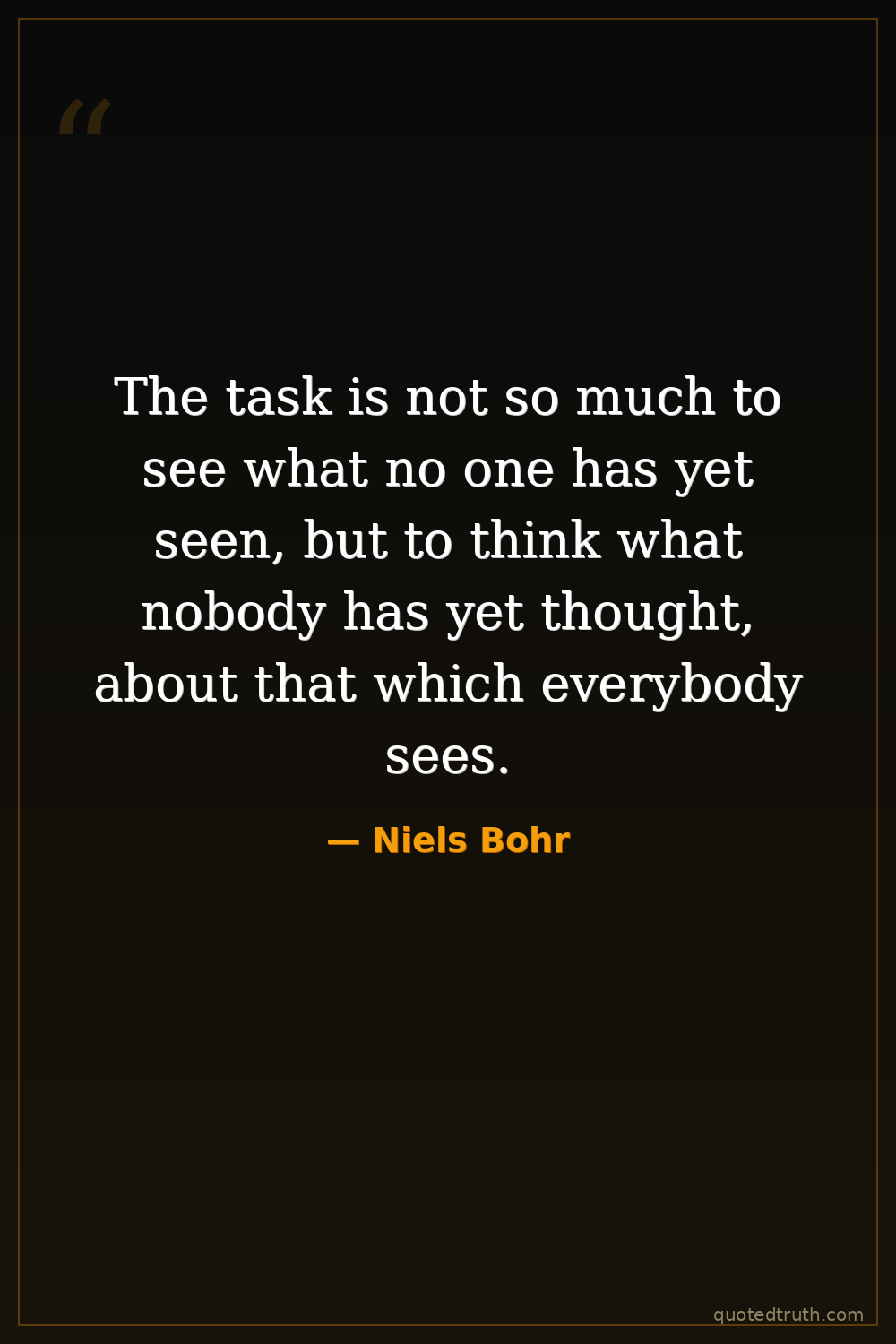
Niels Bohr — "The task is not so much to see what no one has yet seen, but to think what nobod…"
The task is not so much to see what no one has yet seen, but to think what nobody has yet thought, about that which everybody sees.
The task is not so much to see what no one has yet seen, but to think what nobody has yet thought, about that which everybody sees.
Click any product to generate a realistic preview. Up to 3 at a time.
* Initial load can take up to 90 seconds — revising the preview in another color is nearly instant.
"The problem is not to make things simple, but to make them understandable."
"The role of consciousness in quantum mechanics is still a mystery."
"We are trapped by language to such a degree that every attempt to make progress in our understanding of the universe must also be an attempt to perfect our language."
"The meaning of life is that it stops."
"Never express yourself more clearly than you are able to think."
Emphasizing the importance of novel interpretation over mere observation in scientific discovery.
Date: Unknown
ShockingFound in 1 providers: gemini
1 source checked
Real insight rarely comes from discovering something nobody has laid eyes on. It comes from looking at the same ordinary things everyone already sees and interpreting them in a way no one has considered. Originality is about fresh thinking applied to shared experience, not about finding hidden material. The breakthrough lives in the mind of the observer, not in some exotic object waiting to be found.
Bohr built his atomic model by reinterpreting phenomena physicists already knew well, spectral lines and Rutherford's nucleus, and proposing quantized electron orbits nobody had dared imagine. His complementarity principle likewise reframed familiar experimental results rather than uncovering new ones. Famous for endless Socratic dialogue at his Copenhagen institute, Bohr valued the reframing of accepted facts, believing physics advanced through conceptual courage more than through observation of novelties.
Bohr worked during the early twentieth century quantum revolution, when classical Newtonian physics was buckling under radioactivity, blackbody radiation, and atomic spectra. The raw data was available to everyone, yet Planck, Einstein, Heisenberg, and Bohr rethought what it meant. Against the backdrop of two world wars and the Manhattan Project, the era rewarded minds willing to abandon intuitive assumptions about reality, determinism, and locality, making conceptual reinterpretation the defining scientific act of the age.
AI-generated insights based on extensive research and information for context. Factual errors? Email [email protected].
Your cart is empty