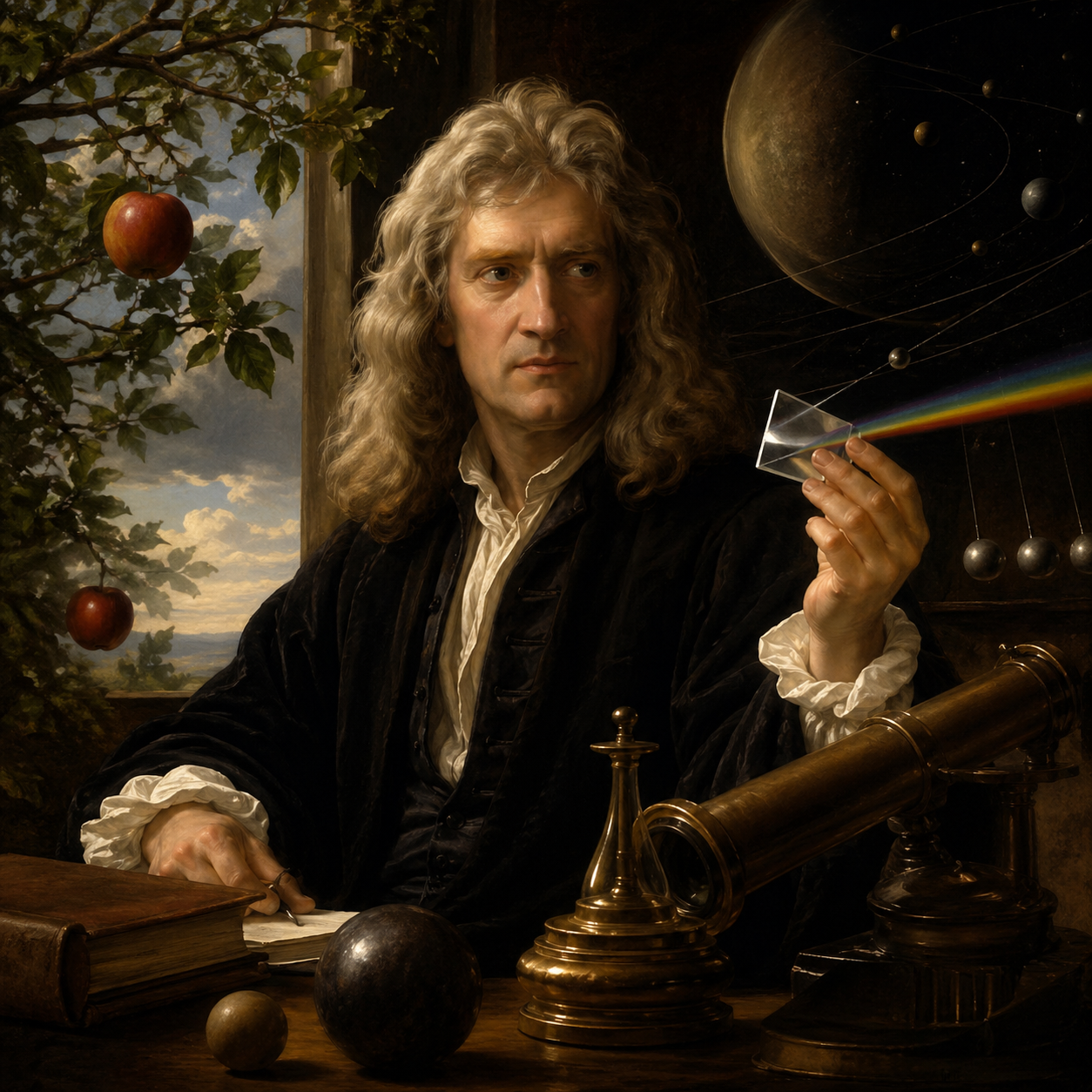
Isaac Newton — "Plato is my friend, Aristotle is my friend, but truth is more my friend."
Plato is my friend, Aristotle is my friend, but truth is more my friend.
Plato is my friend, Aristotle is my friend, but truth is more my friend.
Click any product to generate a realistic preview. Up to 3 at a time.
* Initial load can take up to 90 seconds — revising the preview in another color is nearly instant.
"The causes of gravity are not yet discovered. It is by experiments and observations that we are to know them."
"The light which comes from the sun, and from all fire, consists of all the primary colours mixed together."
"Nothing can be divided into fewer parts than it hath."
"Atheism is so senseless and odious to mankind that it never had many professors."
"I feign no hypotheses."
A common variant of a Latin saying, attributed to Newton in various contexts.
Date: Undetermined, likely before 1700
WisdomFound in 1 providers: grok
1 source checked
No matter how much you admire great thinkers, their authority doesn't override evidence. If a respected philosopher or scientist got something wrong, loyalty to them is no excuse for perpetuating the error. Truth — discovered through observation and rigorous reason — must rank above deference to tradition, reputation, or inherited doctrine. Deep admiration for a person and rejection of their mistaken ideas can coexist.
Newton dismantled Aristotelian physics, which had governed Western scientific thought for nearly 2,000 years. His laws of motion directly contradicted Aristotle's claim that objects require continuous force to remain in motion. He also corrected Descartes and clashed with Hooke. Throughout his career, Newton prioritized experimental observation and mathematical proof over inherited authority — embodying this principle by overturning the very thinkers he acknowledged as intellectual forebears.
Newton worked during the Scientific Revolution, when Aristotelian scholasticism still dominated European universities and the Church had prosecuted Galileo for challenging ancient cosmology. Plato and Aristotle were treated as near-sacred intellectual authorities. Contradicting them carried real professional and sometimes personal risk. This era demanded exactly Newton's stance: intellectual courage to follow evidence even when it overturned two millennia of entrenched orthodoxy and rewrote how humanity understood the physical world.
AI-generated insights based on extensive research and information for context. Factual errors? Email [email protected].
Your cart is empty