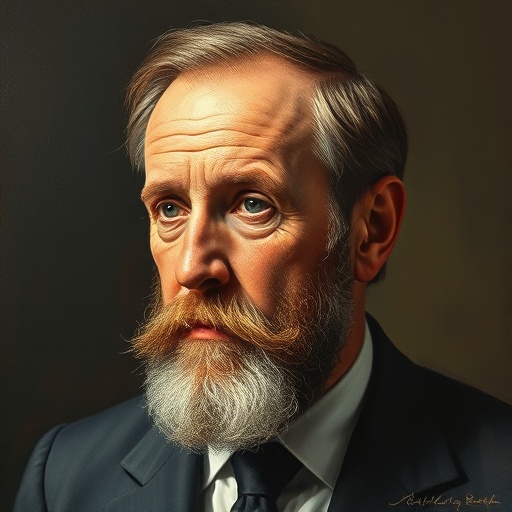
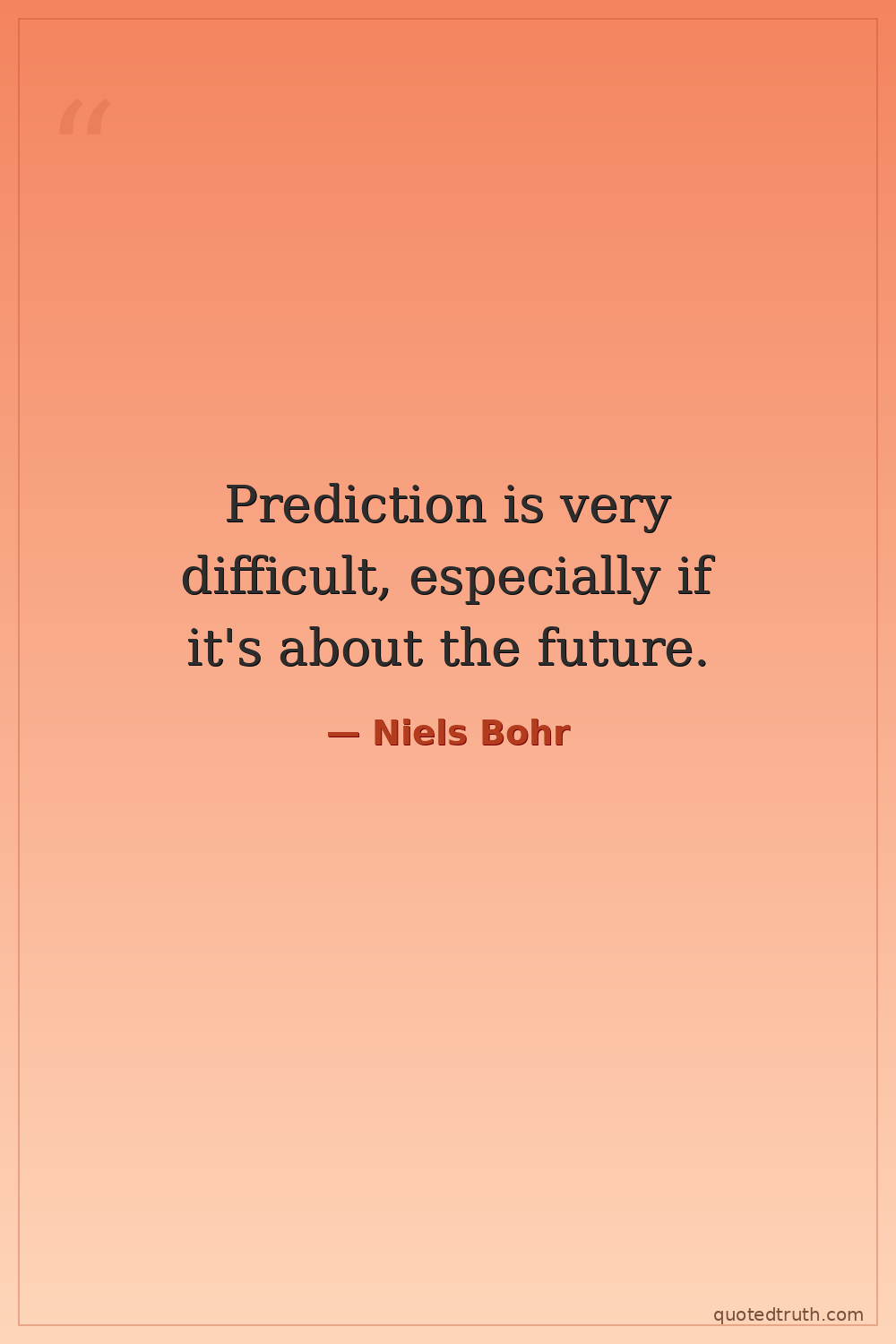
Niels Bohr — "Prediction is very difficult, especially if it's about the future."
Prediction is very difficult, especially if it's about the future.
Prediction is very difficult, especially if it's about the future.
Click any product to generate a realistic preview. Up to 3 at a time.
* Initial load can take up to 90 seconds — revising the preview in another color is nearly instant.
"The very nature of our subject, quantum physics, forces us to realize that we are suspended in language."
"We are trapped by language to such a degree that every attempt to make progress in our understanding of the universe must also be an attempt to perfect our language."
"If quantum mechanics hasn't profoundly shocked you, you haven't understood it yet."
"The future of humanity depends on our ability to understand and harness the power of science."
"No, I certainly do not believe in this superstition. But you know, they say that it does bring luck even if you don't believe in it!"
Widely attributed. Often cited in discussions of complexity and uncertainty.
Date: Mid 20th century
GeneralFound in 3 providers: grok,deepseek,gemini
3 sources checked
Humans are overconfident about their ability to forecast outcomes. This quote uses gentle irony — pointing out the tautological truth that predictions concern things that haven't happened yet — to make a deeper point: uncertainty is unavoidable. No model, expert, or theory can fully account for what the future holds. Whether in science, economics, or daily life, humility about our predictive limits is not weakness; it's honest acknowledgment of how complex reality actually is.
Bohr co-founded quantum mechanics, which proved that nature itself resists precise prediction — only probabilities can be assigned to subatomic events. His Copenhagen interpretation made fundamental uncertainty a cornerstone of physics, and his long debate with Einstein over determinism showed he genuinely wrestled with predictability's limits. Known for dry wit and philosophical depth, Bohr embodied the scientist who understood that even the universe's own laws leave the future irreducibly open.
Bohr worked through the early 20th century's twin upheavals: quantum mechanics dismantling Newtonian determinism, and two World Wars making long-range planning feel futile. Governments and scientists were building early forecasting models — economic planning, nuclear deterrence strategies — while simultaneously learning how badly predictions fail. Einstein's failed quest for a deterministic hidden-variables theory reinforced that uncertainty was baked into reality, making wry skepticism about prediction culturally resonant among physicists and intellectuals of the era.
AI-generated insights based on extensive research and information for context. Factual errors? Email [email protected].
Your cart is empty