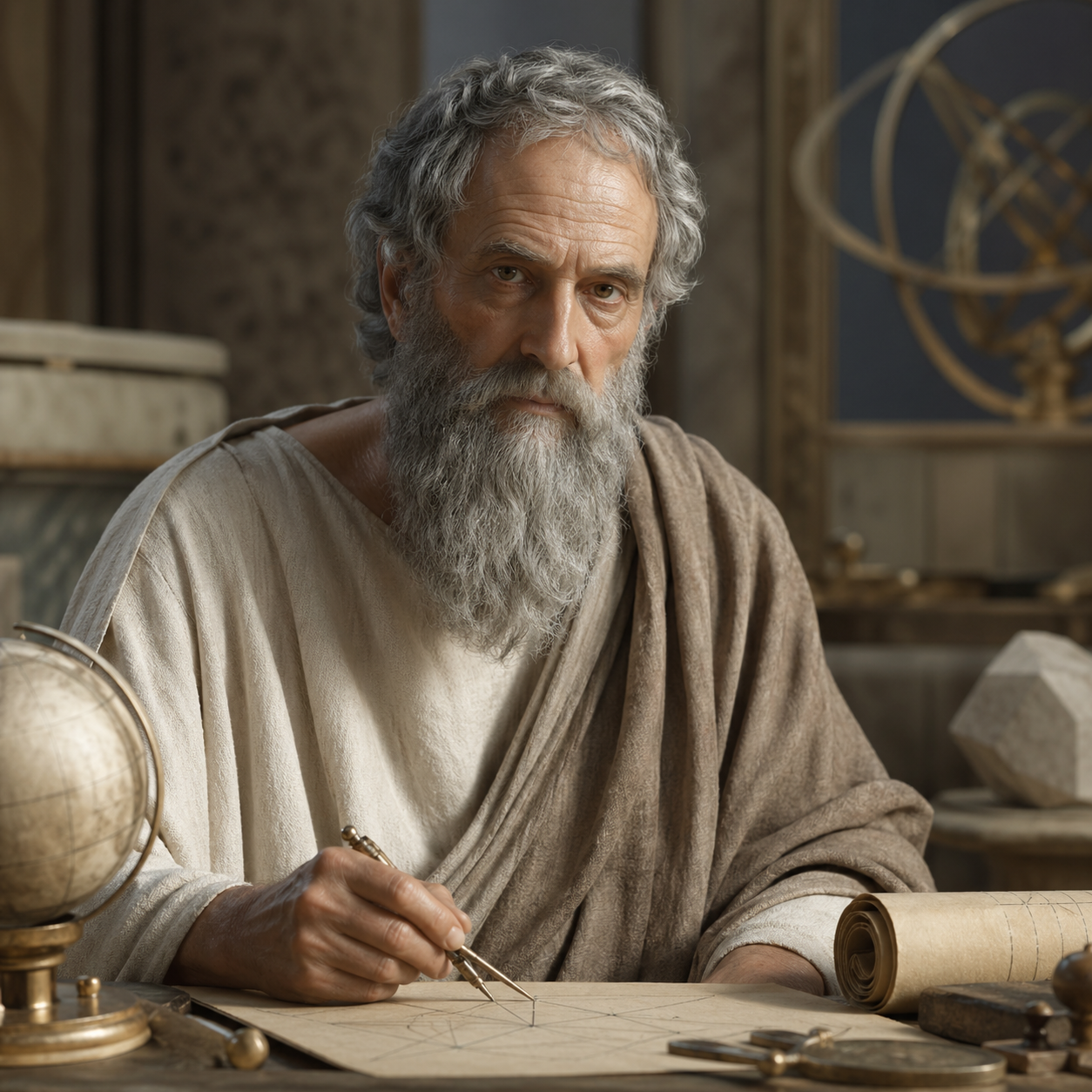
Euclid — "Proof by contradiction is a powerful tool."
Proof by contradiction is a powerful tool.
Proof by contradiction is a powerful tool.
Click any product to generate a realistic preview. Up to 3 at a time.
* Initial load can take up to 90 seconds — revising the preview in another color is nearly instant.
"If a straight line be cut into two equal parts and also into two unequal parts, the rectangle contained by the unequal parts together with the square on the line between the points of section is equal…"
"Things which coincide with one another are equal to one another."
"That which is without parts has no magnitude."
"Parallel straight lines are straight lines which, being in the same plane and being produced indefinitely in both directions, do not meet one another in either direction."
"The square on the side subtending the right angle in right-angled triangles is equal to the squares on the sides containing the right angle."
While Euclid extensively used proof by contradiction (reductio ad absurdum) throughout 'Elements', this specific phrasing is a modern summary of his method, not a direct quote.
Date: c. 300 BCE (implied by method)
ShockingFound in 1 providers: grok
1 source checked
If you want to prove something is true, assume it's false and follow that assumption to its logical end. When it produces an impossible contradiction, the original claim must be correct. Rather than building a direct path to truth, you demolish the alternative. It's one of mathematics' most elegant tools — indirect proof that reveals certainty by exposing the impossibility of the opposite.
Euclid deployed proof by contradiction throughout Elements, his ~300 BCE masterwork that organized all known geometry. His proof that infinitely many primes exist remains the textbook example: assume a finite list, construct a number outside it, contradiction. As geometry's great systematizer, Euclid treated rigorous logical structure as the only acceptable foundation for mathematical knowledge — contradiction was among his sharpest instruments.
Around 300 BCE in Alexandria, mathematics was evolving from practical land-measurement into abstract logical science. Aristotle had just formalized deductive logic; Plato's Academy prized pure reasoning over observation. Euclid worked under Ptolemy I, whose patronage made Alexandria the world's intellectual capital. In this climate, proving something irrefutably — rather than observing it empirically — was a radical cultural commitment, and contradiction proofs were its most dramatic expression.
AI-generated insights based on extensive research and information for context. Factual errors? Email [email protected].
Your cart is empty